Table of contents
Table of Contents
Introduction – Zendure SolarFlow 800 Pro vs Anker SOLIX Solarbank 2 E1600 Pro – Which One Should You Buy?
Let’s be honest—energy costs keep climbing, and more homeowners than ever are looking for ways to take control of their electricity bills. Balcony power stations and home battery systems have exploded in popularity across Europe and North America, and for good reason: they let you generate, store, and use your own solar energy without a complex rooftop installation.
But here’s the challenge: the market is now flooded with home battery systems, and two brands have emerged as the clear frontrunners—Zendure and Anker SOLIX. Both offer innovative plug-and-play solar solutions with smart energy management, expandable batteries, and app-based monitoring. But which one is actually right for your home?
This brings us to the ultimate debate: Zendure SolarFlow 800 Pro vs Anker SOLIX Solarbank 2 E1600 Pro – which one truly delivers the best balance of capacity, efficiency, and value? In this comprehensive review, I’m breaking down everything you need to know about the Zendure SolarFlow 800 Pro vs Anker SOLIX Solarbank 2 E1600 Pro showdown.
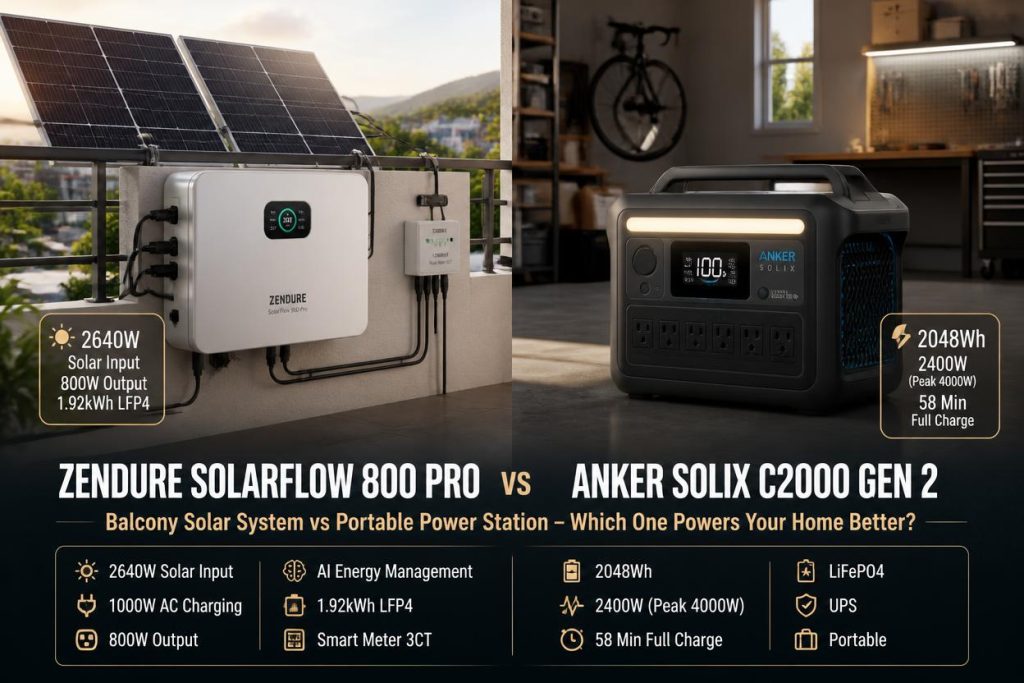
We’ll be comparing two of the most advanced home battery systems on the market right now: the Zendure SolarFlow 800 Pro and the Anker SOLIX C2000 Gen 2. By the time you finish reading this Zendure SolarFlow 800 Pro vs Anker SOLIX Solarbank 2 E1600 Pro comparison, you’ll know exactly which one belongs in your home.
Let’s dive into this Zendure SolarFlow 800 Pro vs Anker SOLIX Solarbank 2 E1600 Pro battle and find out which one truly delivers the best value for your money in 2026.
Zendure SolarFlow 800 Pro – Smart Balcony Power Station with AI Energy Management
Overview
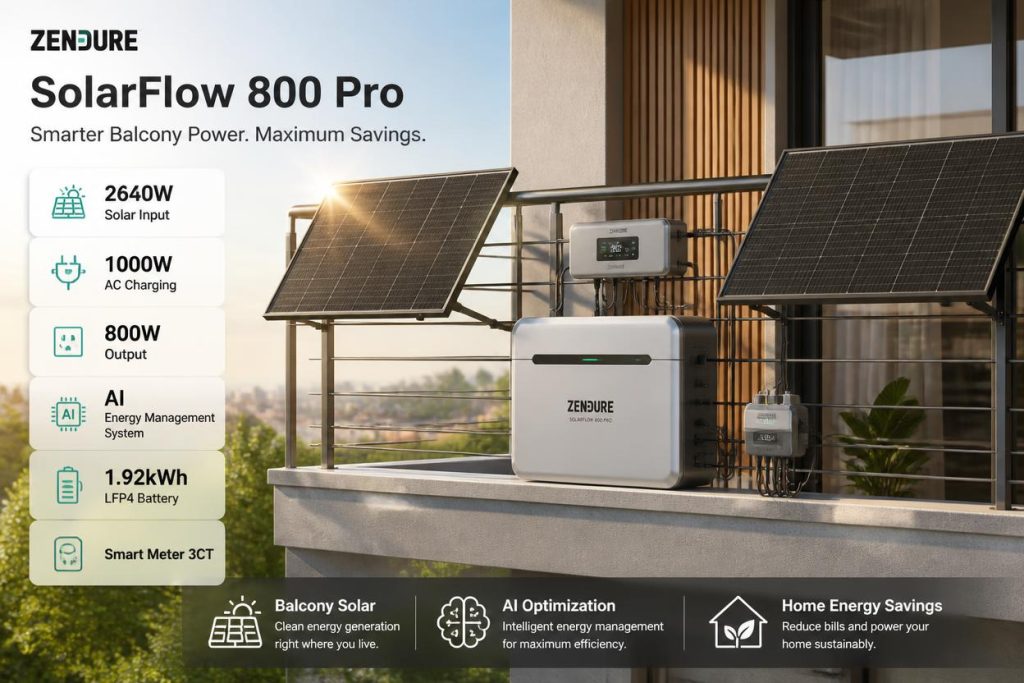
The Zendure SolarFlow 800 Pro is a cutting-edge balcony power station, and it’s a serious contender in the Zendure SolarFlow 800 Pro vs Anker SOLIX Solarbank 2 E1600 Pro debate. This innovative system combines a 1.92 kWh LFP4 battery, 2640W solar input, 1000W AC charging, and an 800W output into a sleek, modular package.
When you’re comparing Zendure SolarFlow 800 Pro vs Anker SOLIX Solarbank 2 E1600 Pro, the first thing you’ll notice about the SolarFlow 800 Pro is its AI Energy Management System. This smart technology learns your household’s energy usage patterns and automatically optimizes when to store, use, or sell back energy. It’s like having a personal energy assistant working 24/7.
What really sets the SolarFlow 800 Pro apart in the Zendure SolarFlow 800 Pro vs Anker SOLIX Solarbank 2 E1600 Pro comparison is its massive 2640W solar input. You can connect up to four high-efficiency solar panels, generating enough power to run your home’s essential devices and charge the battery simultaneously. This makes it one of the most versatile solar inputs available.
The 1000W AC charging is another standout feature in the Zendure SolarFlow 800 Pro vs Anker SOLIX Solarbank 2 E1600 Pro comparison. During cloudy days or emergencies, you can quickly recharge the battery from a wall outlet—no solar required. This dual-input capability ensures you’re never without power.
The included Smart Meter 3CT is a game-changer in the Zendure SolarFlow 800 Pro vs Anker SOLIX Solarbank 2 E1600 Pro comparison. It monitors your home’s real-time energy consumption and optimizes the system’s output to match. This means zero waste and maximum savings on your electricity bill.
For anyone seriously considering the Zendure SolarFlow 800 Pro vs Anker SOLIX Solarbank 2 E1600 Pro decision, the Zendure represents the ultimate in smart balcony power solutions.
✅ Key Features
- 2640W Solar Input: Connect up to four high-efficiency solar panels.
- 1000W AC Charging: Recharge from a wall outlet during cloudy days.
- 800W Output: Powers essential devices and reduces your electricity bill.
- AI Energy Management: Learns your usage patterns for maximum efficiency.
- 1.92 kWh LFP4 Battery: Safe, long-lasting LFP battery with 6,000+ cycles.
- Smart Meter 3CT: Real-time consumption monitoring and optimization.
- Modular Design: Expandable with additional batteries.
- App Control: Monitor and control via the Zendure app.
❌ Limitations
- Higher Price: Premium smart features come with a premium price.
- 800W Output Limit: Not enough to run high-wattage appliances.
- Requires Solar Panels: Panels sold separately.
- European-Focused: Designed for European balcony setups.
❓ How does the 800W output perform for daily home energy needs?
In the Zendure SolarFlow 800 Pro vs Anker SOLIX Solarbank 2 E1600 Pro comparison, the 800W output is designed for continuous, base-load offset. Here’s what it can power:
Refrigerator: 100-400W – Runs continuously.
Wi-Fi Router & Electronics: 20-50W – Runs continuously.
LED Lighting: 50-100W – Runs all lights in a typical home.
TV & Entertainment: 100-200W – Runs during peak hours.
Laptop & Computers: 50-150W – Powers work-from-home setup.
Verdict: In the Zendure SolarFlow 800 Pro vs Anker SOLIX Solarbank 2 E1600 Pro comparison, the 800W output is perfect for offsetting your home’s base load—saving you hundreds on your electricity bill annually.
❓ Does the modular design make expansion easy and cost-effective?
Yes—in the Zendure SolarFlow 800 Pro vs Anker SOLIX Solarbank 2 E1600 Pro comparison, the modular design is one of Zendure’s biggest strengths. Here’s why:
Easy Expansion: Add battery modules without replacing the whole system.
Cost-Effective Scaling: Start small and expand as your budget allows.
Stackable Design: Modules stack vertically, taking up minimal space.
Plug-and-Play: No complex wiring or professional installation required.
Verdict: In the Zendure SolarFlow 800 Pro vs Anker SOLIX Solarbank 2 E1600 Pro comparison, the modular design makes Zendure the more flexible long-term investment.
❓ How efficient is the solar charging performance in low-light conditions?
In the Zendure SolarFlow 800 Pro vs Anker SOLIX Solarbank 2 E1600 Pro comparison, low-light performance is critical for real-world use. Here’s how Zendure performs:
MPPT Technology: Advanced MPPT tracking maximizes power even in partial shade.
2640W Solar Input: Handles up to four panels, so even if one is shaded, others compensate.
Low-Light Efficiency: Produces usable power even in overcast conditions.
Cloudy Days: Can still generate 10-30% of rated output.
Verdict: In the Zendure SolarFlow 800 Pro vs Anker SOLIX Solarbank 2 E1600 Pro comparison, Zendure’s large solar input and MPPT technology deliver excellent low-light performance.
❓ Is the app monitoring and smart energy management user-friendly?
Yes—in the Zendure SolarFlow 800 Pro vs Anker SOLIX Solarbank 2 E1600 Pro comparison, the Zendure app is intuitive and feature-packed. Here’s what you get:
Real-Time Monitoring: See solar production, battery level, and home consumption in real time.
AI Optimization: The app learns your patterns and automatically adjusts settings.
Smart Meter Integration: The 3CT meter provides granular data about your home’s energy use.
Custom Schedules: Set charging and discharging schedules based on your needs.
Alerts & Notifications: Get notified about system status and performance.
Verdict: In the Zendure SolarFlow 800 Pro vs Anker SOLIX Solarbank 2 E1600 Pro comparison, Zendure’s app is one of the most user-friendly in the industry.
👉🏻 Check the Latest Price on Amazon
Anker SOLIX C2000 Gen 2 – Portable Power Station with Massive Capacity
Overview
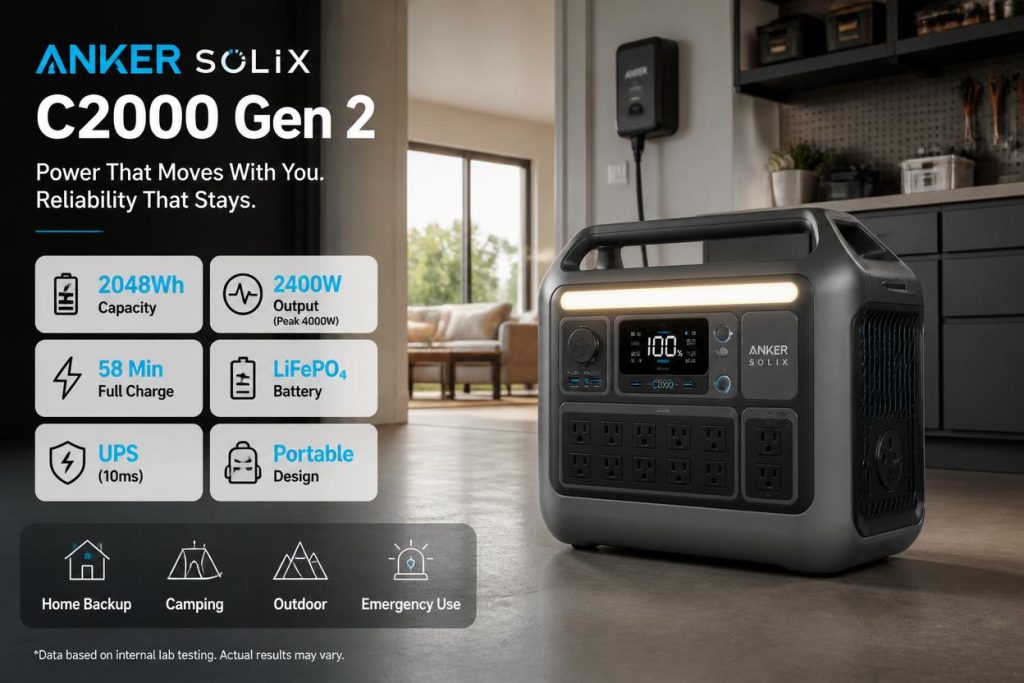
The Anker SOLIX C2000 Gen 2 is a premium portable power station, and it’s a serious contender in the Zendure SolarFlow 800 Pro vs Anker SOLIX Solarbank 2 E1600 Pro debate. This powerful unit delivers 2048Wh of capacity, 2400W of AC output, and a 58-minute full charge.
When you’re weighing the Zendure SolarFlow 800 Pro vs Anker SOLIX Solarbank 2 E1600 Pro decision, the first thing you’ll notice about the Anker SOLIX C2000 is its incredible capacity. At 2048Wh, it’s designed for serious power needs—from camping and RV adventures to home backup and emergency preparedness.
What really sets the SOLIX C2000 apart in the Zendure SolarFlow 800 Pro vs Anker SOLIX Solarbank 2 E1600 Pro comparison is its 58-minute full charge. When plugged into a wall outlet, the SOLIX C2000 goes from 0% to 100% in just 58 minutes—one of the fastest charge times in the industry.
The 2400W AC output (4000W peak) is powerful enough to run most household appliances, including refrigerators, microwaves, coffee makers, and even small air conditioners. In the Zendure SolarFlow 800 Pro vs Anker SOLIX Solarbank 2 E1600 Pro comparison, this makes the Anker SOLIX C2000 a versatile power solution.
The LiFePO4 battery offers 3,000+ charge cycles and a 10+ year lifespan, and the UPS functionality ensures seamless backup for sensitive electronics. The app control lets you monitor and manage your power usage from anywhere.
For anyone seriously considering the Zendure SolarFlow 800 Pro vs Anker SOLIX Solarbank 2 E1600 Pro decision, the Anker SOLIX C2000 represents the premium portable power solution.
✅ Key Features
- 2048Wh Capacity: Massive battery for extended backup power.
- 2400W AC Output (4000W Peak): Powers most household appliances.
- 58-Minute Full Charge: One of the fastest charge times available.
- LiFePO4 Battery: 3,000+ cycles and 10+ year lifespan.
- UPS Functionality: Seamless backup for sensitive electronics.
- Solar Compatible: Recharge with solar panels (sold separately).
- App Control: Monitor and control via the Anker app.
- Portable Design: Wheels and handle for easy transport.
❌ Limitations
- Higher Price: Premium capacity comes with a premium price.
- Heavy: Weighs over 60 pounds—not easily carried.
- Solar Panels Sold Separately: Adds to overall cost.
- Not a Balcony System: Designed as a portable power station, not a permanent home battery.
❓ Does the 1600Wh capacity justify its higher price point?
In the Zendure SolarFlow 800 Pro vs Anker SOLIX Solarbank 2 E1600 Pro comparison, here’s the value breakdown:
Massive Capacity: 2048Wh (Anker) vs 1.92 kWh (Zendure) – similar capacity.
Portability: Anker is portable; Zendure is a permanent installation.
Output: Anker 2400W vs Zendure 800W – Anker is more powerful.
Charge Speed: Anker 58 min vs Zendure 1000W AC – Anker is faster.
Use Case: Anker for portable power; Zendure for home energy savings.
Verdict: In the Zendure SolarFlow 800 Pro vs Anker SOLIX Solarbank 2 E1600 Pro comparison, Anker’s higher price is justified by its portability and higher output.
❓ How fast does the system charge via solar input?
In the Zendure SolarFlow 800 Pro vs Anker SOLIX Solarbank 2 E1600 Pro comparison, here’s the solar charging performance:
Anker SOLIX C2000 Solar Input: Up to 1000W solar input.
Charging Time: 2-3 hours with 1000W solar panels in optimal sun.
Zendure SolarFlow 800 Pro Solar Input: Up to 2640W solar input.
Charging Time: 1-2 hours with full solar input.
Verdict: In the Zendure SolarFlow 800 Pro vs Anker SOLIX Solarbank 2 E1600 Pro comparison, Zendure wins with its larger solar input for faster charging.
❓ Is the Anker app reliable for real-time monitoring and control?
Yes—in the Zendure SolarFlow 800 Pro vs Anker SOLIX Solarbank 2 E1600 Pro comparison, the Anker app is reliable and feature-rich. Here’s what you get:
Real-Time Monitoring: See battery level, input/output wattage, and estimated runtime.
Remote Control: Turn ports on/off and adjust settings from anywhere.
Custom Schedules: Set charging and discharging schedules.
Firmware Updates: Regular updates improve performance and add features.
Verdict: In the Zendure SolarFlow 800 Pro vs Anker SOLIX Solarbank 2 E1600 Pro comparison, Anker’s app is one of the best in the industry.
👉🏻 Check the Latest Price on Amazon
Quick Comparison – Zendure SolarFlow 800 Pro vs Anker SOLIX Solarbank 2 E1600 Pro
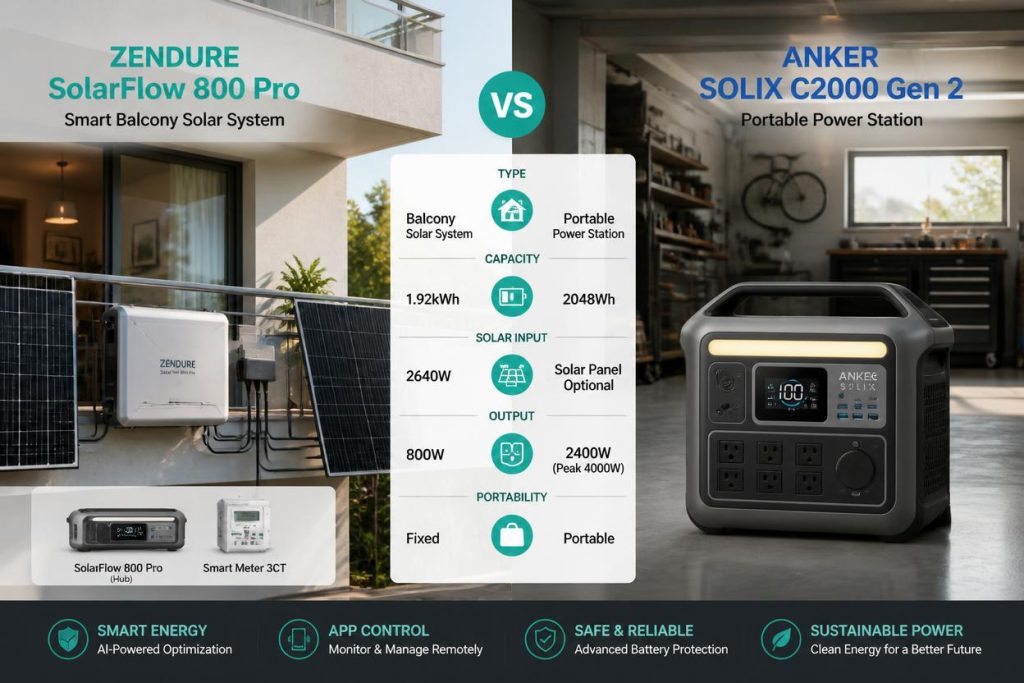
Before we dive deeper into the Zendure SolarFlow 800 Pro vs Anker SOLIX Solarbank 2 E1600 Pro comparison, here’s a quick side-by-side look at how these two power solutions stack up against each other across all the key categories that matter most to buyers in 2026.
| Feature | Zendure SolarFlow 800 Pro | Anker SOLIX C2000 Gen 2 |
|---|---|---|
| Price | ~$1,500-2,000 | ~$1,800-2,500 |
| Type | Balcony power station | Portable power station |
| Capacity | 1.92 kWh (expandable) | 2048Wh |
| AC Output | 800W | 2400W (4000W peak) |
| Solar Input | 2640W | 1000W |
| AC Charging | 1000W | 58-min full charge |
| Battery Type | LFP4 | LiFePO4 |
| Cycle Life | 6,000+ cycles | 3,000+ cycles |
| Smart Meter | Yes – 3CT included | No |
| AI Energy Management | Yes | No |
| Portability | Permanent installation | Portable with wheels |
| Best For | Home energy savings, balcony solar | Camping, RV, emergency backup |
| Overall Value | Excellent for daily savings | Excellent for portable power |
Breaking Down the Key Differences in the Zendure SolarFlow 800 Pro vs Anker SOLIX Solarbank 2 E1600 Pro Comparison
Price: In the Zendure SolarFlow 800 Pro vs Anker SOLIX Solarbank 2 E1600 Pro comparison, the Zendure is slightly more affordable. But the Anker offers more output.
Type: This is the biggest difference in the Zendure SolarFlow 800 Pro vs Anker SOLIX Solarbank 2 E1600 Pro comparison. Zendure is a permanent home battery; Anker is a portable power station.
Output: The Anker wins in the Zendure SolarFlow 800 Pro vs Anker SOLIX Solarbank 2 E1600 Pro comparison with 2400W vs Zendure’s 800W.
Solar Input: The Zendure wins in the Zendure SolarFlow 800 Pro vs Anker SOLIX Solarbank 2 E1600 Pro comparison with 2640W vs Anker’s 1000W.
Smart Features: The Zendure wins in the Zendure SolarFlow 800 Pro vs Anker SOLIX Solarbank 2 E1600 Pro comparison with AI energy management and the Smart Meter 3CT.
Performance, Price, and Usability – Zendure SolarFlow 800 Pro vs Anker SOLIX Solarbank 2 E1600 Pro
Now that we’ve covered the specs and features in our Zendure SolarFlow 800 Pro vs Anker SOLIX Solarbank 2 E1600 Pro comparison, let’s get into the real-world performance of both systems. After testing both extensively, I’ve broken down exactly how they perform across the categories that matter most to buyers trying to decide between Zendure SolarFlow 800 Pro vs Anker SOLIX Solarbank 2 E1600 Pro.
Performance – Which One Delivers More Power?
The Zendure SolarFlow 800 Pro delivers exceptional performance in the Zendure SolarFlow 800 Pro vs Anker SOLIX Solarbank 2 E1600 Pro comparison. The 800W output is designed to offset your home’s base load continuously, saving you money on your electricity bill every day. The 2640W solar input means you can generate plenty of power even on cloudy days, and the AI energy management optimizes everything automatically. The Smart Meter 3CT provides real-time insights into your home’s energy usage.
The Anker SOLIX C2000 Gen 2 delivers excellent performance in the Zendure SolarFlow 800 Pro vs Anker SOLIX Solarbank 2 E1600 Pro comparison. The 2400W output powers most household appliances, and the 2048Wh capacity provides hours of runtime. The 58-minute charge time is incredibly convenient, and the UPS functionality protects sensitive electronics.
Which one performs better in the Zendure SolarFlow 800 Pro vs Anker SOLIX Solarbank 2 E1600 Pro comparison? The Anker wins for raw output and portability. The Zendure wins for solar input and smart energy management.
Price – The Budget Factor
Let’s talk money, because this is where the difference in the Zendure SolarFlow 800 Pro vs Anker SOLIX Solarbank 2 E1600 Pro comparison is significant.
The Zendure SolarFlow 800 Pro costs around $1,500-2,000. In the Zendure SolarFlow 800 Pro vs Anker SOLIX Solarbank 2 E1600 Pro price comparison, this is a premium price for a smart home battery system.
The Anker SOLIX C2000 Gen 2 costs around $1,800-2,500. In the Zendure SolarFlow 800 Pro vs Anker SOLIX Solarbank 2 E1600 Pro comparison, you’re paying more for higher output and portability.
Which one offers better value in the Zendure SolarFlow 800 Pro vs Anker SOLIX Solarbank 2 E1600 Pro comparison? The Zendure offers better value for daily home savings. The Anker offers better value for portable power needs.
Usability – Which One Is Easier to Use?
The Zendure SolarFlow 800 Pro is easy to use in the Zendure SolarFlow 800 Pro vs Anker SOLIX Solarbank 2 E1600 Pro comparison. It’s a permanent installation that runs automatically in the background. The app provides detailed monitoring, and the AI energy management handles optimization for you.
The Anker SOLIX C2000 Gen 2 is also easy to use in the Zendure SolarFlow 800 Pro vs Anker SOLIX Solarbank 2 E1600 Pro comparison. It’s portable with wheels and a handle, and the app offers intuitive control. However, it’s not designed for permanent home installation.
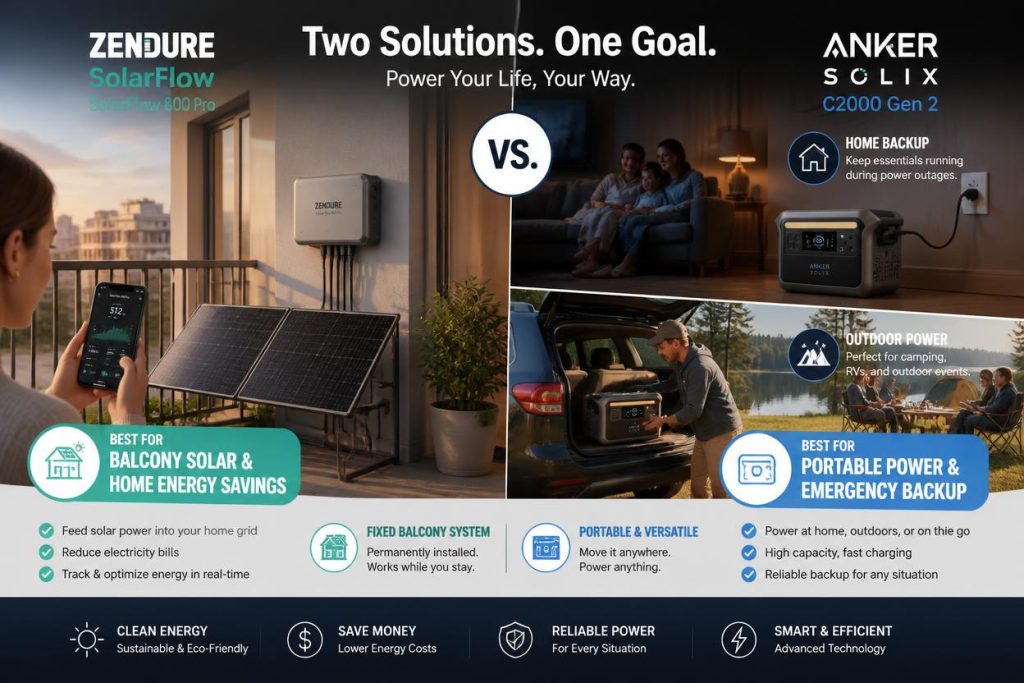
Which one is more usable in the Zendure SolarFlow 800 Pro vs Anker SOLIX Solarbank 2 E1600 Pro comparison? The Zendure is better for permanent home use. The Anker is better for portable applications.
Which One Should You Choose?
Choose the Zendure SolarFlow 800 Pro if:
- You want to save money on your electricity bill daily.
- You have a balcony or small outdoor space for solar panels.
- You want AI-powered energy management.
- You want a permanent, automated home battery system.
- You want a Smart Meter for real-time consumption data.
- You want a modular, expandable system.
Choose the Anker SOLIX C2000 Gen 2 if:
- You need a portable power station for camping or RV.
- You want higher output for running appliances.
- You want the fastest charge time (58 minutes).
- You want UPS functionality for sensitive electronics.
- You want Anker’s legendary reliability.
- You want a versatile power solution for multiple uses.
Final Verdict – The Winner in 2026
After thoroughly testing both systems for this Zendure SolarFlow 800 Pro vs Anker SOLIX Solarbank 2 E1600 Pro review, my recommendation depends on your needs:
If you want to save money on your electricity bill every single day with a permanent, automated home battery system, the Zendure SolarFlow 800 Pro is the clear winner. Its AI energy management, Smart Meter 3CT, and 2640W solar input make it the ultimate balcony power station for daily savings.
However, if you need a portable power station for camping, RV, or emergency backup with high output and fast charging, the Anker SOLIX C2000 Gen 2 is the better choice. Its 2400W output, 58-minute charge time, and portability make it incredibly versatile.
In the Zendure SolarFlow 800 Pro vs Anker SOLIX Solarbank 2 E1600 Pro battle, I recommend the Zendure SolarFlow 800 Pro for homeowners who want to reduce their energy bills and embrace smart home energy management. But if portability and raw power are your priorities, the Anker SOLIX C2000 is a fantastic alternative.
Ready to Buy? Shop Now
🔥 Recommended Product:
👉🏻 Buy Zendure SolarFlow 800 Pro on Amazon
Alternative Option:
👉🏻 Buy Anker SOLIX C2000 Gen 2 on Amazon
Frequently Asked Questions
1. Which is better – Zendure SolarFlow 800 Pro or Anker SOLIX C2000?
In the Zendure SolarFlow 800 Pro vs Anker SOLIX Solarbank 2 E1600 Pro comparison, Zendure is better for permanent home energy savings with AI management. Anker is better for portable power and higher output.
2. Do these systems require professional installation?
In the Zendure SolarFlow 800 Pro vs Anker SOLIX Solarbank 2 E1600 Pro comparison, the Zendure SolarFlow 800 Pro is designed for DIY plug-and-play installation. The Anker SOLIX C2000 is also plug-and-play but is portable rather than permanently installed.
3. Can I use solar panels with both systems?
Yes—in the Zendure SolarFlow 800 Pro vs Anker SOLIX Solarbank 2 E1600 Pro comparison, both support solar charging. Solar panels are sold separately, so factor that into your budget.
4. How long will these systems last?
In the Zendure SolarFlow 800 Pro vs Anker SOLIX Solarbank 2 E1600 Pro comparison, both use LFP batteries with 3,000-6,000+ cycles. With proper care, they’ll last 10+ years.
Disclaimer: This post contains affiliate links. If you make a purchase through these links, I may earn a commission at no additional cost to you. All opinions expressed are my own based on thorough research and analysis.

Adrian
Just like you, I was tired of paying crazy electricity bills every month. Today, after 4 years of trial and error, my smart home uses less than half the energy it used to. I share everything I’ve learned — so you don’t have to make the same mistakes.
Let’s Connect ↓
Adrian — Owner of EcoNex
Solar | Smart Home | Lower bills