Table of contents
Table of Contents
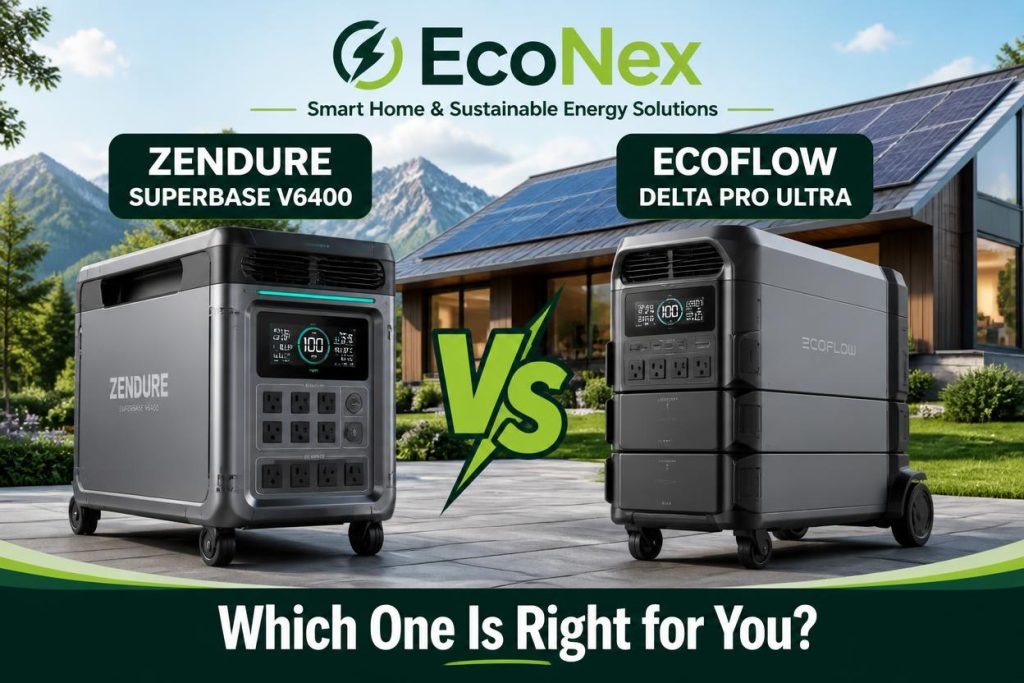
Are you looking for a powerful home backup battery that can keep your essential appliances running during a power outage, reduce your dependence on the electrical grid, and potentially work with solar panels? Choosing the right portable power station can be challenging, especially when comparing two powerful systems designed for serious home backup. In this Zendure SuperBase V6400 vs EcoFlow DELTA Pro Ultra comparison, we will examine their battery capacity, power output, expansion options, charging capabilities, practical applications, and overall value to help you make a smarter buying decision.
Both Zendure and EcoFlow offer energy storage solutions designed for demanding situations, but choosing between them is not simply about picking the model with the highest wattage. You need to consider how much electricity your household uses, which appliances you want to operate, how long you need backup power to last, and whether you plan to expand your system in the future.
The Zendure SuperBase V6400 is an expandable power station designed for home backup, off-grid living, RV trips, and emergency situations. The EcoFlow DELTA Pro Ultra, meanwhile, targets homeowners who need substantial output and a scalable energy storage system for more demanding backup requirements.
So, which system deserves your money in 2026? Is the Zendure SuperBase V6400 powerful enough for your household, or does the EcoFlow DELTA Pro Ultra offer a better long-term investment? We will break down the important differences, explain the advantages and disadvantages of each product, and help you determine which one makes the most sense for your needs.
Our goal: Help you understand what each system can realistically do before you spend your money. Product specifications, availability, included accessories, and prices can vary by configuration and retailer, so always verify the current Amazon listing before purchasing.
Zendure SuperBase V6400 Review: Is This Expandable Power Station Worth It?
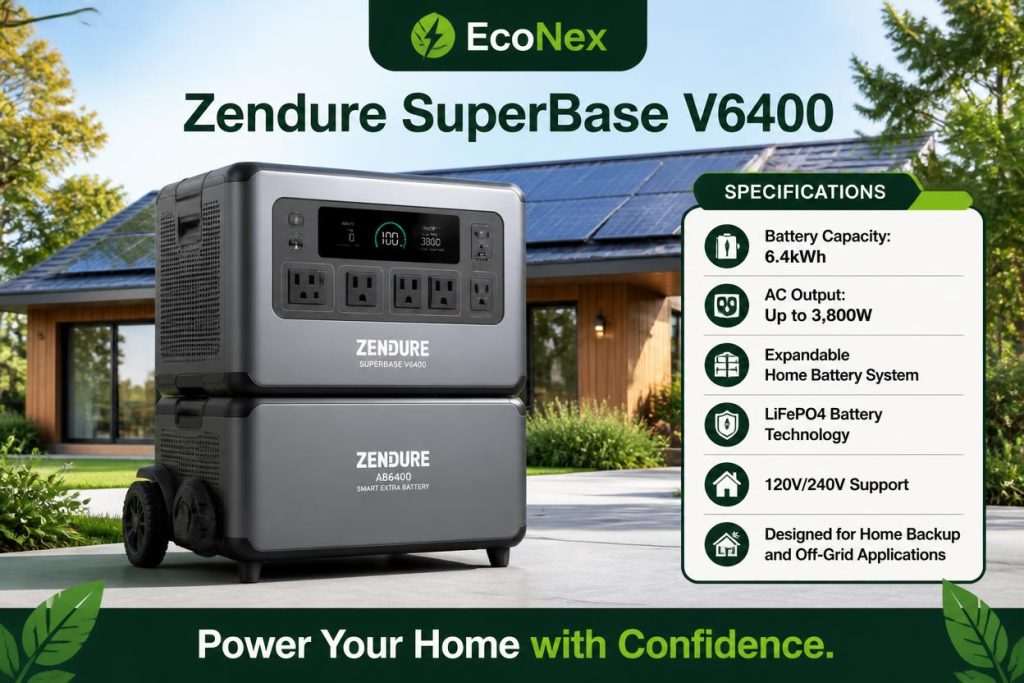
The Zendure SuperBase V6400 is a high-capacity portable power station designed for people who need more than a small battery pack for charging phones and laptops. With a listed battery capacity of approximately 6.4kWh, depending on the exact configuration, it is built to support larger energy needs, including household backup, off-grid activities, and selected high-demand appliances when their electrical requirements are compatible with the system.
One of its biggest attractions is its combination of substantial energy storage and high-output power delivery. According to the product configuration supplied for this comparison, the system offers 120V and 240V output options and up to 3,800W of AC output. These specifications make it worth considering for users who want to power more demanding equipment than a typical compact portable power station can handle.
However, maximum output and battery capacity serve different purposes. Wattage determines how much power the unit can deliver at a particular moment, while kilowatt-hours indicate how much energy the battery stores. Understanding this distinction is essential when deciding whether the SuperBase V6400 can run your refrigerator, networking equipment, lights, computers, or other household appliances during an outage.
What Makes the Zendure SuperBase V6400 Interesting?
The SuperBase V6400 is particularly appealing to buyers who want a flexible backup solution instead of relying entirely on a traditional gasoline generator. Depending on the configuration and compatible accessories, a battery-based system can provide electricity without producing exhaust fumes at the point of use. It can also operate quietly compared with many conventional fuel-powered generators.
Solar charging is another important consideration. When paired with compatible solar panels, a suitable power station can store energy generated during daylight hours and make that electricity available later. Actual charging performance depends on sunlight, panel wattage, temperature, conversion losses, and the system’s supported solar input limits.
For households preparing for storms or unexpected outages, this flexibility can be valuable. You may be able to prioritize essential equipment first and add compatible battery capacity later if your energy needs grow. Before purchasing, however, confirm which expansion batteries, solar panels, cables, and accessories are compatible with the specific SuperBase V6400 package being sold.
Key Features of the Zendure SuperBase V6400
- High-capacity energy storage: The listed configuration provides approximately 6.4kWh of battery capacity, offering considerably more stored energy than many compact portable power stations.
- Powerful AC output: The supplied product description lists up to 3,800W of AC output, making it suitable for a range of compatible household devices and equipment.
- 120V and 240V capability: The advertised configuration supports both voltage options, which can expand its potential applications when the appropriate outlets, connections, and operating conditions are available.
- Expandable energy storage: Compatible expansion options can provide additional stored energy, depending on the exact system configuration and supported accessories.
- LiFePO4 battery chemistry: Lithium iron phosphate batteries are valued for their durability and cycle-life potential when operated and maintained within the manufacturer’s specifications.
- Solar charging potential: Compatible solar panels can recharge the system using sunlight, although actual charging speed depends on the supported input limits and real-world conditions.
- Flexible applications: The system may suit home backup, RV use, tiny houses, workshops, and off-grid applications when its output and installation requirements match the intended use.
How Can the Zendure SuperBase V6400 Help During a Power Outage?
Imagine a storm causes a power outage overnight. Your refrigerator contains groceries, your internet connection is important for work, and you want to keep several lights on without running a noisy fuel-powered generator outside. A sufficiently charged SuperBase V6400 could help support compatible essential equipment, provided the combined load remains within the system’s limits.
The actual runtime depends on the devices you connect and how much electricity they consume. For example, a device that averages 100W uses approximately 100 watt-hours of energy per hour. A 1,000W appliance consumes energy ten times faster at that constant load. Starting surges from refrigerators, pumps, compressors, and other motor-driven appliances can also affect whether a power station can start and operate them successfully.
It is important not to assume that a 6.4kWh battery will deliver its entire rated capacity to AC appliances. Inverter losses, standby consumption, temperature, battery condition, and operating limits reduce usable energy. As a result, actual runtime is usually shorter than a simple calculation based on the advertised battery capacity might suggest.
Zendure SuperBase V6400 Advantages
- Substantial stored energy: Its approximately 6.4kWh listed capacity makes it worth evaluating for extended backup of selected essential devices.
- High power output: The advertised 3,800W output provides more flexibility than lower-powered portable units, assuming the connected appliances are compatible.
- Potential for system expansion: Buyers who anticipate greater energy needs can investigate compatible expansion options before committing to a complete backup setup.
- Battery-based operation: It can supply electricity without combustion exhaust at the unit, making it useful for appropriate indoor applications when installed and operated according to the manufacturer’s safety instructions.
- Solar energy compatibility: A compatible solar setup can help replenish stored energy when sunlight and installation conditions are favorable.
- Multiple use cases: Its intended applications extend beyond emergency backup to certain RV, workshop, and off-grid scenarios.
Zendure SuperBase V6400 Disadvantages
- Significant upfront investment: A high-capacity power station can cost substantially more than a small portable battery, and additional batteries or solar panels may increase the total price.
- Large and heavy design: A system in this capacity class is not as convenient to carry as a compact power bank. Check the exact weight, dimensions, and transportation requirements before buying.
- Runtime depends on consumption: Running high-wattage appliances continuously can drain the battery much faster than running lights, routers, or other low-power devices.
- Accessory compatibility matters: Not every solar panel, expansion battery, or home integration accessory will necessarily work with every configuration.
- Home installation may require additional equipment: Supplying selected household circuits can require compatible transfer equipment and professional electrical installation. Never connect a power station to household wiring through an improvised connection.
- Solar charging is weather-dependent: Cloud cover, seasonal sunlight, shading, and panel placement can significantly affect how quickly the battery recharges.
Who Should Consider the Zendure SuperBase V6400?
The Zendure SuperBase V6400 is worth investigating if you want a substantial portable energy storage system without immediately committing to the largest possible whole-home backup configuration. It may be especially attractive to buyers who prioritize stored energy, flexible applications, and the possibility of adding compatible capacity later.
It is also worth considering if your main goal is to keep essential devices operating during outages rather than run every appliance in your home simultaneously. A carefully planned backup setup can prioritize refrigeration, communications, lighting, and other important equipment according to your available battery capacity.
On the other hand, buyers who expect to operate multiple demanding appliances simultaneously should pay close attention to continuous output, surge capability, voltage requirements, and the exact number and type of available connections. Battery capacity alone cannot tell you whether a power station is suitable for every appliance.
Zendure SuperBase V6400 Buying Link
Check the Latest Zendure SuperBase V6400 Price on Amazon
Buying tip: Verify the exact model, battery capacity, AC output, included accessories, warranty terms, and current seller information on Amazon before ordering. Product configurations and prices may change.
EcoFlow DELTA Pro Ultra Review: Is This Powerful Home Backup System Worth It in 2026?
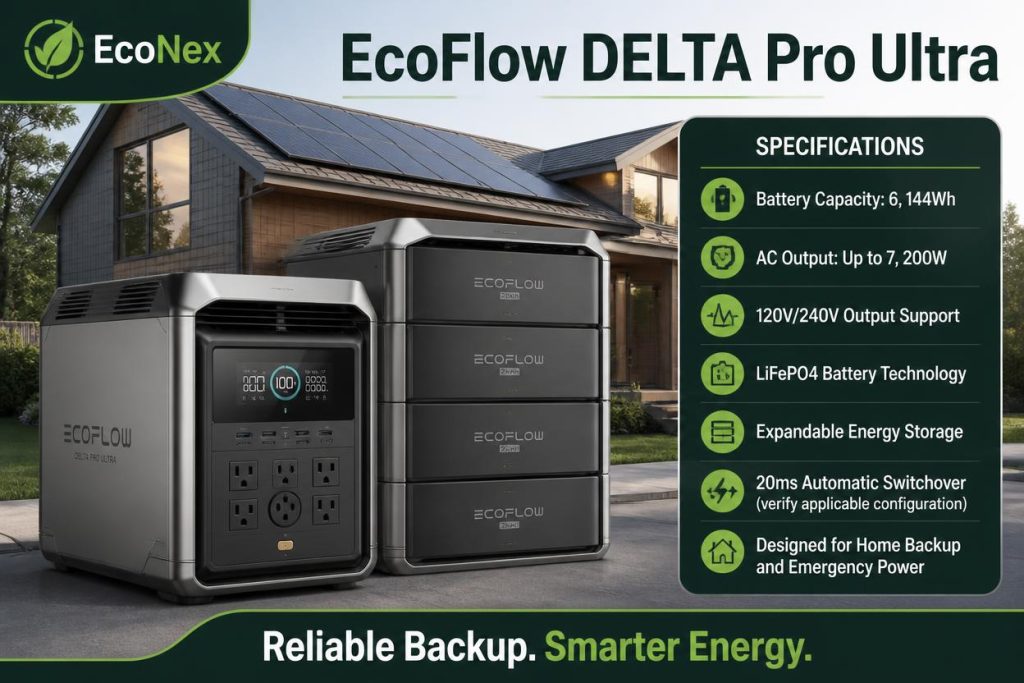
The EcoFlow DELTA Pro Ultra is designed for homeowners who want a serious backup power solution rather than a small portable battery for occasional use. With a listed 6,144Wh battery capacity, 7,200W of continuous AC output, and support for both 120V and 240V power in its US configuration, this system is built to handle demanding backup requirements when properly configured.
What makes the DELTA Pro Ultra particularly interesting is its focus on home energy management. Instead of treating a power station as a device you use only during emergencies, EcoFlow offers an expandable system that can support essential household circuits and, with compatible equipment and professional installation, more extensive home backup applications.
For example, you might want to keep your refrigerator, lighting, internet equipment, computers, and selected other appliances running during a blackout. If your household has higher energy demands, you may also want the flexibility to add more battery capacity rather than replace the entire system. The DELTA Pro Ultra is designed with this type of long-term planning in mind.
According to EcoFlow’s published US specifications, the system provides 6,144Wh of battery capacity and 7,200W of continuous AC output. Its storage can be expanded to as much as 90kWh across a compatible system configuration, while total output capability can also increase with the appropriate additional equipment. These maximum figures describe an expanded system, not what a single battery provides on its own.
That distinction matters when comparing the Zendure SuperBase V6400 vs EcoFlow DELTA Pro Ultra. The EcoFlow offers higher advertised continuous output than the Zendure configuration described in Part 1, while their initial battery capacities are relatively close. However, the best choice still depends on your actual electricity consumption, installation plans, budget, and the appliances you need to power.
1. Powerful AC Output for Demanding Appliances
One of the biggest selling points of the EcoFlow DELTA Pro Ultra is its advertised 7,200W continuous AC output. Compared with smaller portable power stations, this provides greater flexibility for running multiple compatible appliances simultaneously, provided their combined consumption stays within the system’s limits.
Consider a household that needs to keep several essential devices operating during a power outage. A refrigerator, a few lights, a router, a computer, and selected kitchen equipment may all draw power at the same time. A higher-output system gives you more room to manage these loads without immediately reaching the inverter’s maximum rating.
Nevertheless, 7,200W does not mean every appliance can be connected without checking its requirements. Some air conditioners, pumps, compressors, and other motor-driven devices need additional starting power. You should check both the running wattage and the startup surge requirements of each appliance before building your backup plan.
It is also important to distinguish between total system output and the rating of an individual outlet. Each connection has its own electrical limits, and the total load must remain within the system’s operating specifications. For household wiring or high-voltage appliances, use the correct equipment and consult a qualified electrician.
2. A 6,144Wh Battery for Extended Backup
The EcoFlow DELTA Pro Ultra comes with a listed battery capacity of 6,144Wh, equivalent to approximately 6.14kWh. This is substantial storage for a portable battery-based backup system, but it does not guarantee a fixed number of hours of operation.
To understand its practical value, consider three different electricity demands. A low-power setup consisting of lights, internet equipment, and a laptop may use only a few hundred watts. A moderate setup that includes refrigeration and additional appliances can consume considerably more. A high-demand setup running powerful heating, cooling, or cooking equipment may drain the battery much faster.
For a simple illustration, assume the battery provides 5,200Wh of usable AC energy after accounting for conversion losses and other factors. This is an example for estimation, not a guaranteed measured capacity.
- 200W average load: Approximately 26 hours.
- 500W average load: Approximately 10.4 hours.
- 1,000W average load: Approximately 5.2 hours.
- 2,000W average load: Approximately 2.6 hours.
Actual results can differ because of inverter efficiency, standby consumption, temperature, battery condition, appliance cycling, and other operating factors. Refrigerators and air conditioners, for instance, do not always consume their maximum rated power continuously. Your real-world results will depend on their duty cycles and the surrounding conditions.
The main takeaway is simple: the EcoFlow DELTA Pro Ultra can provide substantial backup energy, but choosing the right battery capacity starts with understanding how much electricity your home actually uses.
3. Expandable Capacity for Growing Energy Needs
Another major advantage of the DELTA Pro Ultra is its expansion potential. EcoFlow lists a maximum of 30kWh of battery capacity for a single inverter configuration and up to 90kWh for a compatible expanded system. Reaching the larger figure requires additional batteries and compatible system components.
Why does that matter? Your energy requirements may change over time. You might initially want backup for essential appliances and later decide to include more household circuits, increase your solar charging capacity, or extend the time your home can operate during a prolonged outage.
An expandable system gives you a way to plan for those changes. Instead of buying all your storage at once, you can investigate a staged setup that matches your current budget and expected future needs.
However, additional batteries are a significant investment. You should compare the complete cost of the inverter, batteries, solar equipment, compatible home integration hardware, installation, and any necessary electrical upgrades before deciding whether expansion is financially worthwhile.
4. Solar Charging and Energy Independence
Solar charging can make the EcoFlow DELTA Pro Ultra more useful during extended outages. With compatible solar panels and suitable sunlight, you can replenish stored energy during the day and use that energy later when the sun is no longer available.
EcoFlow’s US specifications list up to 5,600W of total solar input across two solar inputs, subject to the voltage, current, and other limits of the individual input ports. This is a system input rating, not a promise that the battery will receive 5,600W continuously under ordinary outdoor conditions.
Solar performance depends on panel wattage, sunlight intensity, shading, panel orientation, temperature, wiring, and the system’s charging limits. A setup that performs well on a clear summer afternoon may produce much less electricity on a cloudy winter day.
For homeowners who already have solar panels or are planning a new solar installation, compatibility deserves special attention. Check the electrical specifications of the panels and confirm that the complete arrangement falls within the manufacturer’s approved limits. High-voltage solar configurations should be designed and installed with appropriate expertise.
Solar charging also does not automatically make a home independent of the utility grid. The available energy must be sufficient for your consumption, and the system must be configured correctly for the intended backup application. During several days of poor sunlight, even a large battery can eventually run out of stored energy.
5. Fast Charging and Automatic Backup Options
Charging speed is another important factor when evaluating a home backup system. EcoFlow advertises rapid charging capabilities for the DELTA Pro Ultra, but the time required depends on the input source, electrical circuit, configuration, battery temperature, and starting charge level.
The product listing supplied for this comparison mentions charging in approximately two hours under suitable conditions. Buyers should verify the precise charging claim for their selected model and input method rather than assume that every outlet or solar setup will fully recharge the battery in that amount of time.
The DELTA Pro Ultra also supports backup functionality designed to reduce disruption when utility power fails. EcoFlow specifies backup UPS switching in under 20 milliseconds and a separate online UPS mode rated at 0 milliseconds for supported configurations. These figures apply to the specified operating modes and should not be treated as a guarantee that every appliance will remain uninterrupted in every setup.
For household backup, automatic switching may require the compatible EcoFlow Smart Home Panel 2 and professional installation. Check which equipment is included in the package because buying the power station alone may not provide every component needed for automatic backup of household circuits.
EcoFlow DELTA Pro Ultra Key Features
- 6,144Wh battery capacity: Provides a substantial starting point for backup power and selected off-grid applications.
- 7,200W continuous AC output: Supports a range of demanding loads within the system’s electrical limits.
- 120V and 240V output: The US configuration supports both voltage options for compatible appliances and equipment.
- Expandable energy storage: Supports larger battery configurations when compatible expansion batteries and system components are added.
- LiFePO4 battery chemistry: Uses lithium iron phosphate technology, with EcoFlow listing 80% remaining capacity after 3,500 cycles under specified test conditions.
- Solar charging support: Accepts compatible solar input, with published US specifications listing up to 5,600W across two inputs.
- UPS functionality: Offers specified backup and online UPS operating modes for compatible equipment and configurations.
- Smart home integration options: Can be integrated with compatible home backup hardware for more convenient power management.
- Connected monitoring: Supports wireless connectivity options for monitoring and managing the system through compatible features.
EcoFlow DELTA Pro Ultra Advantages
- Higher continuous output: Its advertised 7,200W output exceeds the 3,800W figure listed for the Zendure configuration in this comparison.
- Substantial starting capacity: Its 6,144Wh battery offers a strong foundation for essential household backup.
- Extensive expansion potential: Compatible configurations can scale to significantly more storage than the initial battery provides.
- Home backup integration: Compatible hardware can support automatic switching and backup of selected household circuits.
- Flexible charging options: Supports AC charging and compatible solar charging, helping users plan for different energy sources.
- Long-term planning: The modular approach can appeal to homeowners who expect their energy requirements to grow.
- Detailed system specifications: Published electrical ratings help buyers evaluate whether the system matches their intended loads and installation.
EcoFlow DELTA Pro Ultra Disadvantages
- Potentially high total cost: The inverter, battery storage, additional batteries, solar panels, and home integration equipment can make a complete installation expensive.
- Heavy components: The inverter and battery are separate, substantial components. The inverter alone is listed at approximately 70 pounds, while an individual battery weighs approximately 112 pounds in the US specification.
- Expansion requires extra purchases: The maximum advertised capacity is not included in the basic single-battery configuration.
- Installation complexity: Whole-home integration can require a compatible transfer or smart home panel and a qualified electrician.
- Runtime still depends on the load: High-output capability does not prevent the battery from draining quickly when demanding appliances operate for long periods.
- Solar output varies: Maximum advertised solar input does not guarantee the same charging rate throughout the day or in every weather condition.
- Regional compatibility matters: Electrical output, connectors, charging specifications, and supported installation methods can differ by market. Confirm the version available to you before purchasing.
Frequently Asked Questions About EcoFlow DELTA Pro Ultra
How Many Watts Is the EcoFlow DELTA Pro Ultra?
The US version of the EcoFlow DELTA Pro Ultra is rated for 7,200W of continuous AC output, with a listed surge output of up to 10,800W. Its battery capacity is 6,144Wh, which measures stored energy rather than instantaneous power. The total output available at an individual outlet may be lower than the system-wide maximum, so check the relevant port ratings and appliance requirements.
How Long Will EcoFlow DELTA Pro Ultra Last?
Runtime depends on the connected appliances and the amount of usable energy available. As a rough illustration, if a 6,144Wh battery provides 5,200Wh of usable AC energy, a constant 500W load would run for approximately 10.4 hours, while a constant 1,000W load would run for approximately 5.2 hours. These are estimates rather than guaranteed results. For long-term battery lifespan, EcoFlow lists 80% remaining capacity after 3,500 cycles under specified test conditions; actual aging depends on use, temperature, and maintenance.
What Size Generator Is Needed to Charge EcoFlow DELTA Pro Ultra?
The appropriate generator depends on the DELTA Pro Ultra’s supported AC input, the generator’s continuous output, and the charging rate you want to achieve. For the US version, EcoFlow lists AC charging input options of 100–120V at up to 15A and 200–240V at up to 12.5A, subject to the specified operating conditions. A generator must provide compatible voltage, frequency, and a suitable continuous power rating. A larger generator does not automatically make charging faster if the power station’s input limit is already reached. Check the official manual and generator compatibility requirements before connecting the equipment.
How Much Does the EcoFlow DELTA Pro Ultra Cost?
The price depends on the seller, current promotions, included batteries, and whether the package includes solar panels or home integration equipment. The basic inverter-and-battery arrangement can cost substantially less than a fully expanded home backup installation. Because prices change, check the current Amazon listing and compare the total package contents instead of judging the purchase by the headline price alone.
Who Should Buy the EcoFlow DELTA Pro Ultra?
The EcoFlow DELTA Pro Ultra is worth considering if you need high continuous output, want the option to expand battery storage substantially, and plan to build a more integrated home backup solution. It is particularly relevant to homeowners who want to evaluate backup power for multiple circuits or appliances rather than simply charge a few small devices.
It may also be a strong option if you want to combine battery storage with compatible solar charging and gradually increase your available energy capacity. This approach can provide flexibility as your household’s requirements change, although every additional component should be evaluated against its cost and practical benefit.
If your priority is a more portable system for occasional emergency use, however, the size, weight, installation requirements, and overall investment may be more than you need. Compare your actual load requirements before paying for capacity or output that you are unlikely to use.
Check the EcoFlow DELTA Pro Ultra on Amazon
Explore the EcoFlow DELTA Pro Ultra Price and Available Packages on Amazon
Before purchasing, verify the exact model, battery configuration, charging specifications, warranty, included accessories, and seller details. The advertised 90kWh maximum applies to an expanded compatible system, not the standard single-battery package.
Zendure SuperBase V6400 vs EcoFlow DELTA Pro Ultra: Quick Comparison Table
When comparing the Zendure SuperBase V6400 vs EcoFlow DELTA Pro Ultra, the most important factors are battery capacity, continuous power output, expansion options, charging flexibility, and total ownership cost. Both systems are designed for demanding power needs, but their specifications and intended applications may make one a better fit for your household than the other.
The table below compares the main specifications of the configurations discussed in this review. Prices, accessories, and performance can vary by package, so verify the exact model and current listing before making your final decision.
| Feature | Zendure SuperBase V6400 | EcoFlow DELTA Pro Ultra |
|---|---|---|
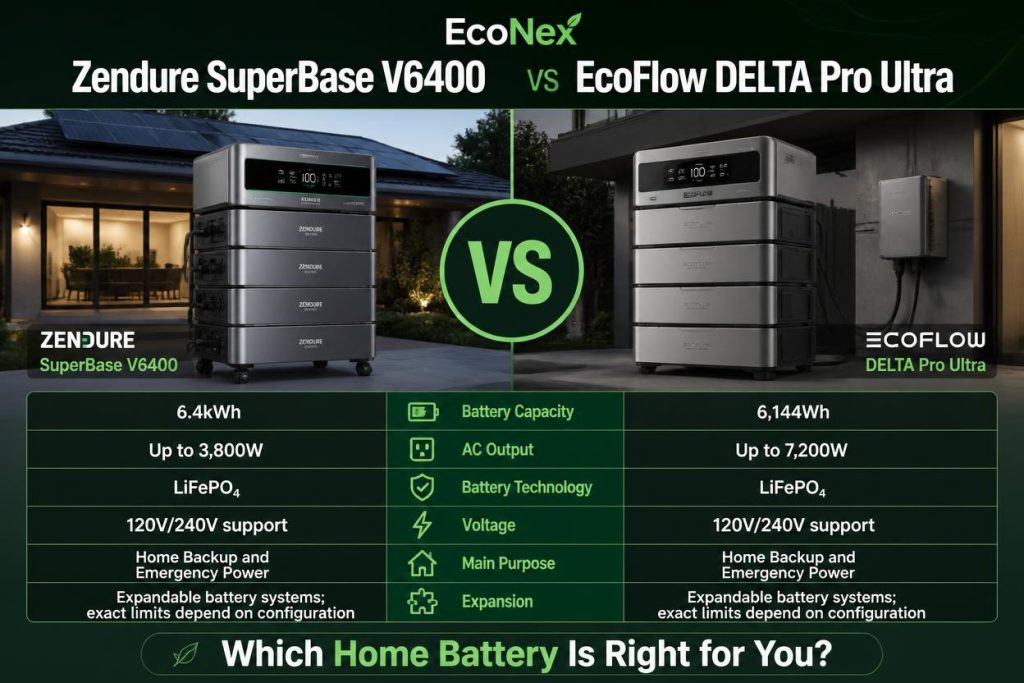
| Battery Capacity | Approximately 6,400Wh | 6,144Wh |
| Advertised AC Output | Up to 3,800W | 7,200W continuous |
| Voltage Support | 120V / 240V in the specified configuration | 120V / 240V in the US configuration |
| Battery Chemistry | LiFePO4 | LiFePO4 |
| Expansion Potential | Compatible expansion options; verify the supported configuration | Up to 90kWh in a compatible expanded system |
| Solar Charging | Supported with compatible solar equipment | Supported; published US specifications list up to 5,600W of solar input across two inputs |
| Charging Flexibility | Depends on the supported charging inputs and accessories | AC and compatible solar charging, with additional charging options depending on configuration |
| Home Backup | Suitable for compatible backup loads and supported installation arrangements | Designed for substantial home backup, with compatible integration equipment where required |
| RV and Off-Grid Use | Potentially suitable when the power and portability requirements match | Potentially suitable for demanding off-grid applications, depending on installation and transport needs |
| Price | Check the current listing | Check the current listing |
| Best For | Buyers prioritizing substantial battery capacity and flexible backup applications | Buyers prioritizing higher continuous output and extensive system expansion |
Important: The specifications above refer to the product configurations described in this article. Confirm the exact Zendure model, output rating, expansion limits, and regional version before relying on these figures for an installation.
1. Performance: Which Power Station Delivers More Power?
Performance is one of the biggest differences in this comparison. The Zendure SuperBase V6400 configuration described here offers up to 3,800W of AC output, while the EcoFlow DELTA Pro Ultra is rated for 7,200W of continuous AC output in its US configuration.
That gives the EcoFlow a substantial advantage in advertised continuous output. If you want to run several compatible appliances at the same time, its higher rating provides more room to manage combined electrical loads without immediately reaching the system’s maximum output.
For example, a household might need to operate a refrigerator, a desktop computer, lights, networking equipment, and another appliance during a power outage. The EcoFlow’s higher output can make it a more flexible option when the total load is high. However, you must still consider startup surges, individual outlet limits, voltage requirements, and the electrical requirements of every connected device.
The Zendure SuperBase V6400 should not be dismissed simply because its advertised output is lower. A 3,800W system can still provide substantial power for many backup situations. If you plan to run a carefully selected group of essential devices rather than several demanding appliances simultaneously, its output may be sufficient.
Neither system should be selected based on maximum wattage alone. A power station with a higher output rating cannot necessarily run appliances for longer because output describes the power available at a given moment, not the amount of energy stored in the battery.
Performance Winner: EcoFlow DELTA Pro Ultra
Based on the stated continuous output ratings, the EcoFlow DELTA Pro Ultra is the stronger choice for users who need higher simultaneous power delivery. The Zendure remains a viable option for buyers whose combined appliance loads fit comfortably within its supported output limits.
2. Battery Capacity: Which One Stores More Energy?
Battery capacity determines how much energy a power station can store, making it a major factor when you want to keep essential equipment running during a prolonged outage.
The Zendure configuration discussed here offers approximately 6,400Wh of storage, compared with 6,144Wh for the EcoFlow DELTA Pro Ultra. The difference is 256Wh, meaning the listed Zendure capacity is approximately 4.2% higher than the EcoFlow’s initial battery capacity.
In practical terms, these starting capacities are relatively close. The Zendure’s slightly larger listed capacity does not automatically mean it will deliver a noticeably longer runtime in every situation. Actual usable energy, inverter efficiency, standby consumption, and the appliances connected to each unit all influence the results.
Consider a simple example. If your essential equipment averages 400W, both systems could potentially support several hours of operation before requiring a recharge. If your equipment averages 2,000W, the batteries will drain much faster regardless of which unit you choose.
The more useful question is not simply which battery has the largest number on its specification sheet. Instead, ask how much energy your household consumes overnight, how many hours of backup you need, and whether you can recharge the system during the following day.
Battery Capacity Winner: Zendure SuperBase V6400 for Initial Storage
Based on the listed starting capacities, the Zendure has a small advantage. However, the difference is modest, so this factor alone should not determine your purchase. The EcoFlow’s greater continuous output and extensive expansion potential may be more important if your long-term goal is a larger home backup system.
3. Expansion: Which System Is Better for Future Growth?
Expansion can make a major difference if you want your power station to support changing energy needs over several years.
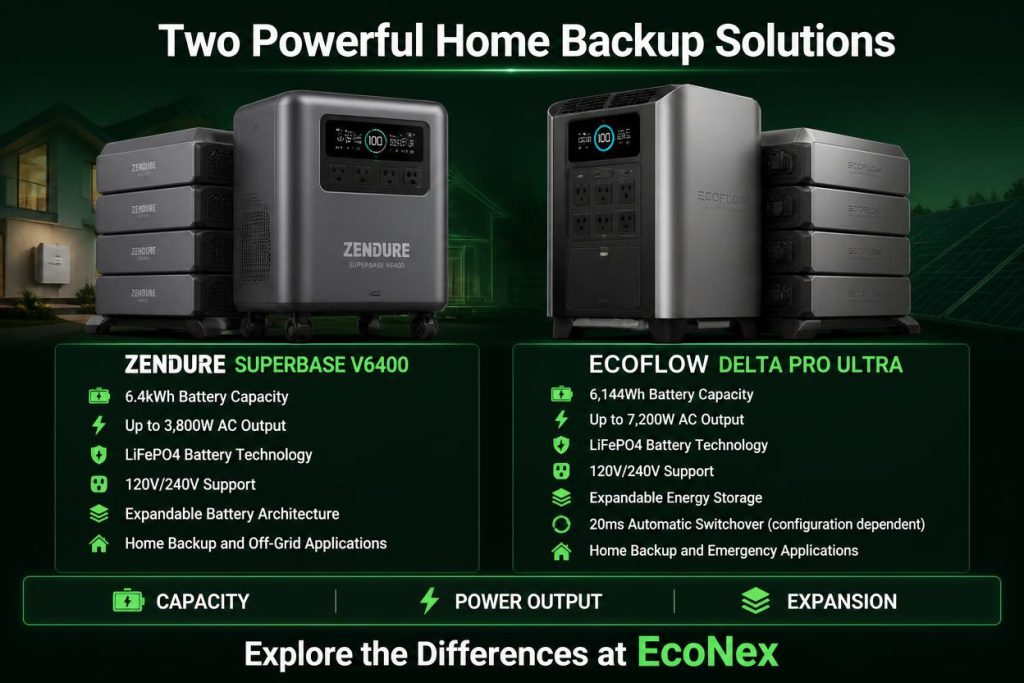
The Zendure SuperBase V6400 supports compatible expansion options, but you should confirm the maximum supported capacity and the exact battery combinations available for the model you intend to purchase. Expansion specifications should never be assumed to be identical across every product in a manufacturer’s range.
The EcoFlow DELTA Pro Ultra offers a clearly stated expansion path. EcoFlow lists up to 30kWh for a single inverter configuration and up to 90kWh for a compatible expanded system. These larger configurations require additional batteries and the necessary compatible equipment.
This can be attractive for homeowners who want to begin with one battery and add more storage later. A larger battery bank can extend backup duration, particularly when paired with a suitable solar array and a sensible household energy plan.
Still, more storage is not automatically better for every buyer. Additional batteries cost money, require space, and add weight. If you only need to power a refrigerator, router, and several lights during occasional outages, paying for a very large system may not provide enough additional value to justify the expense.
Expansion Winner: EcoFlow DELTA Pro Ultra
EcoFlow has the advantage for buyers who want a documented path toward a very large storage system. If future expansion is a major part of your purchasing decision, compare the cost of each additional battery and all required components before making your final choice.
4. Solar Charging: Which System Makes More Sense for Off-Grid Power?
Solar charging can reduce your reliance on the electrical grid, but it works best when the power station and solar array are planned together.
The Zendure SuperBase V6400 may appeal to users who want to combine a substantial battery with compatible solar panels for camping, RV use, or emergency backup. Its actual charging speed will depend on its supported solar input specifications and the equipment included in or added to the system.
The EcoFlow DELTA Pro Ultra offers published US solar input specifications of up to 5,600W across two solar inputs. This can be useful for users planning a substantial solar array, although the maximum rating does not mean that the system will consistently receive that amount of power in everyday conditions.
Solar production varies with the season, weather, shading, panel orientation, temperature, and available daylight. A larger array may improve the potential charging rate, but only when the system’s input limits and real-world sunlight conditions allow it.
When planning an off-grid system, estimate your daily energy use first. Then determine how much energy your solar panels can realistically produce in your location and how much battery storage you need to cover nighttime use or periods of poor weather.
Solar Charging Winner: EcoFlow DELTA Pro Ultra for Higher Advertised Input
Based on the published US input rating, EcoFlow is the stronger candidate for users planning a high-input solar configuration. However, the best system for you depends on the compatible panels, local sunlight conditions, installation requirements, and total cost.
5. Price and Overall Value: Which One Is Worth Your Money?
Price is one of the most important considerations in the Zendure SuperBase V6400 vs EcoFlow DELTA Pro Ultra decision. Both systems belong to the high-capacity power station category, so the initial purchase price may be only one part of the total investment.
The Zendure may offer better value for buyers who want substantial starting battery capacity and do not need the EcoFlow’s higher advertised continuous output. If its current price is meaningfully lower and it satisfies your appliance requirements, it could be a sensible choice.
The EcoFlow may justify a higher investment for users who need 7,200W of continuous output, want extensive battery expansion, or plan to integrate their backup system with selected household circuits. Its additional capabilities are most valuable when they solve a real requirement rather than simply look impressive on a specification sheet.
Since retail prices and Amazon packages can change, it would be misleading to declare one product the cheapest without checking current listings. Compare the same type of package, including the inverter, battery, expansion batteries, solar panels, cables, home integration equipment, shipping, and warranty coverage.
Also consider the cost of installation. A home backup system that requires a smart home panel, transfer equipment, or electrical work may have a substantially higher final cost than the product listing initially suggests.
Value Winner: It Depends on Your Requirements and the Current Price
The Zendure could offer better value if you need its capacity and output at a lower overall cost. The EcoFlow could provide better long-term value if its higher output and expansion capabilities are important to your household. Compare complete system costs instead of choosing based on the purchase price alone.
6. Everyday Use: Which Power Station Fits Your Lifestyle?
For occasional outages and selected essential appliances, the Zendure SuperBase V6400 may provide the balance of capacity and output you need. It is worth considering for users who want backup energy for refrigeration, lighting, computers, and other compatible equipment without necessarily building an extensive whole-home system.
For homeowners with higher simultaneous loads or plans for a more substantial installation, the EcoFlow DELTA Pro Ultra may be the better fit. Its higher continuous output and larger expansion ceiling make it particularly interesting for users who expect their backup requirements to grow.
Portability also deserves attention. Neither system should be treated like a lightweight battery pack. Before purchasing, review the dimensions, component weights, available wheels or handles, storage requirements, and whether you can safely move the equipment between locations.
If you primarily need electricity for RV trips or off-grid activities, check whether the system fits your vehicle, available storage space, charging setup, and electrical connections. A powerful home backup system is not automatically the most convenient choice for travel.
Everyday Use Winner: Choose According to Your Setup
Choose Zendure if its specifications comfortably meet your needs and you prefer a suitable solution without paying for additional output you will not use. Choose EcoFlow if higher output, extensive expansion, and more advanced home integration are priorities.
7. Which Power Station Is Better for Emergency Preparedness?
Emergency preparedness is not only about buying a large battery. It is about making sure your backup equipment can provide the right amount of power for the right length of time.
Start by listing the devices you consider essential. Include their running wattage, estimated daily operating hours, and any startup power requirements. Calculate your expected energy consumption and add a reasonable allowance for conversion losses and unexpected needs.
Next, determine how you will recharge the system. Grid charging may be convenient before a storm, while compatible solar panels can provide another source of energy when conditions permit. A battery that cannot be recharged during an extended outage will eventually run out of stored energy.
Both Zendure and EcoFlow can be candidates for emergency preparedness, provided their electrical specifications and operating conditions match your requirements. For either system, follow the manufacturer’s instructions, maintain suitable ventilation and operating conditions, and use qualified professionals for household electrical integration.
Do not assume that a portable power station can automatically power every circuit in your house. Whole-home or selected-circuit backup requires the appropriate system design, compatible transfer equipment, and compliance with applicable electrical codes.
Emergency Preparedness Winner: EcoFlow for Higher Output, Zendure for Comparable Starting Capacity
The EcoFlow’s higher continuous output makes it attractive for more demanding loads, while the Zendure’s listed initial battery capacity is slightly higher. Your preferred option should depend on the appliances you need to support, the duration of the outage, and your available budget.
Zendure SuperBase V6400 vs EcoFlow DELTA Pro Ultra: Which One Should You Buy in 2026?
After comparing battery capacity, continuous output, solar charging, expansion options, and practical applications, one thing becomes clear: the best power station is not necessarily the one with the biggest specifications. It is the one that provides the right combination of power, storage, flexibility, and affordability for your actual needs.
The Zendure SuperBase V6400 vs EcoFlow DELTA Pro Ultra comparison comes down to two different priorities. Zendure offers a slightly larger listed starting battery capacity in the configurations discussed here, while EcoFlow provides substantially higher advertised continuous AC output and a clearly documented path toward a much larger expanded storage system.
Before you buy either product, consider how you intend to use it. Do you want to keep a few essential appliances running during an occasional blackout? Are you planning a solar-powered off-grid setup? Or do you want a scalable home backup system that can support increasingly demanding electrical loads?
Answering those questions will help you avoid spending money on features you do not need or choosing a system that cannot handle your household’s requirements.
Choose the Zendure SuperBase V6400 If…
The Zendure SuperBase V6400 deserves serious consideration if you want a high-capacity power station for essential backup loads, selected off-grid applications, or compatible RV setups. Its advertised 3,800W AC output and approximately 6.4kWh starting battery capacity make it worth considering for buyers who need substantial stored energy without necessarily requiring the EcoFlow’s higher continuous output.
- You want substantial starting battery capacity: Its listed capacity of approximately 6,400Wh is slightly higher than the EcoFlow’s 6,144Wh starting capacity in this comparison.
- Your combined appliance load fits its output rating: If your planned equipment stays within the supported continuous and surge limits, you may not need to pay for a higher-output system.
- You want a flexible backup solution: It can be worth considering for selected household devices, compatible solar charging, and other supported applications.
- You are comparing total purchase costs: If the Zendure package is less expensive and includes the accessories you need, it could offer better value for your particular setup.
- You want to investigate future expansion: Check the supported expansion batteries and maximum system capacity before committing to a configuration.
- You do not need the largest available system: A well-planned backup setup for essential appliances may be more practical than investing in a much larger installation.
For example, imagine that your main priorities are keeping a refrigerator, internet router, several LED lights, and a laptop running during a power outage. If their combined load and startup requirements fit within the Zendure’s limits, its starting capacity may be sufficient for your intended use.
However, you should still estimate your daily energy consumption and consider how you will recharge the battery. A large battery can provide useful backup, but it cannot run appliances indefinitely without an additional energy source.
When Zendure May Not Be the Best Choice
The Zendure may not be the ideal option if your planned loads approach or exceed its advertised output rating, or if you expect to expand to a very large home backup system. In those situations, the EcoFlow’s higher continuous output and documented expansion options may better match your long-term goals.
Before buying, confirm the precise SuperBase V6400 model, its continuous output, supported voltage configuration, expansion compatibility, solar input limits, and included accessories. Do not rely on a product title alone when making electrical compatibility decisions.
Choose the EcoFlow DELTA Pro Ultra If…
The EcoFlow DELTA Pro Ultra is the more compelling candidate if your priority is higher continuous power output and a scalable backup system for demanding household applications. Its advertised 7,200W continuous AC output provides considerably more output capacity than the 3,800W rating listed for the Zendure configuration discussed in this article.
- You need higher continuous output: Its 7,200W rating gives you more flexibility for compatible combinations of appliances and equipment.
- You want extensive battery expansion: EcoFlow lists configurations of up to 90kWh for a compatible expanded system, although additional batteries and equipment are required.
- You are planning substantial home backup: Compatible home integration equipment can support backup for selected household circuits when professionally installed.
- You want a high-input solar setup: Its published US specifications list up to 5,600W of solar input across two inputs, subject to the relevant electrical limits.
- You want room for future energy needs: An expandable system may be useful if you expect to add appliances, increase backup duration, or invest in more solar generation later.
- You value system-level flexibility: Compatible charging and home integration options can help you build a backup setup around your specific requirements.
Imagine that you want to back up several household circuits rather than only a refrigerator and a few lights. You may want to operate additional equipment simultaneously and retain the option to add batteries in the future. In that situation, the EcoFlow’s higher output and expansion potential make it an attractive choice to investigate.
Its advantages are most valuable when you actually need them. If your electricity consumption is modest, you may not benefit enough from the higher output and extensive expansion ceiling to justify the additional cost of a larger setup.
When EcoFlow May Not Be the Best Choice
The EcoFlow may be more system than you need if your main objective is occasional backup for a small number of low-power devices. Its separate components, substantial weight, optional integration equipment, and potential installation costs can make it a larger investment than a simpler setup.
Also, do not assume that the advertised 90kWh capacity comes with the basic purchase. That figure applies to a compatible expanded configuration. Confirm the included battery capacity and calculate the cost of all additional equipment before deciding whether the system fits your budget.
Which Product Offers Better Value for Money?
Value is about more than the initial price. A power station can appear affordable until you discover that you need additional batteries, solar panels, cables, home integration equipment, or professional installation.
For a fair comparison, evaluate both products using the same purchasing assumptions. Compare the base system with the base system, and compare fully equipped backup packages with similarly equipped alternatives.
Consider the Total Cost of Ownership
- Initial purchase: Compare the current prices of the exact configurations available from the sellers.
- Additional batteries: Calculate how much extra capacity costs if the starting battery is not enough.
- Solar equipment: Include compatible panels, mounting hardware, wiring, and any required installation costs.
- Home integration: Determine whether you need a compatible transfer switch or smart home panel and professional electrical work.
- Warranty and support: Review the warranty duration, coverage conditions, return policy, and seller reputation.
- Long-term requirements: Consider whether the system can meet your expected needs without requiring an expensive replacement.
If the Zendure costs considerably less and already meets your requirements, it may be the more economical choice. If you need the EcoFlow’s additional output and expansion options, its higher overall cost may be justified by the capabilities you gain.
Because Amazon prices and package contents change, neither product should be declared the cheapest without checking current listings. Look at the complete system cost before making your decision.
Which Is Better for Solar Power and Off-Grid Living?
Both systems can be relevant to off-grid power planning when paired with compatible solar equipment. However, off-grid living requires more than a large battery and a few solar panels.
You need to calculate your daily electricity consumption, estimate realistic solar production, account for nighttime use, and decide how many days of backup you want when sunlight is limited. You should also consider seasonal differences in solar production and the power requirements of appliances such as refrigerators, water pumps, and air conditioners.
The EcoFlow is attractive if you want to investigate a larger solar input configuration and substantial future battery expansion. The Zendure may be worth considering if its specifications meet your needs and its total cost is more suitable for your budget.
For either option, verify the maximum solar input voltage, current, and power. Never connect panels that exceed the manufacturer’s permitted electrical limits. If you are installing a permanent off-grid system, consult a qualified professional to ensure the complete setup is safe and compatible.
Which Is Better for Home Emergency Backup?
For emergency backup, the first step is to identify the appliances you cannot comfortably go without. Many households prioritize refrigeration, lighting, communications, computers, and selected medical or accessibility equipment that has an appropriate backup plan.
Next, calculate the total running wattage and estimate how many hours each device will operate. Appliances with motors or compressors may require additional starting power, so the total running wattage alone is not always enough to determine compatibility.
The Zendure can be a sensible candidate if your planned loads fit within its supported output and battery capacity. The EcoFlow becomes more attractive if you need higher continuous output or intend to expand your backup system substantially.
For either system, ensure that any critical medical equipment has a suitable backup arrangement recommended by its manufacturer or healthcare provider. A portable power station should not be assumed to provide uninterrupted operation in every circumstance.
Our Final Verdict: Zendure SuperBase V6400 vs EcoFlow DELTA Pro Ultra
After considering the specifications and intended applications, our overall recommendation is the EcoFlow DELTA Pro Ultra for buyers who want a powerful, expandable home backup system.
The deciding factor is its advertised 7,200W continuous AC output, which is substantially higher than the 3,800W listed for the Zendure configuration in this comparison. EcoFlow also provides a documented expansion path to a compatible system capacity of up to 90kWh, making it a strong candidate for homeowners who want room to grow.
That does not mean the EcoFlow is the right purchase for everyone. The Zendure SuperBase V6400 offers a slightly larger listed starting battery capacity, and it may be the smarter value if its output is sufficient for your needs and its current package price is more attractive.
Our recommendation is therefore based on the goal of building a powerful, scalable home backup system rather than finding the lowest purchase price. If you want higher output, substantial expansion options, and compatible home integration, the EcoFlow DELTA Pro Ultra is the product we would choose.
If you only need to power a selected group of essential devices and want to keep the initial investment under control, compare the Zendure’s current price and included accessories before making your final decision.
Before You Buy: A Quick Checklist
- Calculate the combined running wattage of your appliances.
- Check startup surge requirements for refrigerators, pumps, and compressors.
- Estimate the battery capacity needed for your desired backup duration.
- Confirm compatibility with your solar panels and charging equipment.
- Check whether home integration equipment and professional installation are required.
- Compare the complete price, warranty, and included accessories on Amazon.
Bottom line: The EcoFlow DELTA Pro Ultra is our preferred choice for a higher-output, expandable home backup system. The Zendure SuperBase V6400 remains a worthwhile alternative when its capacity and output satisfy your needs at a more attractive total cost.
Where to Buy Zendure SuperBase V6400 and EcoFlow DELTA Pro Ultra
Now that you understand the main differences between these two power stations, the next step is to check their current prices and available packages. Before ordering, compare the included accessories, battery configuration, warranty coverage, and seller details to make sure you are getting the right system for your needs.
Both products represent a significant investment, so take a moment to confirm that the selected configuration provides the power output, battery capacity, and charging options you actually need.
1. Buy the Zendure SuperBase V6400
The Zendure SuperBase V6400 is worth considering if you want substantial battery storage, up to 3,800W of advertised AC output in the specified configuration, and a flexible solution for selected home backup and off-grid applications.
Before placing your order, confirm the exact model, supported expansion options, solar charging specifications, included accessories, and current price. If your appliance requirements fit within its limits, it may provide the capabilities you need without paying for a higher-output system.
Check Today’s Zendure SuperBase V6400 Price and Available Deals on Amazon
2. Buy the EcoFlow DELTA Pro Ultra
The EcoFlow DELTA Pro Ultra is our preferred option for buyers who prioritize higher continuous AC output, extensive battery expansion, and the potential to build a more comprehensive home backup system.
Its advertised 7,200W continuous output and expandable storage options make it worth investigating if your household has demanding energy requirements. Make sure you understand which components are included in the selected package and whether additional batteries or home integration equipment are necessary.
Explore the EcoFlow DELTA Pro Ultra Price and Current Offers on Amazon
Frequently Asked Questions
1. Is the Zendure SuperBase V6400 Better Than the EcoFlow DELTA Pro Ultra?
Neither product is better for every buyer. The Zendure configuration discussed in this review offers approximately 6,400Wh of battery capacity and up to 3,800W of advertised AC output. The EcoFlow DELTA Pro Ultra offers 6,144Wh of starting battery capacity and 7,200W of continuous AC output in its US configuration. Choose Zendure if its capacity and output meet your needs at a suitable price. Choose EcoFlow if higher output and extensive system expansion are more important.
2. Can Either Power Station Run an Entire House During a Power Outage?
Both systems may support selected household circuits when their electrical specifications, battery capacity, and installation arrangements are appropriate. However, running an entire house depends on total electricity demand, the appliances being used, and the available energy storage. A compatible transfer system or home integration equipment and professional installation may be required. Neither product should be assumed to power every appliance in every home without careful planning.
3. Can You Recharge These Power Stations With Solar Panels?
Both systems support solar charging with compatible equipment. The actual charging speed depends on the supported input limits, panel configuration, sunlight, temperature, shading, and other operating conditions. Before connecting solar panels, confirm that their voltage and current ratings comply with the manufacturer’s requirements. A properly sized solar array can help replenish stored energy, but cloudy weather and limited daylight can reduce production significantly.
Final Thoughts: Which Power Station Is Worth Your Money in 2026?
Choosing between the Zendure SuperBase V6400 and EcoFlow DELTA Pro Ultra comes down to understanding your energy requirements and deciding which features deserve your investment.
The Zendure offers a slightly larger listed starting battery capacity in the configurations compared here. It may be the right choice if you need substantial stored energy for essential appliances and its advertised output is sufficient for your planned loads.
The EcoFlow DELTA Pro Ultra, however, stands out for its higher advertised continuous output and its potential to expand into a much larger energy storage system. For homeowners who want a powerful backup solution with room for future growth, it is our preferred option.
Remember that a higher wattage rating does not automatically mean longer runtime, and a larger battery does not guarantee compatibility with every appliance. Check your power requirements, estimate your expected consumption, and compare the complete purchase cost before making a decision.
If your priority is a powerful and expandable home backup system, start by reviewing the EcoFlow DELTA Pro Ultra’s current package and specifications. If you want a system with substantial initial storage and your requirements fit within the Zendure’s limits, compare its current offer as well.
Our recommendation: The EcoFlow DELTA Pro Ultra is the better overall choice for buyers who prioritize high continuous output and extensive expansion potential. The Zendure SuperBase V6400 remains a worthwhile alternative for buyers whose needs are more modest or whose budget makes it the better-value option.
Ready to Choose Your Home Backup Power Station?
Do not wait until the next power outage to discover that your backup system cannot handle your essential appliances. Compare both options, verify the specifications, and choose the configuration that fits your household, budget, and future energy plans.
- For substantial battery storage and flexible backup applications: Compare the Zendure SuperBase V6400 and its available packages.
- For higher continuous output and extensive expansion options: Explore the EcoFlow DELTA Pro Ultra and its compatible accessories.
Shop the Zendure SuperBase V6400 on Amazon
Shop the EcoFlow DELTA Pro Ultra on Amazon
Affiliate disclosure: This article contains affiliate links. If you purchase through qualifying links, we may earn a commission at no additional cost to you. Product specifications, availability, prices, and promotions may change, so verify the latest information on the retailer’s website before purchasing.
Editorial note: This comparison is intended for general informational purposes. Always follow the manufacturer’s instructions and consult a qualified electrician for permanent home backup installations or electrical connections.

Adrian
Just like you, I was tired of paying crazy electricity bills every month. Today, after 4 years of trial and error, my smart home uses less than half the energy it used to. I share everything I’ve learned — so you don’t have to make the same mistakes.
Let’s Connect ↓
Adrian — Owner of EcoNex
Solar | Smart Home | Lower bills