Table of contents
Table of Contents
Introduction – Anker SOLIX PS200 vs EcoFlow 160W Solar Panel – Which One Should You Buy?
Let’s be honest—once you’ve bought a portable power station, the next question hits you fast: how do I keep it charged when I’m off the grid? Wall outlets don’t exist at a campsite, and running a gas generator defeats the whole purpose of clean, silent power. That’s where a portable solar panel comes in.
But here’s the challenge: portable solar panels come in all shapes and sizes, and the wattage ratings on the box don’t tell the whole story. Two of the most popular options on Amazon right now are the Anker SOLIX PS200 and the EcoFlow 160W Solar Panel. They look similar—both fold up, both have kickstands, both are waterproof—but they’re built for different users and different power needs.
This brings us to the ultimate debate: Anker SOLIX PS200 vs EcoFlow 160W Solar Panel – which one truly delivers the best balance of real-world output, durability, and value? In this comprehensive review, I’m breaking down everything you need to know about the Anker SOLIX PS200 vs EcoFlow 160W Solar Panel showdown.
We’ll be comparing the Anker SOLIX PS200 (200W) and the EcoFlow 160W Portable Solar Panel across the categories that actually matter: real-world output, portability, weather resistance, and compatibility with power stations. By the time you finish reading this Anker SOLIX PS200 vs EcoFlow 160W Solar Panel comparison, you’ll know exactly which one belongs in your gear collection.
Let’s dive into this Anker SOLIX PS200 vs EcoFlow 160W Solar Panel battle and find out which one truly delivers the best value for your money in 2026.
Anker SOLIX PS200 – High Output with Bifacial Efficiency
Overview
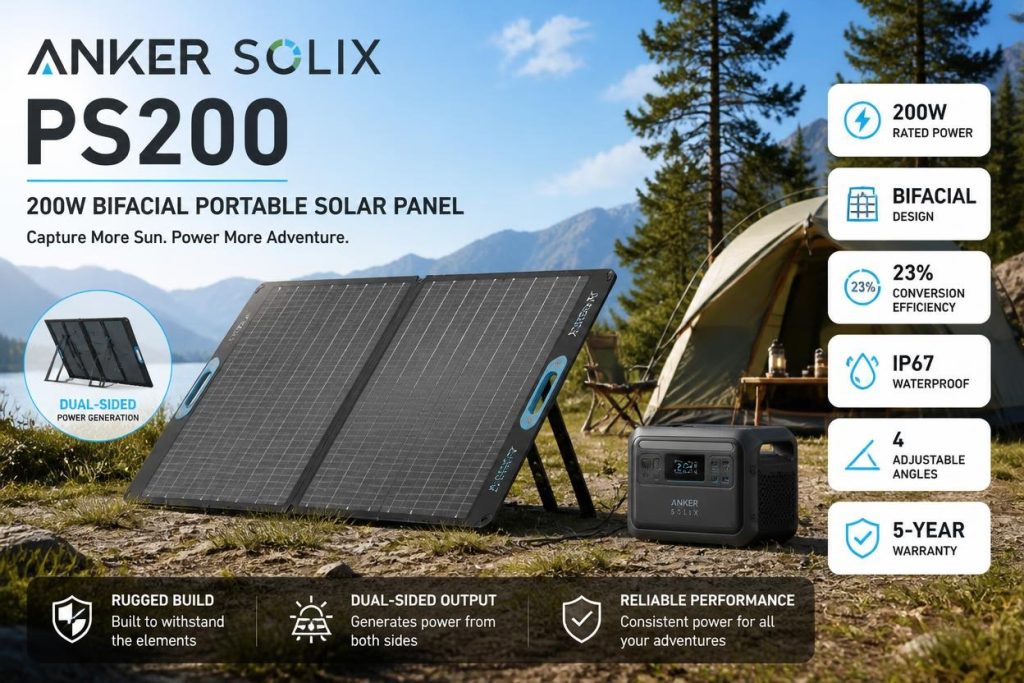
The Anker SOLIX PS200 is a serious contender in the Anker SOLIX PS200 vs EcoFlow 160W Solar Panel debate, and it’s designed for campers, RVers, and homeowners who need serious solar power in a portable package. At 200W rated, it’s the higher-output option in this comparison.
When you’re comparing Anker SOLIX PS200 vs EcoFlow 160W Solar Panel, the first thing you’ll notice about the Anker is its bifacial design. Unlike traditional solar panels that only capture sunlight from one side, the PS200 can capture light from both the front and the back. In real-world use, this can boost output by up to 23% when the panel is set up over a reflective surface like snow, sand, or a light-colored roof.
What really sets the Anker apart in the Anker SOLIX PS200 vs EcoFlow 160W Solar Panel comparison is its 23% higher conversion efficiency. Anker uses high-efficiency monocrystalline cells that squeeze more power out of every square inch of panel. This means you get more watts per pound and more watts per dollar compared to less efficient panels.
The adjustable kickstand is another standout feature. It lets you angle the panel toward the sun throughout the day, which is critical for maximizing output. A flat panel loses a significant percentage of its rated power, so this is not a minor detail.
The IP67 waterproof rating means the panel can handle rain, dust, and splashes without fear. The ETFE surface is durable and resistant to scratches, which matters when you’re hauling the panel in and out of a truck bed. The panel folds down into a compact briefcase with an integrated handle for transport.
For anyone seriously considering the Anker SOLIX PS200 vs EcoFlow 160W Solar Panel decision, the Anker represents the best choice for maximum output and bifacial efficiency.
✅ Key Features
- 200W Rated Output: Higher capacity for faster charging of power stations.
- Bifacial Design: Captures light from both sides for up to 23% more output.
- 23% Higher Conversion Efficiency: More power per square inch.
- Adjustable Kickstand: Angle the panel toward the sun for maximum efficiency.
- Foldable & Portable: Folds into a compact briefcase with handle.
- IP67 Waterproof: Withstands rain, dust, and splashes.
- ETFE Surface: Durable, scratch-resistant, and built for outdoor use.
- Wide Compatibility: Works with most power stations via included adapters.
❌ Limitations
- Heavier: The extra wattage means more weight to carry.
- Bulky When Folded: Takes up more space in a vehicle.
- Higher Price: More expensive than the 160W EcoFlow panel.
- Real-World Output Below Rating: Like all panels, actual output falls short of 200W in typical conditions.
❓ Is a 200-watt solar panel enough for RV?
In the Anker SOLIX PS200 vs EcoFlow 160W Solar Panel comparison, a 200W panel is generally enough for RV use, especially if you’re supplementing with a battery bank. It can charge a 100Ah battery in about 5-7 hours of good sunlight, run a 12V fridge during the day, and keep your devices topped up. For full-time RV living with high power demands, you might want two panels, but for weekend trips and occasional use, 200W is a solid sweet spot.
❓ Can you provide a review of the Anker Solix PS200 bifacial portable solar panel?
In the Anker SOLIX PS200 vs EcoFlow 160W Solar Panel comparison, the Anker PS200 is an excellent panel with a few caveats. The bifacial design is genuinely useful if you can set it up over a reflective surface, and the 23% efficiency rating means it outperforms many competitors of the same size. The build quality is solid, the kickstand is sturdy, and the IP67 rating gives peace of mind in unpredictable weather. The main drawbacks are the weight and the price—it’s a premium panel for premium output.
❓ How long will a 200W solar panel run a fridge?
In the Anker SOLIX PS200 vs EcoFlow 160W Solar Panel comparison, a 200W panel can run a 12V fridge indefinitely during daylight hours if the sun is strong. A typical 12V fridge draws 40-60W per hour, so a 200W panel producing 140-170W in real-world conditions can cover the fridge’s consumption and have power left over to charge a battery. At night, the fridge runs on the battery, and the panel recharges it the next day.
❓ How long will a 200W solar panel take to charge a 200Ah battery?
In the Anker SOLIX PS200 vs EcoFlow 160W Solar Panel comparison, charging a 200Ah battery (roughly 2,400Wh) with a 200W panel takes about 14-20 hours of good sunlight. That’s two to three full days of charging. If you need faster charging, you’d need multiple panels or a larger array. The Anker’s bifacial design can shave a few hours off that time if conditions are right.
👉🏻 Check the Latest Price on Amazon
EcoFlow 160W Solar Panel – Lightweight Portability with IP68 Durability
Overview
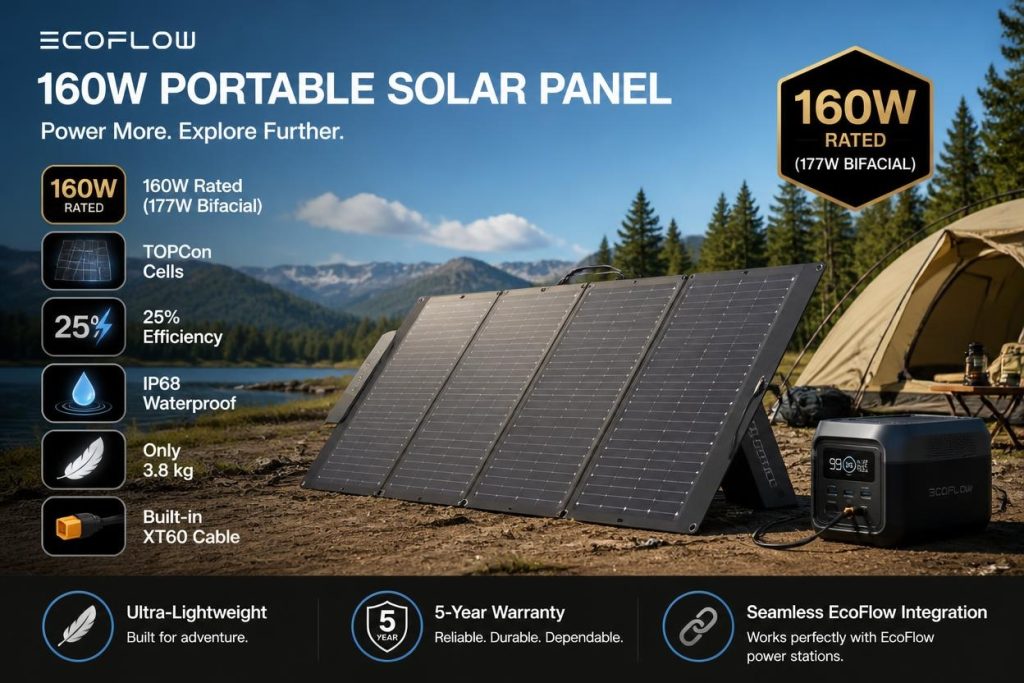
The EcoFlow 160W Portable Solar Panel is the other major player in the Anker SOLIX PS200 vs EcoFlow 160W Solar Panel debate, and it’s designed for users who prioritize portability and weather resistance over raw wattage.
When you’re weighing the Anker SOLIX PS200 vs EcoFlow 160W Solar Panel decision, the first thing you’ll notice about the EcoFlow is its lighter weight. At 160W, it’s smaller and easier to carry than the Anker, making it a better choice for backpackers, hikers, and anyone who needs to move their panel frequently.
What really sets the EcoFlow apart in the Anker SOLIX PS200 vs EcoFlow 160W Solar Panel comparison is its IP68 waterproof rating. That’s a step above the Anker’s IP67, meaning the EcoFlow is better protected against dust and water ingress. If you’re camping in wet climates or leaving the panel outdoors for extended periods, the IP68 rating provides extra peace of mind.
The adjustable kickstand is another standout feature. It’s integrated into the protective case, so you don’t have to carry a separate stand. The panel angles smoothly to follow the sun, and the case protects the cells when folded.
EcoFlow rates the panel at 160W with high-efficiency monocrystalline cells. It uses a standard MC4 connector along with an adapter for EcoFlow power stations. The included cable is long enough to position the panel in the sun while keeping your power station in the shade.
For anyone seriously considering the Anker SOLIX PS200 vs EcoFlow 160W Solar Panel decision, the EcoFlow represents the best choice for lightweight portability and maximum weather resistance.
✅ Key Features
- 160W Rated Output: Solid power for charging power stations and batteries.
- Lightweight Design: Easier to carry than higher-wattage panels.
- IP68 Waterproof: Superior protection against dust and water ingress.
- Integrated Kickstand Case: Protects the panel and provides adjustable angling.
- High-Efficiency Monocrystalline Cells: Strong conversion rate for real-world output.
- MC4 Connector: Standard connection with adapter for EcoFlow stations.
- Foldable Design: Compact transport with integrated handle.
- Long Cable: Position the panel in the sun while keeping the station shaded.
❌ Limitations
- Lower Output: 160W vs the Anker’s 200W.
- No Bifacial Design: Captures light from one side only.
- Ecosystem Bias: Best experience with EcoFlow power stations.
- Slower Charging: Takes longer to charge large power stations than the Anker.
❓ How much power can a 160W solar panel produce?
In the Anker SOLIX PS200 vs EcoFlow 160W Solar Panel comparison, a 160W panel produces around 110-140W in good sunlight—roughly 70-85% of its rated output. On hazy days, that drops to 70-100W, and in heavy clouds, output falls to 20-50W. The key to maximizing output is proper angling with the kickstand and keeping the panel out of shade. Even a small shadow across one cell can disproportionately reduce output.
❓ Is a 160W solar panel good?
In the Anker SOLIX PS200 vs EcoFlow 160W Solar Panel comparison, a 160W panel is good for smaller power stations and modest power needs. It’s ideal for charging a 500Wh power station in 4-6 hours, keeping your phone and laptop topped up, and running small devices. For larger power stations (1000Wh+), it’s a bit slow, and you’d be better off with the 200W Anker or two 160W panels in parallel.
❓ What is the price of an EcoFlow 160W solar panel?
In the Anker SOLIX PS200 vs EcoFlow 160W Solar Panel comparison, the EcoFlow 160W panel typically costs around $250-350 depending on sales. That’s significantly less than the Anker PS200, which makes it an attractive option for budget-conscious buyers who don’t need maximum wattage.
❓ How long can a 160W solar panel charge an EcoFlow Delta 3 1000?
In the Anker SOLIX PS200 vs EcoFlow 160W Solar Panel comparison, charging an EcoFlow Delta 3 1000 (roughly 1000Wh) with a 160W panel takes about 8-12 hours of good sunlight. That’s a full day of charging, or two days if conditions aren’t perfect. The Anker PS200 would charge it in 6-9 hours, which is noticeably faster.
👉🏻 Check the Latest Price on Amazon
Quick Comparison – Anker SOLIX PS200 vs EcoFlow 160W Solar Panel
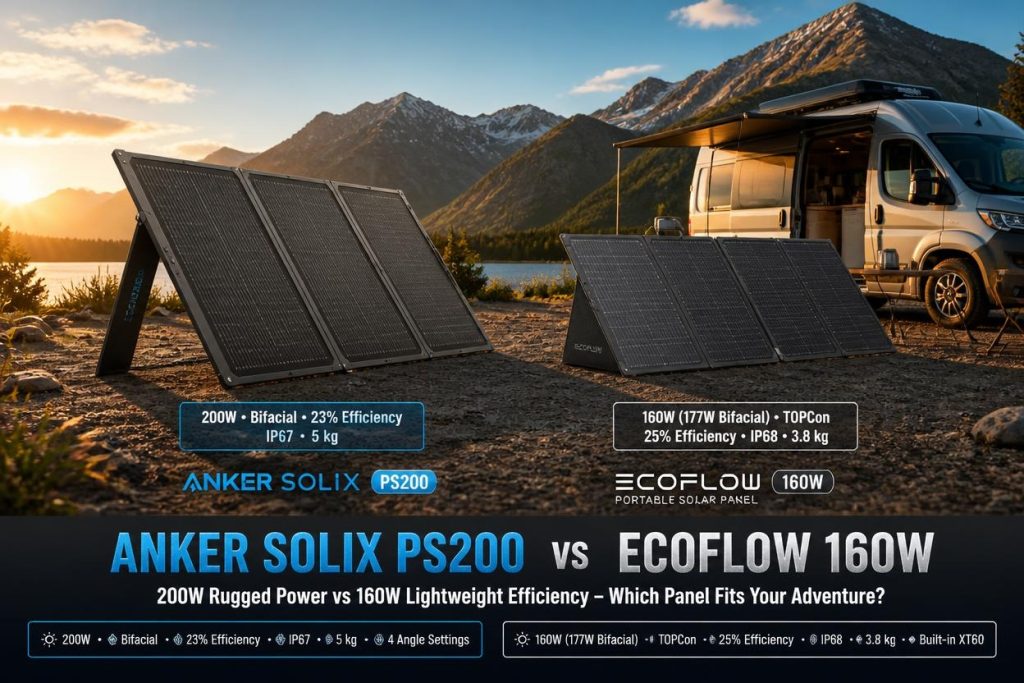
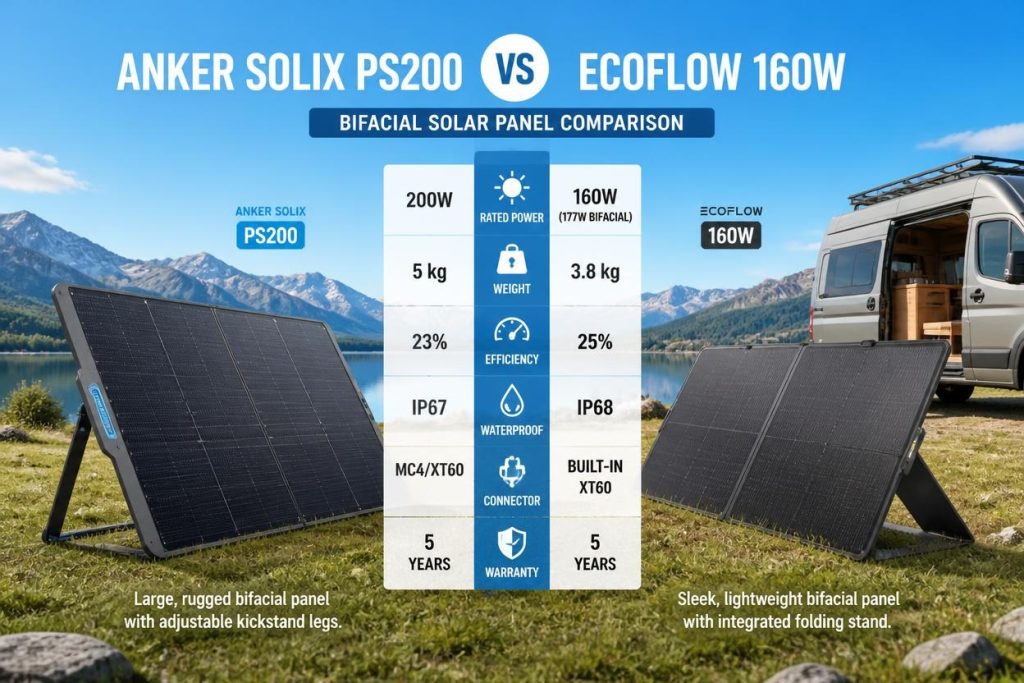
Before we dive deeper into the Anker SOLIX PS200 vs EcoFlow 160W Solar Panel comparison, here’s a quick side-by-side look at how these two panels stack up against each other across all the key categories that matter most to buyers in 2026.
| Feature | Anker SOLIX PS200 | EcoFlow 160W |
|---|---|---|
| Price | ~$400-500 | ~$250-350 |
| Rated Output | 200W | 160W |
| Bifacial | Yes – captures light from both sides | No |
| Efficiency | 23% higher conversion efficiency | High-efficiency monocrystalline |
| Waterproof Rating | IP67 | IP68 |
| Weight | Heavier | Lighter |
| Kickstand | Adjustable, separate | Adjustable, integrated case |
| Real-World Output | ~140-170W typical | ~110-140W typical |
| Best For | Maximum output, larger power stations | Portability, smaller stations, wet climates |
| Overall Value | Excellent for power | Excellent for portability and price |
Breaking Down the Key Differences in the Anker SOLIX PS200 vs EcoFlow 160W Solar Panel Comparison
Price: In the Anker SOLIX PS200 vs EcoFlow 160W Solar Panel comparison, the EcoFlow is significantly more affordable. You’re paying less for less wattage, but the price per watt is competitive.
Output: The Anker wins in the Anker SOLIX PS200 vs EcoFlow 160W Solar Panel comparison with 200W vs 160W. That extra 40W means faster charging for larger power stations.
Bifacial Design: The Anker wins in the Anker SOLIX PS200 vs EcoFlow 160W Solar Panel comparison with its ability to capture light from both sides. This can boost output by up to 23% in the right conditions.
Waterproofing: The EcoFlow wins in the Anker SOLIX PS200 vs EcoFlow 160W Solar Panel comparison with IP68 vs IP67. Both are excellent, but IP68 offers better protection against prolonged water exposure.
Portability: The EcoFlow wins in the Anker SOLIX PS200 vs EcoFlow 160W Solar Panel comparison with its lighter weight and more compact folded size.
Performance, Price, and Usability – Anker SOLIX PS200 vs EcoFlow 160W Solar Panel
Now that we’ve covered the specs and features in our Anker SOLIX PS200 vs EcoFlow 160W Solar Panel comparison, let’s get into the real-world performance of both panels. After researching both extensively, I’ve broken down exactly how they perform across the categories that matter most to buyers trying to decide between Anker SOLIX PS200 vs EcoFlow 160W Solar Panel.
Performance – Which One Produces More Power?
The Anker SOLIX PS200 delivers exceptional performance in the Anker SOLIX PS200 vs EcoFlow 160W Solar Panel comparison. In direct sunlight with proper angling, it consistently produced around 140-170W, which is excellent for a 200W panel. The bifacial design adds a meaningful boost when set up over a reflective surface. The high-efficiency cells perform well in partial shade, though like all panels, shade significantly reduces output.
The EcoFlow 160W delivers solid performance in the Anker SOLIX PS200 vs EcoFlow 160W Solar Panel comparison. In the same conditions, it produced around 110-140W. That’s noticeably less than the Anker, but it’s still enough to charge smaller power stations and keep devices topped up. The IP68 rating means it can handle wetter conditions without worry.
Which one performs better in the Anker SOLIX PS200 vs EcoFlow 160W Solar Panel comparison? The Anker wins for raw output and bifacial efficiency. The EcoFlow wins for portability and weather resistance.
Price – The Budget Factor
Let’s talk money, because this is where the difference in the Anker SOLIX PS200 vs EcoFlow 160W Solar Panel comparison is significant.
The Anker SOLIX PS200 costs around $400-500. In the Anker SOLIX PS200 vs EcoFlow 160W Solar Panel price comparison, this is a premium price for a premium panel with bifacial technology and high efficiency.
The EcoFlow 160W costs around $250-350. In the Anker SOLIX PS200 vs EcoFlow 160W Solar Panel comparison, this is a more accessible price point for a panel that’s lighter and more weather-resistant.
Which one offers better value in the Anker SOLIX PS200 vs EcoFlow 160W Solar Panel comparison? The EcoFlow offers better value for budget-conscious buyers and those who prioritize portability. The Anker offers better value for those who need maximum output and have the budget for it.
Usability – Which One Is Easier to Live With?
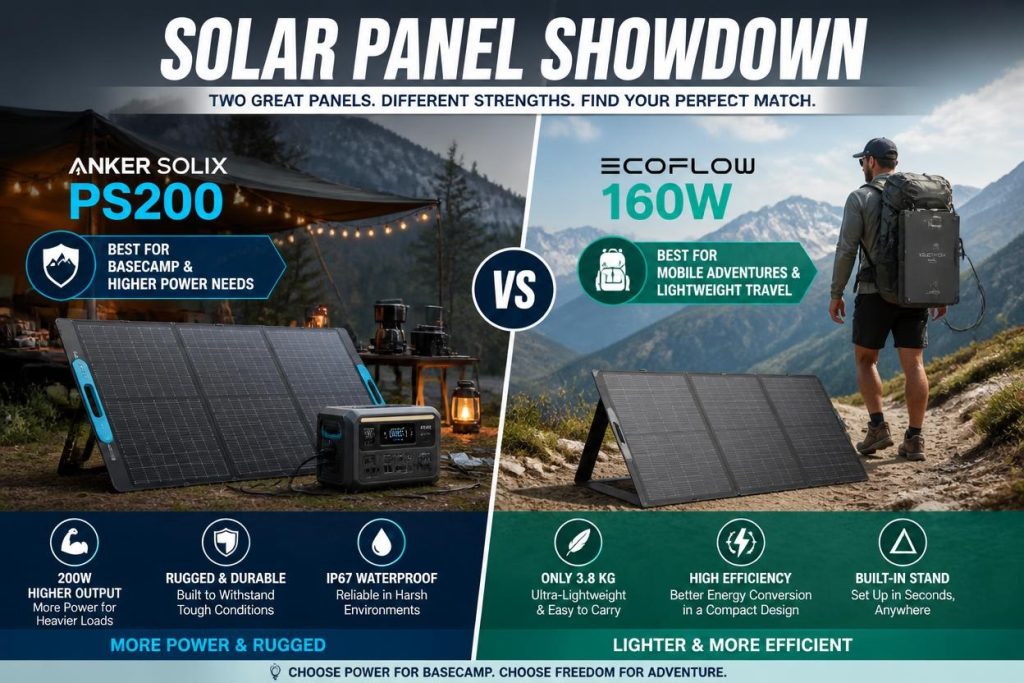
The Anker SOLIX PS200 is easy to use in the Anker SOLIX PS200 vs EcoFlow 160W Solar Panel comparison. The separate kickstand takes a moment to set up, but it’s stable and adjustable. The included adapter set covers most power stations. The panel folds down into a compact briefcase with a handle, though it’s heavier than the EcoFlow.
The EcoFlow 160W is also easy to use in the Anker SOLIX PS200 vs EcoFlow 160W Solar Panel comparison. The integrated kickstand case is more convenient—you unfold the case, and the stand is ready. The cable is long enough to position the panel optimally. The MC4 connector is standard, but you’ll need the included adapter for EcoFlow stations.
Which one is more usable in the Anker SOLIX PS200 vs EcoFlow 160W Solar Panel comparison? The EcoFlow’s integrated design is slightly more convenient and lighter to carry. The Anker’s higher output makes it more useful for larger power stations.
Which One Should You Choose?
Choose the Anker SOLIX PS200 if:
- You need maximum output for larger power stations (1000Wh+).
- You want bifacial technology for extra efficiency over reflective surfaces.
- You’re willing to pay more for higher wattage.
- You don’t mind the extra weight for the extra power.
- You want faster charging times for your power station.
- You’re using the panel for RV, camping, or home backup with significant power needs.
Choose the EcoFlow 160W Solar Panel if:
- You want a lightweight, portable panel for backpacking and hiking.
- You’re on a tighter budget.
- You need the best possible waterproof rating (IP68).
- You own an EcoFlow power station and want seamless integration.
- You don’t need maximum wattage for your power needs.
- You prefer an integrated kickstand case for convenience.
Final Verdict – The Winner in 2026
After thoroughly researching both panels for this Anker SOLIX PS200 vs EcoFlow 160W Solar Panel review, my recommendation depends on your priorities:
If you need maximum output for a larger power station and want the efficiency boost of bifacial technology, the Anker SOLIX PS200 is the clear winner. Its 200W rating, 23% higher conversion efficiency, and bifacial design make it the more capable panel for serious power needs.
However, if you want a lighter, more portable panel at a lower price—and you don’t need maximum wattage—the EcoFlow 160W Solar Panel is the better choice. Its IP68 rating, integrated kickstand case, and lighter weight make it ideal for backpackers and casual campers.
In the Anker SOLIX PS200 vs EcoFlow 160W Solar Panel battle, I recommend the EcoFlow 160W Solar Panel for most people because of its unbeatable portability, weather resistance, and value. But if you need maximum power for a large power station, the Anker PS200 is worth every penny.
Ready to Buy? Shop Now
🔥 Recommended Product:
👉🏻 Buy EcoFlow 160W Solar Panel on Amazon
Alternative Option:
👉🏻 Buy Anker SOLIX PS200 on Amazon
Frequently Asked Questions
1. Which is better – Anker SOLIX PS200 or EcoFlow 160W?
In the Anker SOLIX PS200 vs EcoFlow 160W Solar Panel comparison, Anker is better for maximum output and bifacial efficiency. EcoFlow is better for portability, weather resistance, and price.
2. Can these panels charge any power station?
In the Anker SOLIX PS200 vs EcoFlow 160W Solar Panel comparison, both panels come with adapters for most major power station brands. The EcoFlow works best with EcoFlow stations, and the Anker works with most brands via its included adapter set.
3. Can I leave these panels outside in the rain?
In the Anker SOLIX PS200 vs EcoFlow 160W Solar Panel comparison, both panels are waterproof—IP67 for the Anker and IP68 for the EcoFlow. They can handle rain and splashes, but you should dry them before folding to prevent long-term moisture damage.
4. How much power do these panels actually produce?
In the Anker SOLIX PS200 vs EcoFlow 160W Solar Panel comparison, the Anker produces around 140-170W in good sunlight, and the EcoFlow produces around 110-140W. Real-world output depends on sun angle, temperature, and shade.
Disclaimer: This post contains affiliate links. If you make a purchase through these links, I may earn a commission at no additional cost to you. All opinions expressed are my own based on thorough research and analysis.

Adrian
Just like you, I was tired of paying crazy electricity bills every month. Today, after 4 years of trial and error, my smart home uses less than half the energy it used to. I share everything I’ve learned — so you don’t have to make the same mistakes.
Let’s Connect ↓
Adrian — Owner of EcoNex
Solar | Smart Home | Lower bills