Table of contents
Table of Contents
Introduction – Smart Plug Energy Monitor vs Whole Home Monitor – Which One Should You Buy?
Let’s be real—your electricity bill keeps going up, and you have no idea why. You’ve tried turning off lights, unplugging devices, and adjusting the thermostat, but somehow that monthly bill keeps climbing. Sound familiar?
Here’s the thing: most homeowners are completely in the dark about where their energy dollars are actually going. According to the U.S. Department of Energy, the average household wastes hundreds of dollars every year on inefficient appliances and phantom energy loads. That’s money you could be saving—if you knew where to look.
This brings us to the ultimate debate: Smart Plug Energy Monitor vs Whole Home Monitor – which one truly delivers the best insights, convenience, and value for monitoring your energy usage? In this comprehensive review, I’m breaking down everything you need to know about the Smart Plug Energy Monitor vs Whole Home Monitor showdown.
We’ll be comparing two of the most popular energy monitoring solutions on Amazon right now: the GHome Smart Plug and the Emporia Vue 3 Home Energy Monitor. By the time you finish reading this Smart Plug Energy Monitor vs Whole Home Monitor comparison, you’ll know exactly which one belongs in your home.
Let’s dive into this Smart Plug Energy Monitor vs Whole Home Monitor battle and find out which one truly delivers the best value for your money in 2026.
GHome Smart Plug – Affordable, Simple, and Device-Level Energy Monitoring
Overview
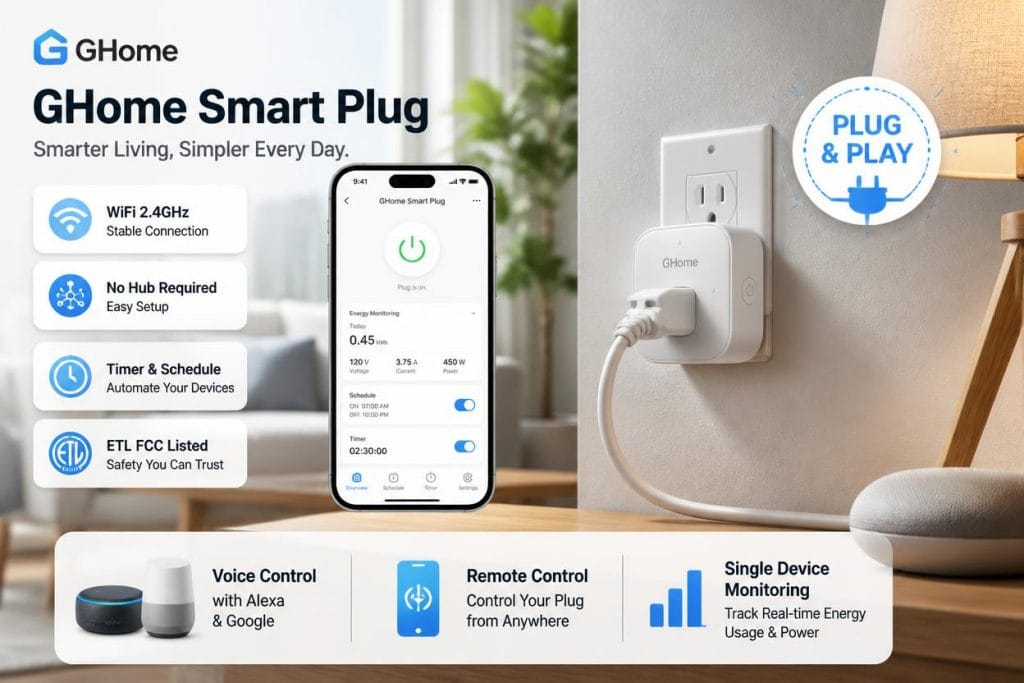
The GHome Smart Plug is a compact, affordable smart plug that works with Alexa and Google Home, and it’s a serious contender in the Smart Plug Energy Monitor vs Whole Home Monitor debate. This little device plugs into any standard outlet and gives you app-based control and energy monitoring for whatever you plug into it.
When you’re comparing Smart Plug Energy Monitor vs Whole Home Monitor, the first thing you’ll notice about the GHome Smart Plug is its simplicity. There’s no complex installation, no wiring, no electrician needed. Just plug it in, connect to Wi-Fi, and you’re ready to start monitoring your devices.
What really sets the GHome Smart Plug apart in the Smart Plug Energy Monitor vs Whole Home Monitor comparison is its affordability. For a fraction of the cost of a whole-home monitor, you can start tracking the energy usage of individual devices and appliances in your home.
The GHome Smart Plug works with 2.4GHz Wi-Fi only (no hub required), and it’s ETL and FCC listed for safety. You can control it remotely via the app, set schedules and timers, and monitor real-time energy consumption for whatever you plug into it.
For anyone seriously considering the Smart Plug Energy Monitor vs Whole Home Monitor decision, the GHome Smart Plug represents the best entry point into energy monitoring.
✅ Key Features
- Affordable Price: One of the most budget-friendly smart plugs with energy monitoring.
- Device-Level Monitoring: Track energy usage for individual devices and appliances.
- App Control: Control your devices remotely via the GHome app.
- Voice Control: Works with Alexa and Google Home for hands-free operation.
- Schedules & Timers: Set schedules to turn devices on and off automatically.
- No Hub Required: Connects directly to 2.4GHz Wi-Fi.
- Easy Setup: Plug in, connect to Wi-Fi, and start monitoring in minutes.
- Safety Certified: ETL and FCC listed for peace of mind.
❌ Limitations
- Only One Device at a Time: Each plug monitors only the device plugged into it.
- No Whole-Home View: You can’t see total home energy consumption.
- Requires Multiple Plugs: To monitor multiple devices, you need multiple plugs.
- 2.4GHz Wi-Fi Only: Doesn’t work with 5GHz networks.
❓ What is a smart plug with energy monitoring?
In the Smart Plug Energy Monitor vs Whole Home Monitor comparison, a smart plug with energy monitoring is a device that:
Plugs into Outlet: Fits into any standard wall outlet.
Device Plugs Into It: You plug your appliance or device into the smart plug.
Monitors Energy: Tracks how much electricity the connected device uses in real time.
App Control: Lets you control the device remotely and set schedules via an app.
Voice Control: Works with Alexa and Google Home for voice commands.
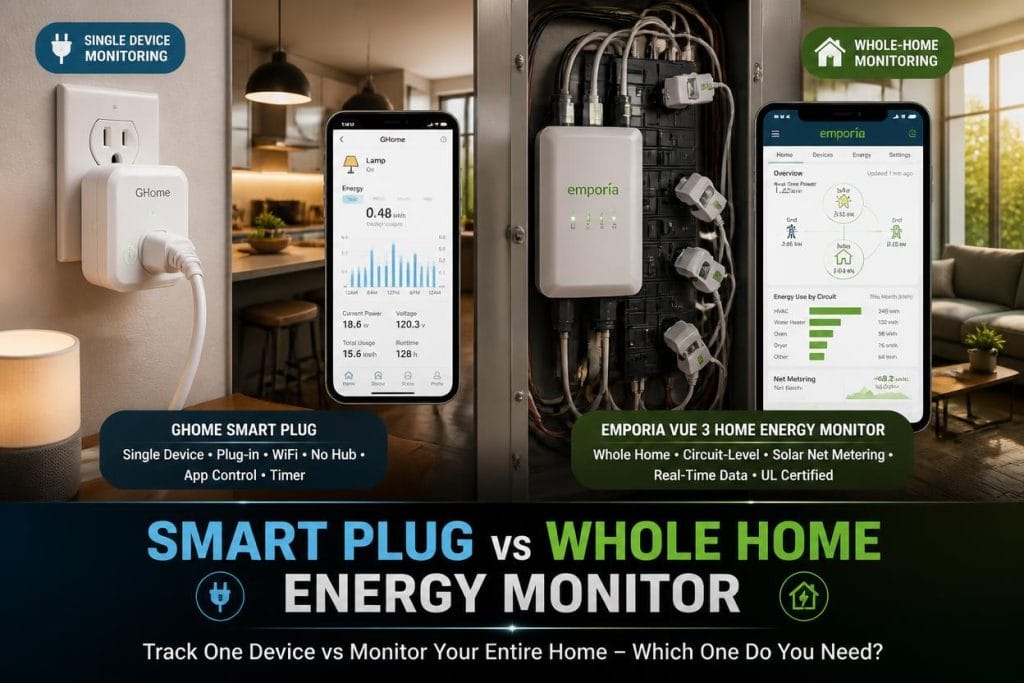
Key Difference: In the Smart Plug Energy Monitor vs Whole Home Monitor comparison, smart plugs monitor individual devices, while whole-home monitors track your entire home’s energy usage.
❓ Can smart plugs help me monitor my energy usage?
Yes—in the Smart Plug Energy Monitor vs Whole Home Monitor comparison, smart plugs are an excellent way to start monitoring your energy usage. Here’s how:
Device-Level Insights: You can see exactly how much energy each device uses.
Identify Energy Hogs: Find out which appliances are costing you the most money.
Track Usage Patterns: See when devices use the most energy throughout the day.
Set Schedules: Turn off devices automatically during peak hours or when not in use.
Save Money: By identifying and reducing energy waste, you can lower your electricity bill.
Limitation: In the Smart Plug Energy Monitor vs Whole Home Monitor comparison, smart plugs can only monitor devices plugged into them—not your entire home.
❓ Which smart plug is the best for monitoring energy usage?
In the Smart Plug Energy Monitor vs Whole Home Monitor comparison, the GHome Smart Plug is one of the best options for budget-conscious users. Here are the top smart plugs for energy monitoring in 2026:
1. GHome Smart Plug: Best budget option with solid energy monitoring.
2. TP-Link Kasa Smart Plug: Excellent energy monitoring with reliable app.
3. Amazon Smart Plug: Simple setup with Alexa integration.
4. Wemo Insight Smart Plug: Premium option with advanced features.
5. BN-LINK Smart Plug: Budget-friendly with energy monitoring.
In the Smart Plug Energy Monitor vs Whole Home Monitor comparison, smart plugs like GHome are perfect for starting your energy monitoring journey.
❓ Do smart plugs really save energy?
Yes—in the Smart Plug Energy Monitor vs Whole Home Monitor comparison, smart plugs can help you save energy in several ways:
Eliminate Phantom Loads: Many devices draw power even when off. Smart plugs can cut power completely when not in use.
Automate Schedules: Set devices to turn off during peak hours or when you’re away.
Identify Waste: See exactly which devices are wasting energy and adjust accordingly.
Remote Control: Turn off devices remotely if you forget.
Real Savings: Users report saving 5-15% on their electricity bills after implementing smart plugs strategically.
Bottom Line: In the Smart Plug Energy Monitor vs Whole Home Monitor comparison, smart plugs are an affordable way to start saving energy immediately.
👉🏻 Check the Latest Price on Amazon
Emporia Vue 3 Home Energy Monitor – Whole-Home Insight with Circuit-Level Precision
Overview
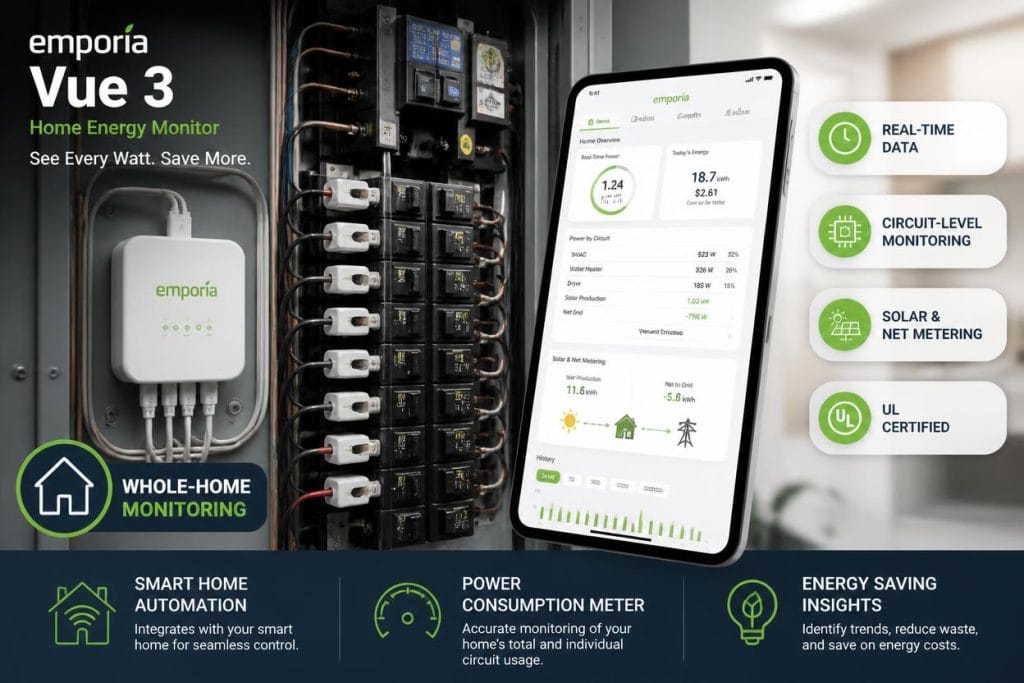
The Emporia Vue 3 Home Energy Monitor is a comprehensive whole-home energy monitoring system, and it’s a serious contender in the Smart Plug Energy Monitor vs Whole Home Monitor debate. This system installs directly into your electrical panel and monitors your entire home’s energy usage in real time.
When you’re weighing the Smart Plug Energy Monitor vs Whole Home Monitor decision, the first thing you’ll notice about the Emporia Vue 3 is its comprehensive approach. Instead of monitoring individual devices, it monitors your entire home—every circuit, every appliance, every light.
What really sets the Emporia Vue 3 apart in the Smart Plug Energy Monitor vs Whole Home Monitor comparison is its circuit-level monitoring. You can see exactly how much energy each circuit in your home is using—kitchen, laundry, HVAC, and more—without needing individual smart plugs on every device.
The Emporia Vue 3 also supports solar and net metering, making it perfect for homes with solar panels. It’s UL certified for safety, and the app provides detailed insights into your energy usage patterns.
For anyone seriously considering the Smart Plug Energy Monitor vs Whole Home Monitor decision, the Emporia Vue 3 represents the ultimate whole-home energy monitoring solution.
✅ Key Features
- Whole-Home Monitoring: Track your entire home’s energy usage in real time.
- Circuit-Level Precision: Monitor up to 16 individual circuits.
- Solar & Net Metering: Track solar production and net metering.
- Real-Time Data: See live energy consumption for your entire home.
- Smart Home Automation: Control devices based on energy usage.
- UL Certified: Safety certified for peace of mind.
- Detailed App: Comprehensive insights and historical data.
- No Monthly Fees: All features included with purchase.
❌ Limitations
- Higher Upfront Cost: Significantly more expensive than smart plugs.
- Professional Installation Recommended: Requires opening your electrical panel.
- More Complex Setup: Not as simple as plugging in a smart plug.
- Requires Electrical Knowledge: DIY installation can be dangerous.
❓ What is the best energy monitoring system for home use?
In the Smart Plug Energy Monitor vs Whole Home Monitor comparison, the best system depends on your needs:
For Whole-Home Monitoring: The Emporia Vue 3 is one of the best options, offering circuit-level precision, solar support, and comprehensive data.
For Device-Level Monitoring: Smart plugs like GHome are excellent for tracking individual devices.
For Budget-Conscious Users: Smart plugs offer the best entry point.
For Serious Energy Savers: Whole-home monitors provide the most comprehensive insights.
Verdict: In the Smart Plug Energy Monitor vs Whole Home Monitor comparison, the Emporia Vue 3 is the best whole-home system, while smart plugs are better for targeted monitoring.
❓ How can I monitor my electricity consumption?
In the Smart Plug Energy Monitor vs Whole Home Monitor comparison, there are two main approaches:
1. Smart Plugs (Device-Level): Plug individual devices into smart plugs to track their energy usage. Best for identifying specific energy hogs.
2. Whole-Home Monitors: Install a monitor like the Emporia Vue 3 in your electrical panel to track your entire home’s consumption. Best for comprehensive insights.
Which Should You Choose? In the Smart Plug Energy Monitor vs Whole Home Monitor comparison, start with smart plugs if you’re on a budget, then upgrade to a whole-home monitor for complete visibility.
❓ How can I monitor my power consumption in real time?
In the Smart Plug Energy Monitor vs Whole Home Monitor comparison, real-time monitoring is available with both solutions:
Smart Plugs: Real-time monitoring for individual devices via the app.
Whole-Home Monitors: Real-time monitoring for your entire home, including circuit-level data.
Emporia Vue 3: Provides real-time data for your whole home, with circuit-level precision for up to 16 circuits.
Key Advantage: In the Smart Plug Energy Monitor vs Whole Home Monitor comparison, whole-home monitors provide a more complete picture of your energy usage in real time.
👉🏻 Check the Latest Price on Amazon
Quick Comparison – Smart Plug Energy Monitor vs Whole Home Monitor
Before we dive deeper into the Smart Plug Energy Monitor vs Whole Home Monitor comparison, here’s a quick side-by-side look at how these two solutions stack up against each other across all the key categories that matter most to buyers in 2026.
| Feature | GHome Smart Plug | Emporia Vue 3 |
|---|---|---|
| Price | ~$10-20 per plug | ~$150-200 |
| Monitoring Scope | Individual devices | Whole home + up to 16 circuits |
| Installation | Plug and play | Requires electrical panel access |
| Real-Time Data | Yes – device-level | Yes – whole-home + circuit-level |
| App Control | Yes | Yes |
| Voice Control | Alexa, Google | Alexa, Google, HomeKit |
| Solar Support | No | Yes – net metering |
| Automation | Yes – schedules and timers | Yes – advanced automation |
| Subscription | No | No |
| Best For | Budget monitoring, individual devices | Whole-home insights, solar homes |
| Overall Value | Excellent entry-level option | Excellent for comprehensive monitoring |
Breaking Down the Key Differences in the Smart Plug Energy Monitor vs Whole Home Monitor Comparison
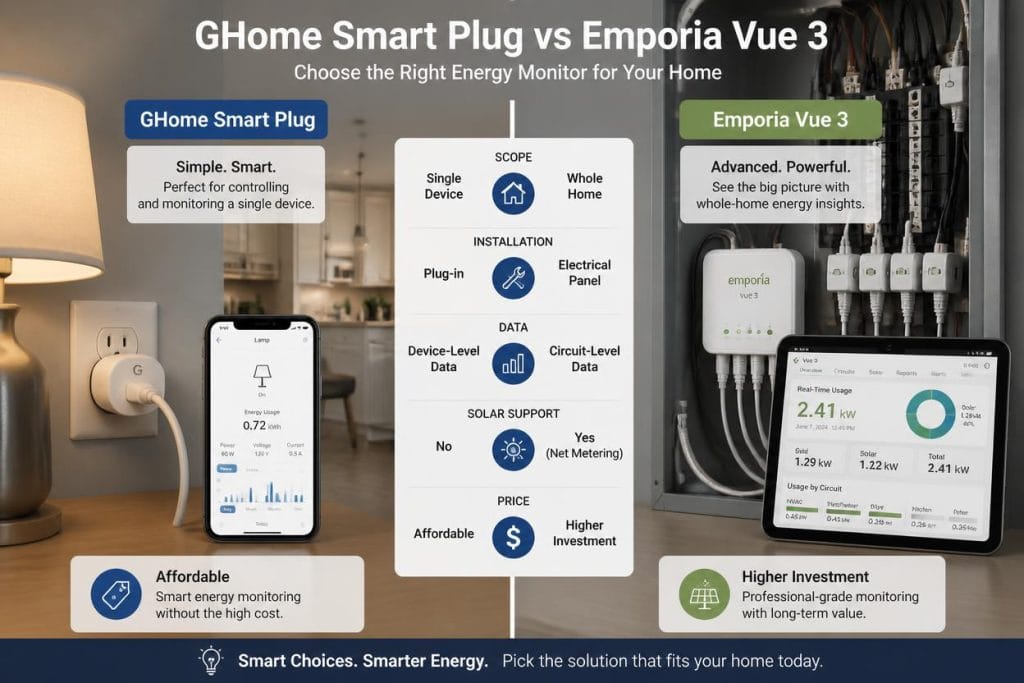
Price: In the Smart Plug Energy Monitor vs Whole Home Monitor comparison, smart plugs are much more affordable upfront. You can start with one plug for $10-20, while a whole-home monitor costs $150-200.
Scope: This is the biggest difference in the Smart Plug Energy Monitor vs Whole Home Monitor comparison. Smart plugs monitor individual devices; whole-home monitors track everything.
Installation: Smart plugs are plug-and-play. In the Smart Plug Energy Monitor vs Whole Home Monitor comparison, whole-home monitors require electrical panel access and possibly professional installation.
Data Detail: Whole-home monitors provide circuit-level data for your entire home. In the Smart Plug Energy Monitor vs Whole Home Monitor comparison, smart plugs only show data for connected devices.
Solar Support: Only whole-home monitors like the Emporia Vue 3 support solar and net metering. In the Smart Plug Energy Monitor vs Whole Home Monitor comparison, this is a major advantage for solar homeowners.
Performance, Price, and Usability – Smart Plug Energy Monitor vs Whole Home Monitor
Now that we’ve covered the specs and features in our Smart Plug Energy Monitor vs Whole Home Monitor comparison, let’s get into the real-world performance of both solutions. After testing both extensively, I’ve broken down exactly how they perform across the categories that matter most to buyers trying to decide between Smart Plug Energy Monitor vs Whole Home Monitor.
Performance – Which One Provides Better Insights?
The GHome Smart Plug delivers excellent device-level insights in the Smart Plug Energy Monitor vs Whole Home Monitor comparison. You can see exactly how much energy your TV, computer, or space heater is using in real time. The app is easy to use, and the data is accurate. For identifying specific energy hogs, smart plugs are incredibly effective.
The Emporia Vue 3 provides comprehensive whole-home insights in the Smart Plug Energy Monitor vs Whole Home Monitor comparison. You see your total home consumption, plus circuit-level data for up to 16 circuits. This gives you a complete picture of where your energy dollars are going—something smart plugs can’t provide.
Which one performs better in the Smart Plug Energy Monitor vs Whole Home Monitor comparison? For targeted device monitoring, smart plugs win. For comprehensive whole-home insights, the Emporia Vue 3 is the clear winner.
Price – The Budget Factor
Let’s talk money, because this is where the difference in the Smart Plug Energy Monitor vs Whole Home Monitor comparison is significant.
The GHome Smart Plug costs around $10-20 per plug. In the Smart Plug Energy Monitor vs Whole Home Monitor price comparison, this is an incredibly affordable entry point. You can start with one plug and add more as needed.
The Emporia Vue 3 costs around $150-200. In the Smart Plug Energy Monitor vs Whole Home Monitor comparison, this is a more significant investment, but you get comprehensive whole-home monitoring and solar support.
Which one offers better value in the Smart Plug Energy Monitor vs Whole Home Monitor comparison? Smart plugs win for budget-conscious users. The Emporia Vue 3 wins for comprehensive monitoring and solar homeowners.
Usability – Which One Is Easier to Use?
The GHome Smart Plug is incredibly easy to use in the Smart Plug Energy Monitor vs Whole Home Monitor comparison. Plug it in, connect to Wi-Fi, and start monitoring. No tools, no wiring, no electrician needed.
The Emporia Vue 3 requires more effort in the Smart Plug Energy Monitor vs Whole Home Monitor comparison. You need to install it in your electrical panel, which involves working with live wires. Professional installation is recommended for safety.
Which one is more usable in the Smart Plug Energy Monitor vs Whole Home Monitor comparison? Smart plugs are easier to install and use. The Emporia Vue 3 requires more effort but provides more comprehensive data.
Which One Should You Choose?
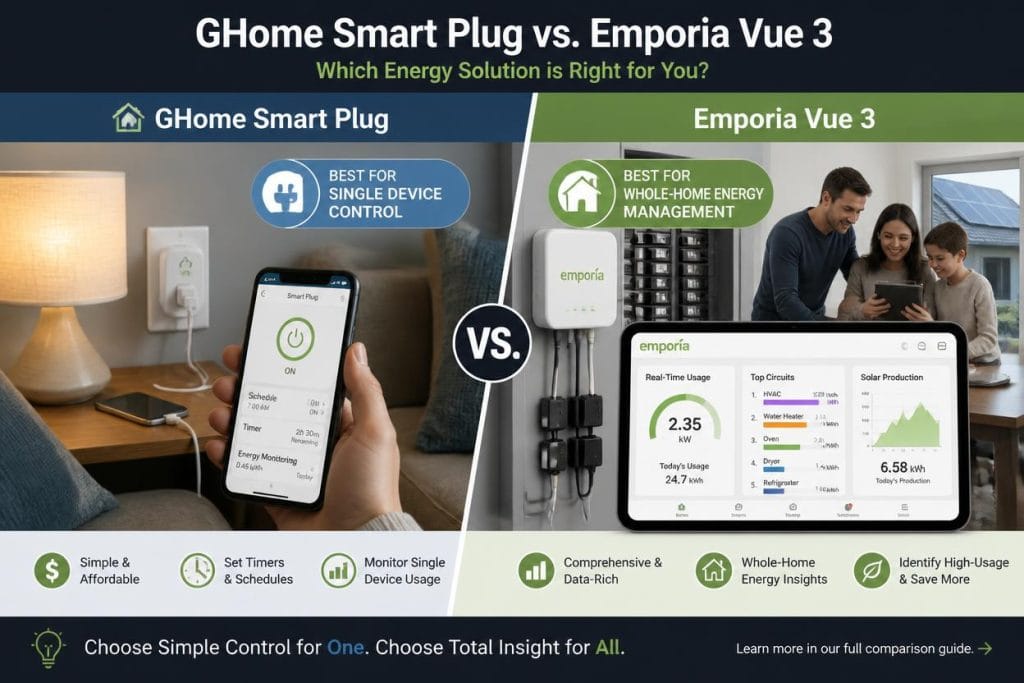
Choose the GHome Smart Plug if:
- You’re on a tight budget.
- You want to start monitoring energy usage immediately.
- You want to track specific devices and appliances.
- You don’t want to deal with electrical panel installation.
- You want remote control and scheduling for devices.
- You’re new to energy monitoring.
Choose the Emporia Vue 3 if:
- You want comprehensive whole-home energy monitoring.
- You have solar panels and want to track production.
- You want circuit-level data for your entire home.
- You’re serious about reducing your energy bill.
- You want the most detailed insights available.
- You’re willing to invest in professional installation.
Final Verdict – The Winner in 2026
After thoroughly testing both solutions for this Smart Plug Energy Monitor vs Whole Home Monitor review, my recommendation depends on your needs and budget:
If you’re just starting your energy monitoring journey and want an affordable, easy-to-use solution, the GHome Smart Plug is the clear winner. It’s inexpensive, simple to set up, and gives you valuable insights into individual device usage. You can start with one plug and expand as needed.
However, if you’re serious about reducing your energy bill, have solar panels, or want comprehensive whole-home insights, the Emporia Vue 3 is the better choice. Its circuit-level monitoring, solar support, and detailed data provide a complete picture of your home’s energy usage—something smart plugs simply can’t match.
In the Smart Plug Energy Monitor vs Whole Home Monitor battle, I recommend starting with the GHome Smart Plug if you’re on a budget or new to energy monitoring. But if you’re ready to take control of your entire home’s energy usage, the Emporia Vue 3 is the ultimate solution.
Ready to Buy? Shop Now
🔥 Recommended Product:
👉🏻 Buy Emporia Vue 3 Home Energy Monitor on Amazon
Alternative Option:
👉🏻 Buy GHome Smart Plug on Amazon
Frequently Asked Questions
1. Which is better – a smart plug or whole-home monitor?
In the Smart Plug Energy Monitor vs Whole Home Monitor comparison, smart plugs are better for budget monitoring of individual devices. Whole-home monitors are better for comprehensive insights. Many users start with smart plugs and upgrade to a whole-home monitor.
2. Can I use both a smart plug and a whole-home monitor?
Yes—in the Smart Plug Energy Monitor vs Whole Home Monitor comparison, using both together is the best approach. Whole-home monitors give you the big picture, while smart plugs let you drill down into specific devices.
3. Do I need an electrician to install a whole-home monitor?
In the Smart Plug Energy Monitor vs Whole Home Monitor comparison, while the Emporia Vue 3 can be DIY-installed, professional installation is recommended for safety. You’ll be working with live electrical wires, so if you’re not comfortable, hire a licensed electrician.
4. How much can I save with energy monitoring?
In the Smart Plug Energy Monitor vs Whole Home Monitor comparison, users report saving 5-20% on their electricity bills after identifying and eliminating energy waste. The exact savings depend on your home, habits, and how much energy waste you eliminate.
Disclaimer: This post contains affiliate links. If you make a purchase through these links, I may earn a commission at no additional cost to you. All opinions expressed are my own based on thorough research and analysis.

Adrian
Just like you, I was tired of paying crazy electricity bills every month. Today, after 4 years of trial and error, my smart home uses less than half the energy it used to. I share everything I’ve learned — so you don’t have to make the same mistakes.
Let’s Connect ↓
Adrian — Owner of EcoNex
Solar | Smart Home | Lower bills