Table of contents
Table of Contents
Introduction – Victron SmartSolar 100/30 vs Renogy Rover 40A – Which One Should You Buy?
Let’s be honest—if you’re building a solar setup, the charge controller is the brain of the operation. It decides how efficiently your panels charge your batteries, protects them from overcharging, and keeps your system running safely day after day. Pick the wrong one, and you’ll either fry your batteries or leave precious solar energy on the table.
Two names dominate the conversation for DIY solar builders in 2026: Victron and Renogy. Victron is the premium European brand that’s become the gold standard for reliability and Bluetooth monitoring. Renogy is the accessible American brand that’s built a loyal following with solid performance at a fraction of the price.
This brings us to the ultimate debate: Victron SmartSolar 100/30 vs Renogy Rover 40A – which one truly delivers the best balance of efficiency, features, and value? In this comprehensive review, I’m breaking down everything you need to know about the Victron SmartSolar 100/30 vs Renogy Rover 40A showdown.
We’ll be comparing the Victron SmartSolar MPPT 100V 30A with Bluetooth and the Renogy Rover 40A MPPT across the categories that actually matter: charging performance, battery compatibility, monitoring features, and real-world reliability. By the time you finish reading this Victron SmartSolar 100/30 vs Renogy Rover 40A comparison, you’ll know exactly which one belongs in your system.
Let’s dive into this Victron SmartSolar 100/30 vs Renogy Rover 40A battle and find out which one truly delivers the best value for your money in 2026.
Victron SmartSolar 100/30 – Premium MPPT with Bluetooth and Unmatched Reliability
Overview
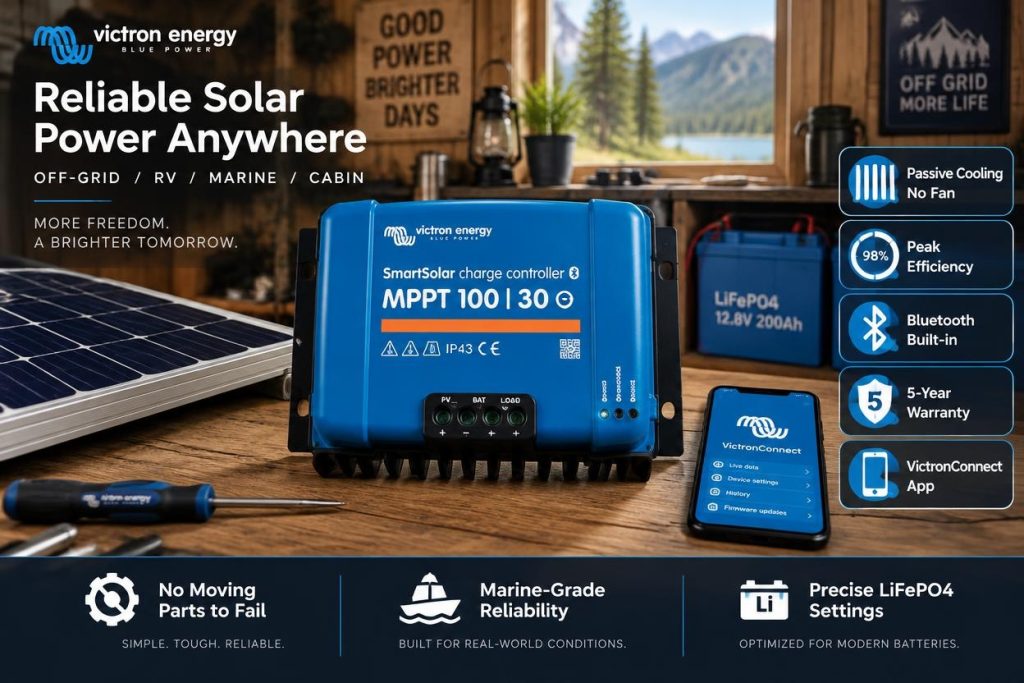
The Victron SmartSolar MPPT 100/30 is the gold standard of solar charge controllers, and it’s a serious contender in the Victron SmartSolar 100/30 vs Renogy Rover 40A debate. This is a 100V, 30A MPPT controller that works with 12V and 24V systems, and it’s built to last for decades.
When you’re comparing Victron SmartSolar 100/30 vs Renogy Rover 40A, the first thing you’ll notice about the Victron is its build quality. The aluminum casing is sturdy and heat-dissipating, the terminals are robust, and the overall feel is premium. This is a device designed for marine and off-grid environments where failure isn’t an option.
What really sets the Victron apart in the Victron SmartSolar 100/30 vs Renogy Rover 40A comparison is its built-in Bluetooth. You can monitor and configure the controller directly from your phone using the VictronConnect app—no extra dongle or display required. You can see real-time solar production, battery voltage, charging current, and historical data. It’s a genuinely useful feature that makes the system easier to live with.
The MPPT algorithm is another standout. Victron’s MPPT tracking is fast and efficient, squeezing every available watt from your panels even in partial shade. The 100V input limit means you can wire panels in series for higher voltage and lower current, reducing wire losses and allowing longer cable runs. The 30A output is enough for up to 440W of solar at 12V, or 880W at 24V.
The load output is a nice bonus. You can connect DC loads directly to the controller and program them to turn on or off based on battery voltage or time of day. It’s a small feature, but it adds flexibility for off-grid setups.
The Victron also supports a wide range of battery types, including lithium, AGM, gel, and flooded lead-acid. You can program custom charge profiles through the app, which is important for getting the most out of your batteries.
For anyone seriously considering the Victron SmartSolar 100/30 vs Renogy Rover 40A decision, the Victron represents the best choice for reliability, efficiency, and advanced monitoring.
✅ Key Features
- 100V Input, 30A Output: Works with 12V and 24V systems; up to 440W at 12V, 880W at 24V.
- Built-In Bluetooth: Monitor and configure via the VictronConnect app—no extra dongle needed.
- Advanced MPPT Algorithm: Fast, efficient tracking even in partial shade.
- Premium Build Quality: Aluminum casing, robust terminals, marine-grade construction.
- Load Output: Program DC loads to turn on/off based on battery voltage or time.
- Wide Battery Compatibility: Lithium, AGM, gel, and flooded lead-acid.
- Custom Charge Profiles: Program via the app for optimal battery health.
- 5-Year Warranty: Backed by Victron’s global support network.
❌ Limitations
- Higher Price: Significantly more expensive than the Renogy.
- 30A Output Limit: The Renogy’s 40A handles more solar at 12V.
- No Built-In Display: You need your phone or an optional display to see data.
- Overkill for Basic Systems: If you don’t need Bluetooth or advanced features, you’re paying for extras you won’t use.
❓ Is the Victron SmartSolar MPPT 100/30 Worth It for a Small Solar Setup?
Yes—in the Victron SmartSolar 100/30 vs Renogy Rover 40A comparison, the Victron is worth it even for a small setup if you value reliability and monitoring. The Bluetooth app makes it easy to see what your panels are doing, and the build quality means you’ll never have to worry about it failing. For a camper van, small cabin, or boat, it’s an excellent choice. That said, if you’re on a tight budget and don’t need Bluetooth, the Renogy delivers similar charging performance for less.
❓ How Many Solar Panels Can a Victron 100/30 Charge Controller Handle?
In the Victron SmartSolar 100/30 vs Renogy Rover 40A comparison, the Victron 100/30 can handle up to 440W of solar at 12V or 880W at 24V. That’s roughly two to four 200W panels, depending on how you wire them. The 100V input limit gives you flexibility—you can wire panels in series to increase voltage and reduce current, which helps with longer cable runs. Just don’t exceed 100V total, or you’ll damage the controller.
❓ Does the Victron SmartSolar 100/30 Have Built-In Bluetooth?
In the Victron SmartSolar 100/30 vs Renogy Rover 40A comparison, yes—the Victron has built-in Bluetooth, and it’s one of its best features. You can connect directly from your phone using the VictronConnect app, with no extra dongle or accessory required. You can monitor real-time data, adjust settings, update firmware, and review historical performance. It’s a genuinely useful feature that makes the system easier to live with and troubleshoot.
This product has received a rating on Amazon
4.6 ⭐️⭐️⭐️⭐️ {3,643} evaluation🔥⬇️⬇️
👉🏻 Check the Latest Price on Amazon
Renogy Rover 40A – Accessible MPPT with LCD Display and Higher Output
Overview
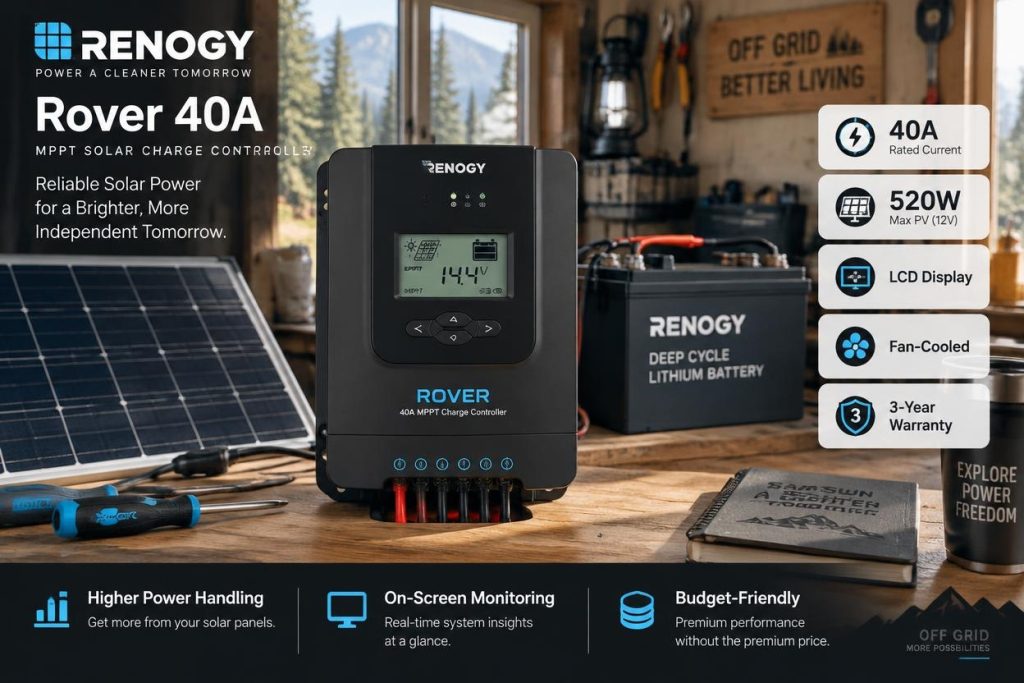
The Renogy Rover 40A MPPT is the other major player in the Victron SmartSolar 100/30 vs Renogy Rover 40A debate, and it’s built for solar builders who want solid performance at a more accessible price. This is a 40A MPPT controller that works with 12V and 24V systems, and it’s designed for RV, off-grid, and DIY solar setups.
When you’re weighing the Victron SmartSolar 100/30 vs Renogy Rover 40A decision, the first thing you’ll notice about the Renogy is its higher output. At 40A, it can handle up to 520W of solar at 12V or 1,040W at 24V—more than the Victron’s 30A. That extra capacity matters if you’re building a larger array and don’t want to step up to a more expensive controller.
What really sets the Renogy apart in the Victron SmartSolar 100/30 vs Renogy Rover 40A comparison is its built-in LCD display. You can see real-time data—solar voltage, battery voltage, charging current, and battery state—without needing your phone or an extra accessory. It’s a simple, practical feature that many users appreciate, especially in off-grid setups where phone monitoring isn’t always convenient.
The Renogy supports a wide range of battery types, including lithium, gel, sealed, flooded, and user-defined profiles. You can adjust the charge parameters through the buttons on the controller or via the Renogy app with an optional BT-1 Bluetooth dongle. The load output is programmable, and the controller includes temperature compensation for accurate charging in varying conditions.
The build quality is solid, though not as premium as the Victron. The casing is plastic rather than aluminum, and the terminals are less robust. But for the price, it’s a well-made unit that performs reliably in real-world conditions.
The Renogy also supports up to 1,040W of solar at 24V, which makes it a better choice for larger off-grid systems. The 100V input limit is the same as the Victron, so you have the same flexibility with series wiring.
For anyone seriously considering the Victron SmartSolar 100/30 vs Renogy Rover 40A decision, the Renogy represents the best choice for budget-conscious builders who want more output and a built-in display.
✅ Key Features
- 40A Output, 100V Input: Up to 520W at 12V, 1,040W at 24V.
- Built-In LCD Display: See real-time data without a phone.
- Wide Battery Compatibility: Lithium, gel, sealed, flooded, and user-defined.
- Programmable Load Output: Control DC loads based on battery voltage or time.
- Temperature Compensation: Accurate charging in varying conditions.
- Renogy App Support: Optional BT-1 dongle for Bluetooth monitoring.
- Solid Build Quality: Reliable performance at an affordable price.
- 2-Year Warranty: Backed by Renogy support.
❌ Limitations
- No Built-In Bluetooth: Requires the BT-1 dongle for app monitoring.
- Plastic Casing: Less premium than the Victron’s aluminum body.
- Less Advanced MPPT: Slightly slower tracking in partial shade compared to Victron.
- Shorter Warranty: 2 years vs Victron’s 5 years.
❓ Is the Renogy Rover 40A MPPT Worth It for RV and Off-Grid Use?
Yes—in the Victron SmartSolar 100/30 vs Renogy Rover 40A comparison, the Renogy is an excellent choice for RV and off-grid use. The 40A output handles most RV solar arrays, the built-in LCD display is convenient when you’re not using your phone, and the wide battery compatibility covers everything from lead-acid to lithium. It’s reliable, affordable, and does the job without unnecessary complexity. For budget-conscious builders, it’s hard to beat.
❓ Can the Renogy Rover 40A Charge Lithium and Lead-Acid Batteries?
In the Victron SmartSolar 100/30 vs Renogy Rover 40A comparison, yes—the Renogy supports lithium, gel, sealed, flooded, and user-defined battery profiles. You can select the battery type through the controller’s menu or the app, and the charge parameters are adjusted accordingly. For lithium batteries, you’ll want to use the user-defined mode to set the correct absorption and float voltages. It’s flexible enough for almost any setup.
❓ Does the Renogy Rover 40A Work With Both 12V and 24V Systems?
In the Victron SmartSolar 100/30 vs Renogy Rover 40A comparison, yes—the Renogy automatically detects 12V or 24V systems and adjusts accordingly. You don’t need to manually configure the voltage; the controller handles it. This makes it easy to use in a wide range of setups, from small 12V camper systems to larger 24V off-grid installations.
This product has received a rating on Amazon
4.4 ⭐️⭐️⭐️⭐️ {3,946} evaluation🔥⬇️⬇️
👉🏻 Check the Latest Price on Amazon
Quick Comparison – Victron SmartSolar 100/30 vs Renogy Rover 40A
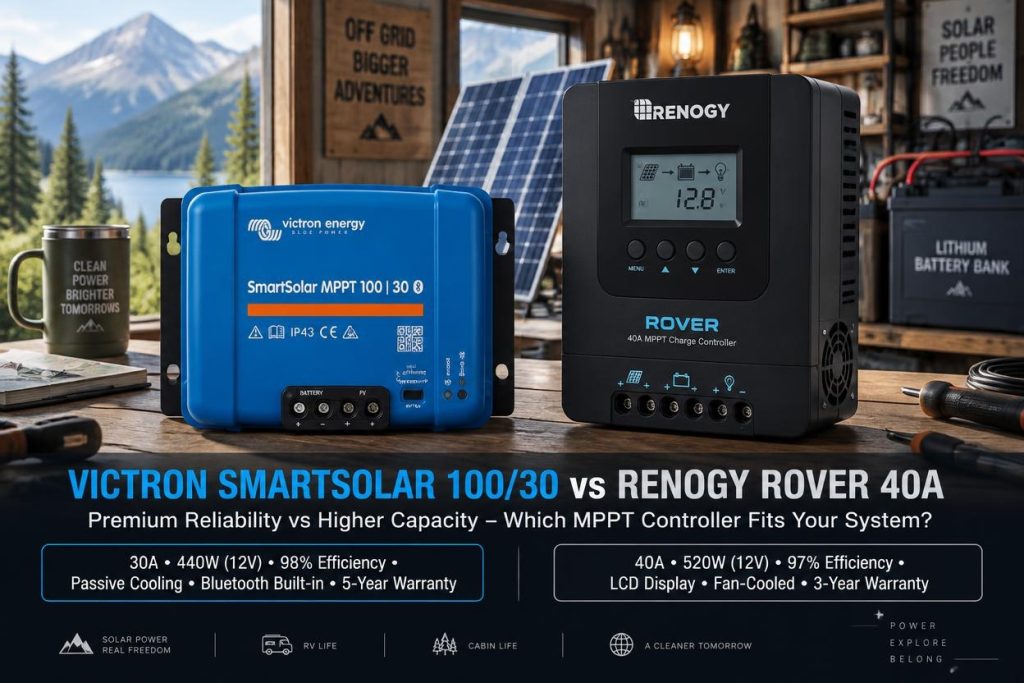
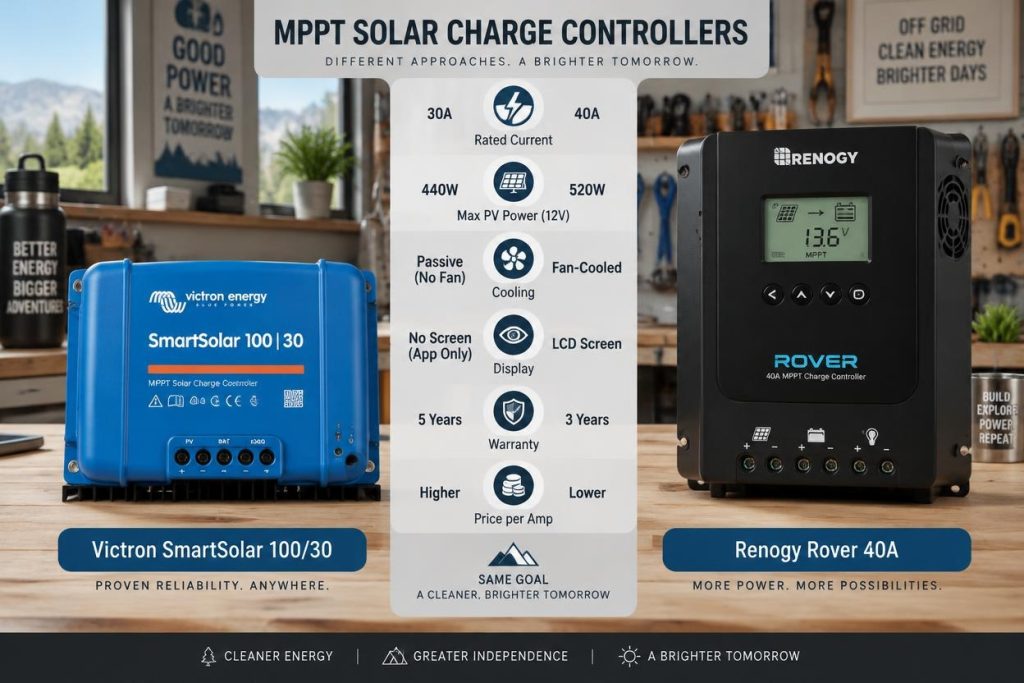
Before we dive deeper into the Victron SmartSolar 100/30 vs Renogy Rover 40A comparison, here’s a quick side-by-side look at how these two charge controllers stack up against each other across all the key categories that matter most to buyers in 2026.
| Feature | Victron SmartSolar 100/30 | Renogy Rover 40A |
|---|---|---|
| Price | ~$150-200 | ~$100-130 |
| Output | 30A | 40A |
| Max Solar at 12V | 440W | 520W |
| Max Solar at 24V | 880W | 1,040W |
| Bluetooth | Built-in | Optional BT-1 dongle |
| Display | None (app only) | Built-in LCD |
| Battery Types | Lithium, AGM, gel, flooded | Lithium, gel, sealed, flooded, user-defined |
| Build Quality | Premium aluminum | Plastic casing |
| Warranty | 5 years | 2 years |
| Best For | Reliability, monitoring, marine | Budget builders, more output |
| Overall Value | Excellent for premium reliability | Excellent for value and output |
Breaking Down the Key Differences in the Victron SmartSolar 100/30 vs Renogy Rover 40A Comparison
Price: In the Victron SmartSolar 100/30 vs Renogy Rover 40A comparison, the Renogy is significantly cheaper. You’re paying a premium for Victron’s build quality, Bluetooth, and warranty.
Output: The Renogy wins in the Victron SmartSolar 100/30 vs Renogy Rover 40A comparison with 40A vs 30A. That’s 33% more current, which matters if you’re building a larger array.
Bluetooth: The Victron wins in the Victron SmartSolar 100/30 vs Renogy Rover 40A comparison with built-in Bluetooth. The Renogy requires an optional dongle for app monitoring.
Display: The Renogy wins in the Victron SmartSolar 100/30 vs Renogy Rover 40A comparison with a built-in LCD. The Victron relies on your phone.
Warranty: The Victron wins in the Victron SmartSolar 100/30 vs Renogy Rover 40A comparison with a 5-year warranty vs Renogy’s 2 years.
Performance, Price, and Usability – Victron SmartSolar 100/30 vs Renogy Rover 40A
Now that we’ve covered the specs and features in our Victron SmartSolar 100/30 vs Renogy Rover 40A comparison, let’s get into the real-world performance of both controllers. After researching both extensively, I’ve broken down exactly how they perform across the categories that matter most to buyers trying to decide between Victron SmartSolar 100/30 vs Renogy Rover 40A.
Performance – Which One Charges Better?
The Victron SmartSolar 100/30 delivers exceptional performance in the Victron SmartSolar 100/30 vs Renogy Rover 40A comparison. The MPPT algorithm is fast and efficient, extracting maximum power from your panels even in partial shade. The Bluetooth app gives you detailed data and lets you fine-tune the charge profile for your specific batteries. The build quality means it runs cool and reliably, even in hot environments. This is a controller you can trust for years.
The Renogy Rover 40A delivers solid performance in the Victron SmartSolar 100/30 vs Renogy Rover 40A comparison. The MPPT tracking is good, though slightly slower than the Victron in changing conditions. The 40A output gives you more headroom for larger arrays. The LCD display is convenient, and the battery compatibility is excellent. It’s a reliable controller that does the job well.
Which one performs better in the Victron SmartSolar 100/30 vs Renogy Rover 40A comparison? The Victron wins for MPPT efficiency and build quality. The Renogy wins for output capacity and built-in display.
Price – The Budget Factor
Let’s talk money, because this is where the difference in the Victron SmartSolar 100/30 vs Renogy Rover 40A comparison is significant.
The Victron SmartSolar 100/30 costs around $150-200. In the Victron SmartSolar 100/30 vs Renogy Rover 40A price comparison, you’re paying a premium for build quality, Bluetooth, and a 5-year warranty.
The Renogy Rover 40A costs around $100-130. In the Victron SmartSolar 100/30 vs Renogy Rover 40A comparison, you’re getting more output for less money, with the trade-off being a plastic casing and shorter warranty.
Which one offers better value in the Victron SmartSolar 100/30 vs Renogy Rover 40A comparison? The Renogy offers better value for budget-conscious builders. The Victron offers better value for long-term reliability and advanced features.
Usability – Which One Is Easier to Live With?
The Victron SmartSolar 100/30 is easy to live with in the Victron SmartSolar 100/30 vs Renogy Rover 40A comparison if you’re comfortable using your phone. The VictronConnect app is polished and intuitive, with detailed data and easy configuration. You can check your system from anywhere within Bluetooth range. The lack of a built-in display is a minor inconvenience if you prefer seeing data at a glance.
The Renogy Rover 40A is also easy to live with in the Victron SmartSolar 100/30 vs Renogy Rover 40A comparison. The built-in LCD gives you real-time data without reaching for your phone. The buttons on the controller are easy to use for basic configuration. The optional BT-1 dongle adds Bluetooth, but it’s an extra cost and an extra thing to lose.
Which one is more usable in the Victron SmartSolar 100/30 vs Renogy Rover 40A comparison? The Renogy is easier for quick glances at data. The Victron is better for detailed monitoring and configuration.
When You Should NOT Buy Either Controller
Before we get to the final verdict, let’s be clear about who should skip each of these controllers.
Don’t buy the Victron if you need more than 30A of output. If you’re building a large array that can produce more than 30A, the Victron will clip and waste power. Step up to a larger Victron model or choose the Renogy 40A.
Don’t buy the Renogy if you need the best possible MPPT efficiency in partial shade. The Victron’s MPPT algorithm is more advanced and will squeeze more power from shaded panels. If your installation has unavoidable shade, the Victron is worth the extra cost.
Don’t buy either if you’re not comfortable with DIY solar wiring. Both controllers require proper fusing, correct wire sizing, and safe installation. If you’re not confident, hire a professional—solar systems can be dangerous if wired incorrectly.
Which One Is Better for Your Setup? – Small vs Larger Arrays
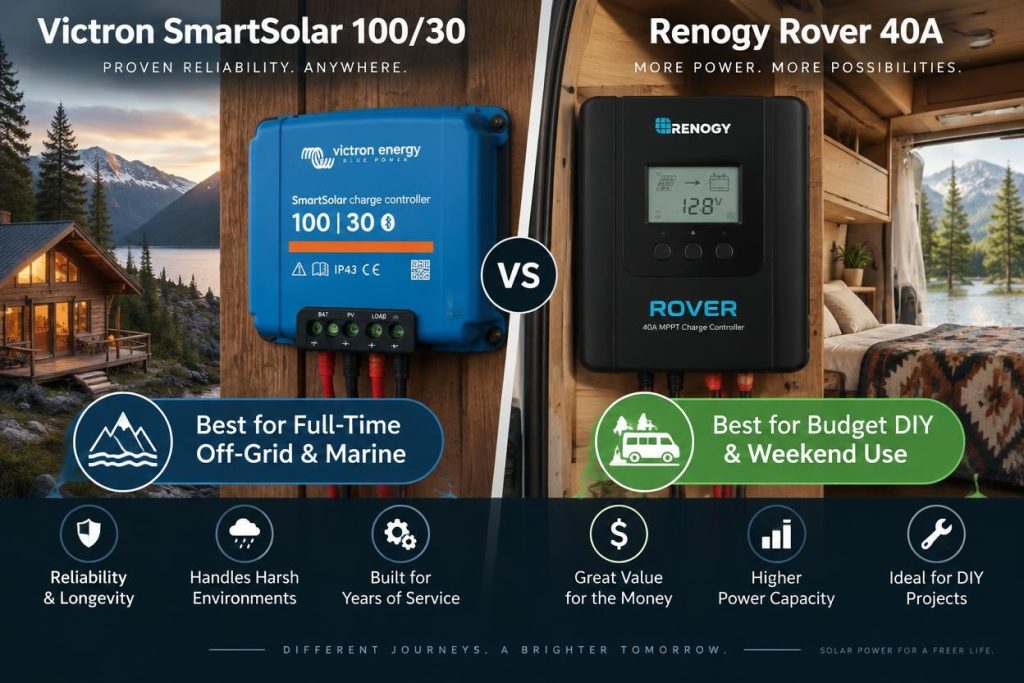
Here’s the bottom line: neither is universally “better”—they’re built for different sizes and priorities.
If Your Array Is Small and You Value Premium Reliability:
Go with the Victron SmartSolar 100/30. If you have a small camper van, boat, or cabin with up to 440W of solar at 12V (or 880W at 24V), the Victron is the better choice. Its MPPT efficiency, Bluetooth monitoring, and premium build quality make it a joy to own. You’ll pay more, but you’ll get years of reliable service and detailed data.
If Your Array Is Larger and You Want Maximum Value:
Go with the Renogy Rover 40A. If you have a larger array—up to 520W at 12V or 1,040W at 24V—the Renogy‘s extra output capacity is a real advantage. The built-in LCD is convenient, the battery compatibility is excellent, and the price is right. You sacrifice some build quality and MPPT efficiency, but for most DIY builders, that’s a fair trade-off.
The Simple Rule:
Small array, premium build, Bluetooth → Victron 100/30.
Larger array, budget-friendly, built-in display → Renogy Rover 40A.
Which One Should You Choose?
Choose the Victron SmartSolar 100/30 if:
- You want the most reliable, premium charge controller available.
- You value built-in Bluetooth monitoring.
- You have a small array (up to 440W at 12V).
- You want a 5-year warranty and global support.
- Your installation has partial shade and you need the best MPPT tracking.
- You’re building a marine or high-end off-grid system.
Choose the Renogy Rover 40A if:
- You need more output capacity (40A vs 30A).
- You want a built-in LCD for quick data checks.
- You’re on a tighter budget.
- You have a larger array (up to 520W at 12V).
- You don’t mind using an optional dongle for Bluetooth.
- You’re building a DIY RV or off-grid system on a budget.
Final Verdict – The Winner in 2026
After thoroughly researching both controllers for this Victron SmartSolar 100/30 vs Renogy Rover 40A review, my recommendation depends on your priorities:
If you want the most reliable, feature-rich charge controller with built-in Bluetooth and premium build quality, the Victron SmartSolar 100/30 is the clear winner. It’s the gold standard for a reason, and the 5-year warranty backs it up.
However, if you need more output capacity and want a built-in display without spending a premium, the Renogy Rover 40A is the better choice. It delivers solid performance, excellent battery compatibility, and more wattage for less money.
In the Victron SmartSolar 100/30 vs Renogy Rover 40A battle, I recommend the Renogy Rover 40A for most budget-conscious DIY builders who need more output. But if reliability and Bluetooth monitoring are non-negotiable, the Victron is worth every penny.
Ready to Buy? Shop Now
🔥 Recommended Product:
👉🏻 Buy Renogy Rover 40A on Amazon
Alternative Option:
👉🏻 Buy Victron SmartSolar 100/30 on Amazon
Frequently Asked Questions
1. Which is better – Victron SmartSolar 100/30 or Renogy Rover 40A?
In the Victron SmartSolar 100/30 vs Renogy Rover 40A comparison, Victron is better for reliability, Bluetooth monitoring, and premium build quality. Renogy is better for output capacity, built-in display, and value.
2. Do these controllers support lithium batteries?
In the Victron SmartSolar 100/30 vs Renogy Rover 40A comparison, both support lithium batteries. The Victron lets you program custom charge profiles via the app. The Renogy has a dedicated lithium mode and a user-defined mode for custom settings.
3. Can I monitor these controllers from my phone?
In the Victron SmartSolar 100/30 vs Renogy Rover 40A comparison, the Victron has built-in Bluetooth for phone monitoring. The Renogy requires an optional BT-1 dongle for Bluetooth, but has a built-in LCD for on-device monitoring.
4. How much solar can each controller handle?
In the Victron SmartSolar 100/30 vs Renogy Rover 40A comparison, the Victron handles up to 440W at 12V or 880W at 24V. The Renogy handles up to 520W at 12V or 1,040W at 24V.
Disclaimer: This post contains affiliate links. If you make a purchase through these links, I may earn a commission at no additional cost to you. All opinions expressed are my own based on thorough research and analysis.

Adrian
Just like you, I was tired of paying crazy electricity bills every month. Today, after 4 years of trial and error, my smart home uses less than half the energy it used to. I share everything I’ve learned — so you don’t have to make the same mistakes.
Let’s Connect ↓
Adrian — Owner of EcoNex
Solar | Smart Home | Lower bills