Table of contents
Table of Contents
Introduction – Redodo vs ECO-WORTHY 100Ah LiFePO4 – Which One Should You Buy?
Let’s be honest—if you’re still running lead-acid batteries in your RV, boat, or solar setup, you’re carrying dead weight. Literally. A traditional Group 31 AGM battery weighs around 60 pounds and lasts maybe three years if you’re lucky. A 100Ah LiFePO4 battery weighs a fraction of that, delivers more usable power, and can last a decade. The upgrade is a no-brainer for anyone who’s tired of replacing batteries every few seasons.
But here’s the challenge: the LiFePO4 market has exploded, and two names keep coming up in the conversation for budget-conscious buyers—Redodo and ECO-WORTHY. Both offer 12V 100Ah batteries with built-in BMS, both claim thousands of cycles, and both are priced competitively. But they’re built for different priorities, and picking the wrong one could leave you frustrated with a battery that doesn’t quite fit your setup.
This brings us to the ultimate debate: Redodo vs ECO-WORTHY 100Ah LiFePO4 – which one truly delivers the best balance of power, features, and value? In this comprehensive review, I’m breaking down everything you need to know about the Redodo vs ECO-WORTHY 100Ah LiFePO4 showdown.
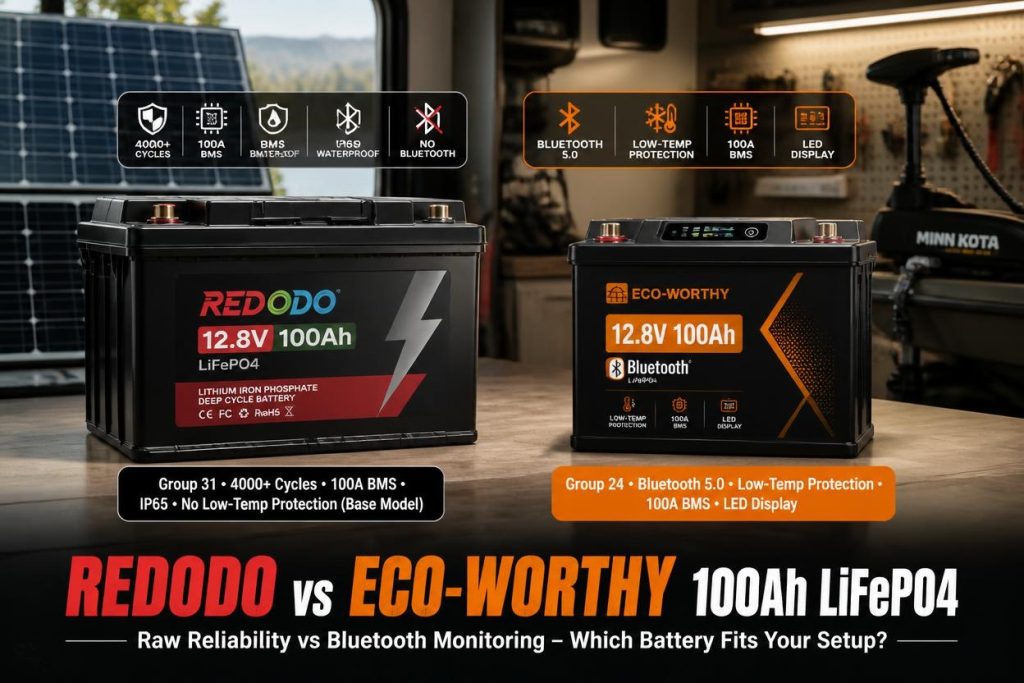
We’ll be comparing the Redodo 12V 100Ah Group 31 and the ECO-WORTHY 12V 100Ah Group 24 with Bluetooth across the categories that actually matter: BMS performance, physical fit, cold-weather protection, and real-world reliability. By the time you finish reading this Redodo vs ECO-WORTHY 100Ah LiFePO4 comparison, you’ll know exactly which one belongs in your battery bank.
Let’s dive into this Redodo vs ECO-WORTHY 100Ah LiFePO4 battle and find out which one truly delivers the best value for your money in 2026.
Redodo 12V 100Ah LiFePO4 – Group 31 Power with a Focus on Raw Performance
Overview
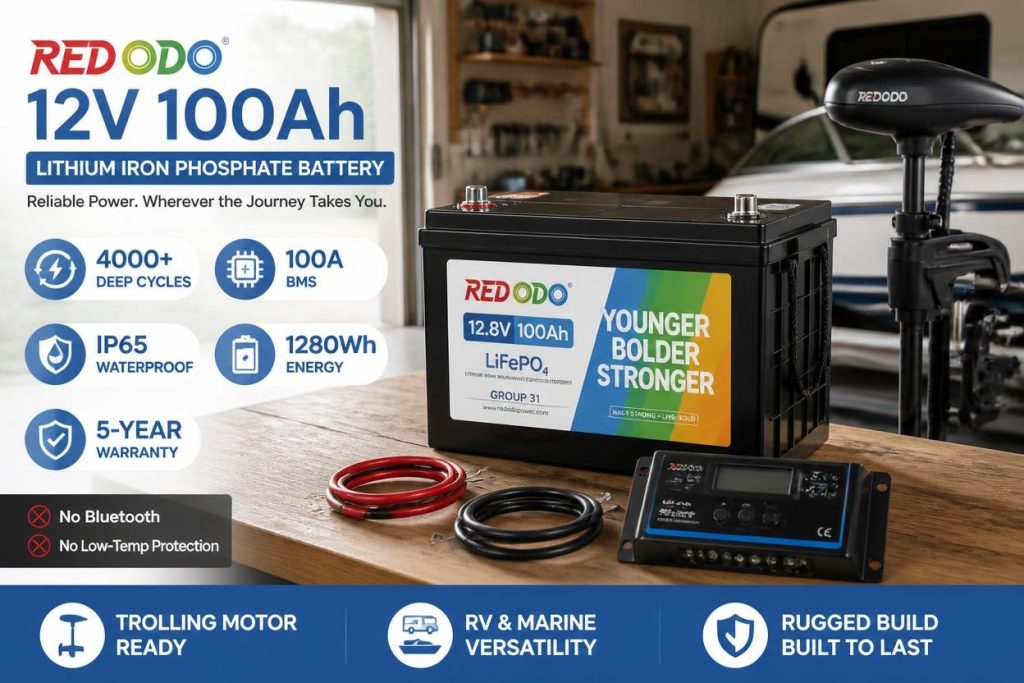
The Redodo 12V 100Ah LiFePO4 is a serious contender in the Redodo vs ECO-WORTHY 100Ah LiFePO4 debate, and it’s built for people who want maximum power in a standard Group 31 footprint. This battery is designed as a direct replacement for lead-acid Group 31 batteries, which means it fits in the same trays and compartments without modification.
When you’re comparing Redodo vs ECO-WORTHY 100Ah LiFePO4, the first thing you’ll notice about the Redodo is its focus on raw performance. The 100A BMS is designed to handle the surge demands of trolling motors, inverters, and other high-draw applications. Users report running 40lb thrust trolling motors all day and still having 50%+ charge left. One reviewer mentioned using it to power a 1000W kettle and a 743W sump pump after fixing a grounding issue, proving the BMS can handle heavy loads.
What really sets the Redodo apart in the Redodo vs ECO-WORTHY 100Ah LiFePO4 comparison is its build quality and cell grade. Redodo uses automotive-grade cells, and the battery is rated for 4,000+ deep cycles at 100% depth of discharge. That’s a lifespan of around 10 years with regular use. The IP65 waterproof rating means it can handle splashes and rain, though it’s not designed for full submersion.
The physical specs are impressive too. At just 22.58 pounds, it’s roughly a third of the weight of a comparable AGM battery. That’s a genuine upgrade for anyone who has to lug their battery in and out of a boat or RV. The Group 31 size means it fits in standard trays, and the terminals are oriented like a traditional lead-acid battery, making the swap straightforward.
However, the Redodo has one notable limitation in the Redodo vs ECO-WORTHY 100Ah LiFePO4 comparison: it doesn’t have Bluetooth monitoring. You get a basic battery, and you’ll need to rely on a separate shunt or monitor if you want to track state of charge. For some users, that’s fine—they just want a reliable battery that works. For others who like seeing real-time data on their phone, the ECO-WORTHY has a clear advantage.
For anyone seriously considering the Redodo vs ECO-WORTHY 100Ah LiFePO4 decision, the Redodo represents the best choice for pure power delivery, trolling motor applications, and anyone who doesn’t need app-based monitoring.
✅ Key Features
- 100A BMS: Handles high-draw applications like trolling motors and inverters.
- Group 31 Size: Direct replacement for standard Group 31 lead-acid batteries.
- 4,000+ Deep Cycles: Rated for 10 years of regular use.
- 22.58 lbs: About a third the weight of a comparable AGM battery.
- IP65 Waterproof: Handles splashes and rain.
- Automotive-Grade Cells: Higher energy density and stability.
- 4P4S Expandable: Up to 16 units for a 48V 400Ah bank (20.48kWh).
- 5-Year Warranty: Backed by Redodo’s customer support.
❌ Limitations
- No Bluetooth: Can’t monitor state of charge from your phone.
- Not for High-Power Applications: Redodo explicitly states it’s not for car starters, golf carts, or high-power devices like water pumps.
- Group 31 Size: Larger than Group 24—check your battery compartment before buying.
- No Low-Temp Cutoff on This Model: The standard Redodo model lacks the low-temperature protection found on some competitors.
❓ Does the 100A BMS handle a 30–70 lb trolling motor without cutting out under load?
In the Redodo vs ECO-WORTHY 100Ah LiFePO4 comparison, the Redodo’s 100A BMS is genuinely capable of handling trolling motors in that range. Real-world users report running 40lb thrust motors all day with charge to spare, and even 80lb thrust motors on 24V setups perform well. The BMS is designed to deliver the continuous current these motors demand without tripping. That said, if you’re running a motor at max speed continuously in strong current, you’ll drain the battery faster than a casual fishing day—but the BMS itself won’t be the bottleneck.
❓ Is the 22 lb weight a real upgrade over a Group 31 lead-acid battery for RV and marine use?
Yes—in the Redodo vs ECO-WORTHY 100Ah LiFePO4 comparison, the weight difference is transformative. A Group 31 AGM battery typically weighs 60-70 pounds. The Redodo at 22.58 pounds is less than half that. For boat owners who have to carry batteries down to the dock, or RVers who need to reposition their battery bank, the difference is immediately noticeable. It’s not just about convenience—lighter weight also means less strain on mounting brackets and easier installation in tight spaces.
❓ Does the IP65 rating hold up in wet marine environments or only light splashes?
In the Redodo vs ECO-WORTHY 100Ah LiFePO4 comparison, the IP65 rating is suitable for marine environments where the battery might be exposed to splashes, spray, or rain. It’s not designed for full submersion, so if your battery compartment is prone to flooding, you’ll want to mount it higher or add additional protection. For typical boat use—where the battery sits in a ventilated compartment and occasionally gets splashed—IP65 is sufficient. Just don’t submerge it.
This product has received a rating on Amazon
4.5 ⭐️⭐️⭐️⭐️ {939} evaluation🔥⬇️⬇️
👉🏻 Check the Latest Price on Amazon
ECO-WORTHY 12V 100Ah LiFePO4 with Bluetooth – Group 24 Convenience with Smart Monitoring
Overview
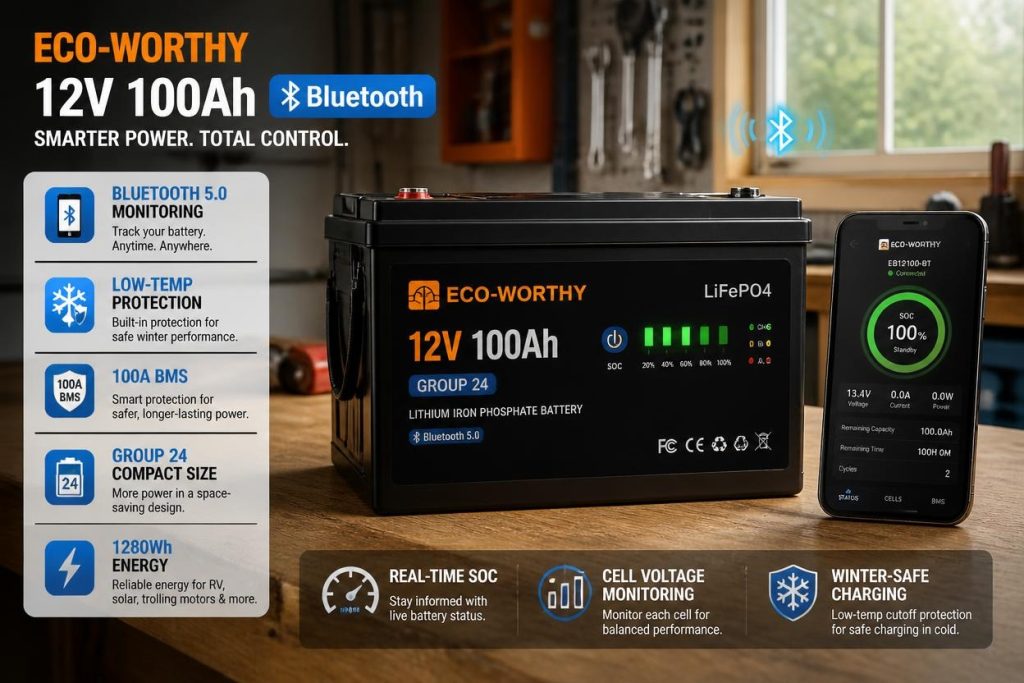
The ECO-WORTHY 12V 100Ah LiFePO4 is the other major player in the Redodo vs ECO-WORTHY 100Ah LiFePO4 debate, and it takes a different approach. Instead of focusing purely on raw power, ECO-WORTHY emphasizes smart features and a more compact physical size.
When you’re weighing the Redodo vs ECO-WORTHY 100Ah LiFePO4 decision, the first thing you’ll notice about the ECO-WORTHY is its Bluetooth monitoring. The battery has a built-in Bluetooth module that connects to the ECO-WORTHY app, letting you see voltage, current, capacity, and state of charge in real time. For anyone who likes data and wants to keep an eye on their battery’s health without adding a separate shunt, this is a genuine advantage.
What really sets the ECO-WORTHY apart in the Redodo vs ECO-WORTHY 100Ah LiFePO4 comparison is its Group 24 size. This battery is smaller and lighter than the Redodo, weighing around 23 pounds but with a more compact footprint. If your battery compartment is tight—a small boat, a camper van, a compact RV—the Group 24 size can be the difference between a battery that fits and one that doesn’t. It’s designed as a direct replacement for Group 24 lead-acid batteries.
The low-temperature protection is another standout feature. The ECO-WORTHY’s BMS cuts off charging when the cell temperature drops below -7°C (19.4°F), protecting the battery from the damage that can occur when charging LiFePO4 cells in freezing conditions. This is a meaningful safety feature for anyone who uses their battery in cold climates.
However, the ECO-WORTHY has its own limitations in the Redodo vs ECO-WORTHY 100Ah LiFePO4 comparison. The 100A BMS is capable, but some users report that the Bluetooth state-of-charge readings can be inaccurate, especially for small loads. One reviewer noted that the SOC would occasionally drop from 50-60% to near-zero without warning, suggesting the BMS doesn’t always account for small current draws accurately. That’s a frustration if you’re relying on the app to know when to recharge.
For anyone seriously considering the Redodo vs ECO-WORTHY 100Ah LiFePO4 decision, the ECO-WORTHY represents the best choice for tight spaces, cold climates, and anyone who wants app-based monitoring.
✅ Key Features
- Bluetooth Monitoring: Real-time voltage, current, capacity, and SOC via the ECO-WORTHY app.
- Group 24 Size: Compact footprint for tight battery compartments.
- Low-Temperature Protection: Cuts off charging below -7°C to prevent cold-weather damage.
- 100A BMS: Handles most trolling motors and RV loads.
- 23 lbs: Lightweight and easy to handle.
- 10-Year Lifespan: Rated for thousands of cycles.
- 4P2S Expandable: Up to 10.24kWh for larger systems.
- 3-Year Warranty: Backed by ECO-WORTHY support.
❌ Limitations
- SOC Accuracy Issues: Some users report inaccurate state-of-charge readings, especially for small loads.
- Lower Peak Current: Some users note the BMS has lower peak current than the Redodo, which matters for high-draw applications.
- Group 24 Size: Smaller than Group 31—may not fit existing Group 31 trays without adaptation.
- App Requires Account: Bluetooth monitoring requires creating an account, which some users find annoying.
❓ Does the Bluetooth monitoring app show accurate real-time SOC and cell voltage?
In the Redodo vs ECO-WORTHY 100Ah LiFePO4 comparison, the Bluetooth app is a mixed bag. It shows voltage, current, and capacity, and for most users, it works well enough to get a general sense of battery status. However, the SOC reading can be inaccurate, especially for small loads that the BMS doesn’t fully account for. Some users report sudden drops from 50-60% to near-zero, which is frustrating if you’re relying on the app to plan your charging. The app also doesn’t show individual cell voltages on this model, which would be helpful for diagnosing balance issues.
❓ How effective is the low-temperature protection cutoff in freezing conditions?
In the Redodo vs ECO-WORTHY 100Ah LiFePO4 comparison, the low-temperature protection is a genuine safety feature. The BMS cuts off charging when the cell temperature drops below -7°C (19.4°F), preventing the lithium plating that can occur when charging LiFePO4 cells below freezing. This is important because charging a cold LiFePO4 battery can cause permanent damage and reduce capacity. The cutoff is effective, and the battery resumes charging once temperatures rise. For anyone using their battery in winter conditions, this is a meaningful advantage over the Redodo, which lacks this feature on the standard model.
❓ Is the Group 24 size a true drop-in fit for tight battery compartments?
Yes—in the Redodo vs ECO-WORTHY 100Ah LiFePO4 comparison, the Group 24 size is a real advantage for tight spaces. The ECO-WORTHY measures roughly 10.23 x 6.6 x 8.43 inches, making it noticeably more compact than the Group 31 Redodo. If you’re replacing a Group 24 lead-acid battery, this is a direct drop-in fit without modifying your tray or wiring. If you have a Group 31 tray, the ECO-WORTHY will fit but may require a spacer or adapter to secure it properly.
This product has received a rating on Amazon
4.4 ⭐️⭐️⭐️⭐️ {655} evaluation🔥⬇️⬇️
👉🏻 Check the Latest Price on Amazon
Quick Comparison – Redodo vs ECO-WORTHY 100Ah LiFePO4
Before we dive deeper into the Redodo vs ECO-WORTHY 100Ah LiFePO4 comparison, here’s a quick side-by-side look at how these two batteries stack up against each other across all the key categories that matter most to buyers in 2026.
| Feature | Redodo 100Ah | ECO-WORTHY 100Ah Bluetooth |
|---|---|---|
| Price | ~$200-250 | ~$180-230 |
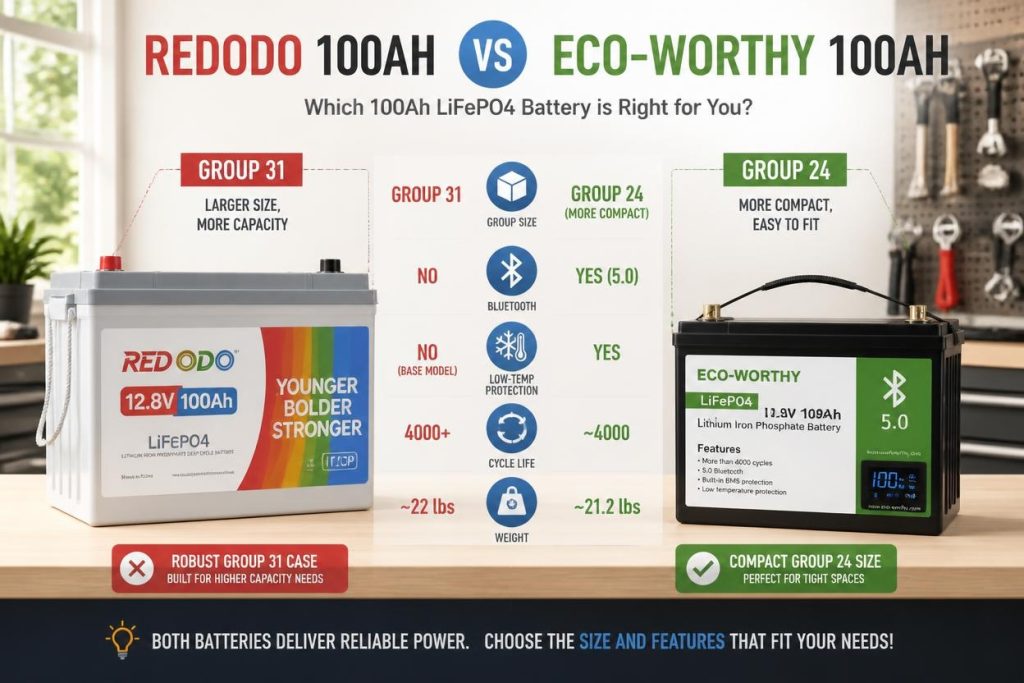
| Group Size | Group 31 | Group 24 |
| Weight | ~22.58 lbs | ~23 lbs |
| Bluetooth | No | Yes |
| Low-Temp Protection | No (standard model) | Yes – cuts off at -7°C |
| BMS | 100A | 100A |
| Cycles | 4,000+ | Up to 15,000 (claimed) |
| Waterproof | IP65 | Not specified |
| Expandability | 4P4S (20.48kWh) | 4P2S (10.24kWh) |
| Warranty | 5 years | 3 years |
| Best For | Trolling motors, high-draw applications | Tight spaces, cold climates, monitoring |
Breaking Down the Key Differences in the Redodo vs ECO-WORTHY 100Ah LiFePO4 Comparison
Price: In the Redodo vs ECO-WORTHY 100Ah LiFePO4 comparison, the ECO-WORTHY is slightly cheaper. You’re paying less for a battery with Bluetooth and low-temp protection, which is a strong value proposition.
Size: This is a critical difference in the Redodo vs ECO-WORTHY 100Ah LiFePO4 comparison. The ECO-WORTHY’s Group 24 size fits tighter spaces. The Redodo’s Group 31 size is standard for larger battery trays and offers more physical stability.
Power Delivery: The Redodo wins in the Redodo vs ECO-WORTHY 100Ah LiFePO4 comparison for raw power delivery. Users report it handles high-draw trolling motors and inverters without cutting out, and some forum users note the ECO-WORTHY has lower peak current.
Features: The ECO-WORTHY wins in the Redodo vs ECO-WORTHY 100Ah LiFePO4 comparison with Bluetooth monitoring and low-temperature protection. These are meaningful features that the Redodo lacks.
Warranty: The Redodo wins in the Redodo vs ECO-WORTHY 100Ah LiFePO4 comparison with a 5-year warranty vs ECO-WORTHY’s 3-year warranty.
Performance, Price, and Usability – Redodo vs ECO-WORTHY 100Ah LiFePO4
Now that we’ve covered the specs and features in our Redodo vs ECO-WORTHY 100Ah LiFePO4 comparison, let’s get into the real-world performance of both batteries. After researching both extensively, I’ve broken down exactly how they perform across the categories that matter most to buyers trying to decide between Redodo vs ECO-WORTHY 100Ah LiFePO4.
Performance – Which One Delivers More Power?
The Redodo 100Ah delivers exceptional performance in the Redodo vs ECO-WORTHY 100Ah LiFePO4 comparison for high-draw applications. The 100A BMS is robust enough to handle trolling motors, inverters, and other power-hungry devices without cutting out. Users report running 40lb thrust motors all day and still having charge left, and even heavier loads like kettles and sump pumps work fine as long as the wiring is correct. The automotive-grade cells maintain stable voltage under load, which is exactly what you want for motor applications.
The ECO-WORTHY 100Ah delivers solid performance in the Redodo vs ECO-WORTHY 100Ah LiFePO4 comparison for typical RV and solar use. The 100A BMS handles most loads, but some users report that the peak current is lower than the Redodo, which could matter for high-draw applications. The Bluetooth monitoring is useful, though the SOC accuracy issues are a frustration. The low-temperature protection is a genuine safety feature that the Redodo lacks.
Which one performs better in the Redodo vs ECO-WORTHY 100Ah LiFePO4 comparison? The Redodo wins for raw power delivery and high-draw applications. The ECO-WORTHY wins for features and cold-weather safety.
Price – The Budget Factor
Let’s talk money, because this is where the difference in the Redodo vs ECO-WORTHY 100Ah LiFePO4 comparison is significant.
The Redodo 100Ah costs around $200-250. In the Redodo vs ECO-WORTHY 100Ah LiFePO4 price comparison, you’re paying for raw power and a 5-year warranty. There’s no Bluetooth, but for some users, that’s a fair trade-off for a battery that just works.
The ECO-WORTHY 100Ah costs around $180-230. In the Redodo vs ECO-WORTHY 100Ah LiFePO4 comparison, you’re getting Bluetooth and low-temp protection for less money. The 3-year warranty is shorter, but the feature set is richer.
Which one offers better value in the Redodo vs ECO-WORTHY 100Ah LiFePO4 comparison? The ECO-WORTHY offers better value for features. The Redodo offers better value for long-term reliability and warranty coverage.
Usability – Which One Is Easier to Live With?
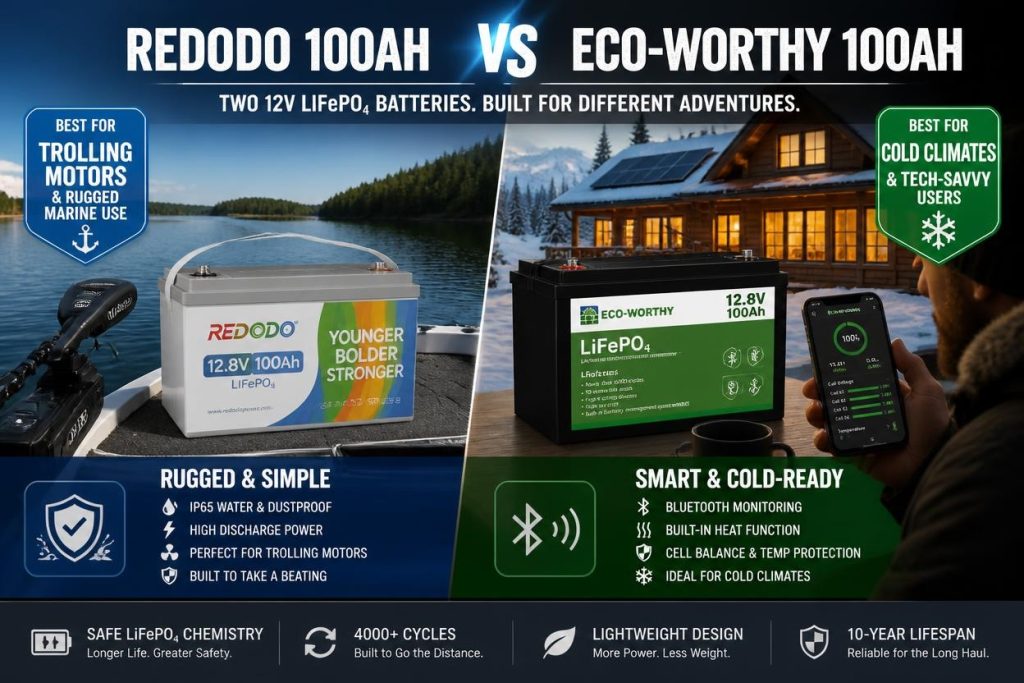
The Redodo 100Ah is easy to live with in the Redodo vs ECO-WORTHY 100Ah LiFePO4 comparison if you don’t need monitoring. You install it, use it, and forget about it. The Group 31 size fits standard trays, and the terminals are oriented like a traditional battery. The lack of Bluetooth means you’ll need a separate monitor if you want to track state of charge, but for many users, a simple voltage check is enough.
The ECO-WORTHY 100Ah is also easy to live with in the Redodo vs ECO-WORTHY 100Ah LiFePO4 comparison, and the Bluetooth monitoring is genuinely convenient. The Group 24 size fits tighter spaces, and the low-temp protection gives peace of mind in winter. The main frustration is the SOC accuracy—if you’re relying on the app to know when to recharge, you might get surprised by a sudden drop.
Which one is more usable in the Redodo vs ECO-WORTHY 100Ah LiFePO4 comparison? The ECO-WORTHY is more feature-rich and convenient for monitoring. The Redodo is simpler and more predictable.
When You Should NOT Buy Either Battery
Before we get to the final verdict, let’s be clear about who should skip both of these batteries.
Don’t buy either if you need a car starter battery. Both Redodo and ECO-WORTHY explicitly state their 100Ah LiFePO4 batteries are not designed for car starters, golf carts, or high-power applications like water pumps or elevator lifts. The BMS will shut down under the surge current those applications demand.
Don’t buy either if you need self-heating for extreme cold. The ECO-WORTHY has low-temperature cutoff, which protects the battery but doesn’t warm it. If you need to charge in sub-freezing temperatures regularly, you need a battery with self-heating technology.
Don’t buy either if you need a Group 24 exact fit for a Group 31 tray, or vice versa. Check your battery compartment dimensions before ordering. The Redodo is Group 31; the ECO-WORTHY is Group 24. While both can be adapted, a true drop-in fit saves headaches.
Which One Should You Choose?
Choose the Redodo 12V 100Ah LiFePO4 if:
- You need maximum power delivery for a trolling motor or inverter.
- You have a standard Group 31 battery tray.
- You don’t need Bluetooth monitoring.
- You want a 5-year warranty.
- You prioritize raw performance over smart features.
- You’re building a large battery bank (up to 20.48kWh).
Choose the ECO-WORTHY 12V 100Ah LiFePO4 if:
- You have a tight battery compartment that needs a Group 24 size.
- You want Bluetooth monitoring on your phone.
- You need low-temperature protection for cold climates.
- You want a slightly lower price.
- You’re using the battery for RV, solar, or moderate loads.
- You don’t mind a 3-year warranty.
Final Verdict – The Winner in 2026
After thoroughly researching both batteries for this Redodo vs ECO-WORTHY 100Ah LiFePO4 review, my recommendation depends on your priorities:
If you need maximum power delivery for a trolling motor or high-draw applications, and you don’t need app-based monitoring, the Redodo 12V 100Ah LiFePO4 is the clear winner. Its robust BMS, automotive-grade cells, and 5-year warranty make it a reliable workhorse for demanding use.
However, if you have a tight battery compartment, want Bluetooth monitoring, or need low-temperature protection for winter use, the ECO-WORTHY 12V 100Ah LiFePO4 is the better choice. Its Group 24 size, smart features, and lower price make it a compelling option for RVers, boaters, and solar users who want more visibility into their battery’s health.
In the Redodo vs ECO-WORTHY 100Ah LiFePO4 battle, I recommend the Redodo for power-hungry applications and the ECO-WORTHY for smart features and tight spaces. Choose based on what your setup actually needs.
Ready to Buy? Shop Now
🔥 Recommended Product:
👉🏻 Buy Redodo 12V 100Ah LiFePO4 on Amazon
Alternative Option:
👉🏻 Buy ECO-WORTHY 12V 100Ah LiFePO4 on Amazon
Frequently Asked Questions
1. Which is better – Redodo or ECO-WORTHY 100Ah LiFePO4?
In the Redodo vs ECO-WORTHY 100Ah LiFePO4 comparison, Redodo is better for high-draw applications and raw power. ECO-WORTHY is better for Bluetooth monitoring, tight spaces, and cold-weather protection.
2. Can I use these batteries as a car starter?
In the Redodo vs ECO-WORTHY 100Ah LiFePO4 comparison, neither battery is designed for car starting. Both are for deep-cycle applications like RV, marine, and solar. Using them as a starter will likely trip the BMS.
3. Do these batteries require a special charger?
In the Redodo vs ECO-WORTHY 100Ah LiFePO4 comparison, both require a LiFePO4-compatible charger. You can use a standard 12V charger with a lithium profile, or a solar charge controller set to LiFePO4. Using a lead-acid charger will not charge them to full capacity.
4. How long will these batteries last?
In the Redodo vs ECO-WORTHY 100Ah LiFePO4 comparison, both are rated for thousands of cycles and a 10-year lifespan. Real-world longevity depends on how deeply you discharge them and how well you maintain them.
Disclaimer: This post contains affiliate links. If you make a purchase through these links, I may earn a commission at no additional cost to you. All opinions expressed are my own based on thorough research and analysis.

Adrian
Just like you, I was tired of paying crazy electricity bills every month. Today, after 4 years of trial and error, my smart home uses less than half the energy it used to. I share everything I’ve learned — so you don’t have to make the same mistakes.
Let’s Connect ↓
Adrian — Owner of EcoNex
Solar | Smart Home | Lower bills