Table of contents
Table of Contents
🔹 Introduction
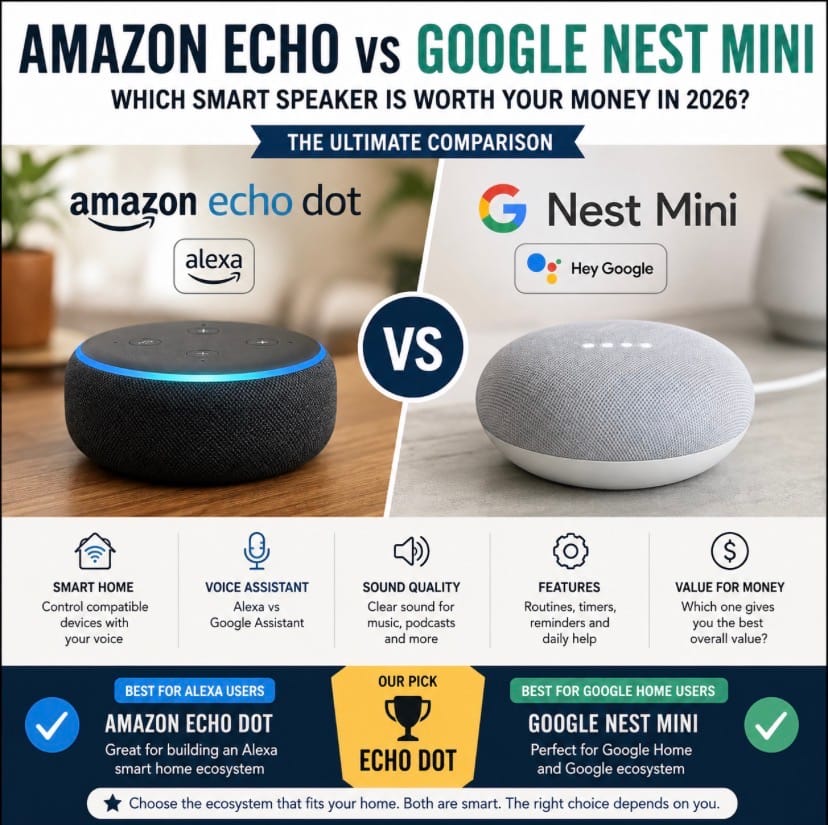
Are you trying to decide between the Amazon Echo Dot and Google Nest Mini but cannot figure out which smart speaker actually deserves a place in your home? You are not alone. Both devices are small, affordable, voice-controlled speakers designed to make everyday tasks easier, but they take different approaches to smart-home control, voice assistance, music, information, and connected devices.
That is exactly why an Amazon Echo vs Google Nest Mini comparison is worth doing before you spend your money. A smart speaker may look simple on the outside, but the voice assistant, microphone performance, smart-home compatibility, sound quality, ecosystem, and everyday convenience can make a noticeable difference after you bring it home.
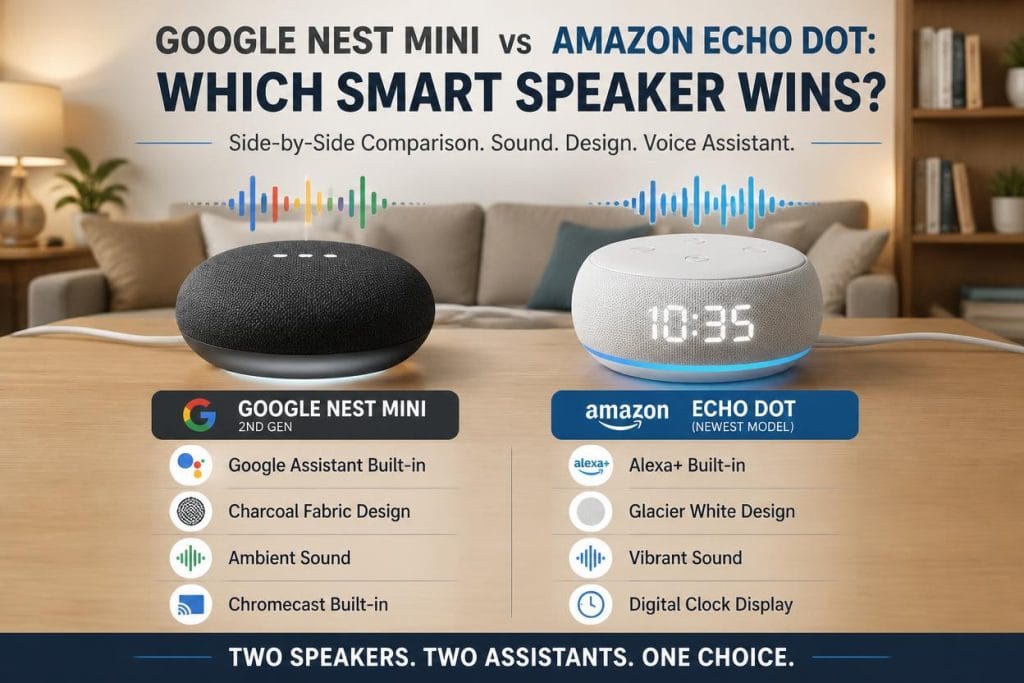
The Google Nest Mini is designed around Google Assistant and the Google Home ecosystem, making it particularly attractive if you already use Google services and compatible smart-home products. The Nest Mini features a compact design, a 40 mm speaker, three far-field microphones, Wi-Fi and Bluetooth connectivity, and Chromecast technology. Google also lists Matter compatibility for the device, giving it a role in newer smart-home setups.
On the other side, the Amazon Echo Dot is built around Alexa and the wider Amazon ecosystem. Echo devices can be used for music, calls, weather, news, information, and smart-home control, while Alexa provides the voice interface that connects these functions together.
So which one is better in 2026? The answer depends on how you plan to use your speaker. If you want strong integration with Google services and frequently search for information using natural questions, the Nest Mini can be a compelling option. If you want Alexa, a broad smart-home ecosystem, and an easy way to control compatible devices around your home, the Echo Dot can make more sense.
In this detailed Amazon Echo vs Google Nest Mini review, we will look at both products individually before putting them head-to-head. We will examine their features, everyday performance, voice recognition, smart-home capabilities, value, and practical advantages so you can choose the speaker that fits your lifestyle rather than simply buying the more popular name.
🔹 Google Nest Mini Review
Google Nest Mini: A Small Smart Speaker Built Around Google Assistant
The Google Nest Mini is one of those products that is easy to underestimate when you first see it. Its small, fabric-covered body does not take up much space, but it is designed to become a convenient voice-controlled assistant for your home.
Instead of reaching for your phone every time you want to check the weather, play music, control a compatible smart-home device, set a reminder, or ask a question, you can simply speak to the Nest Mini. That hands-free experience is the main reason people buy compact smart speakers in the first place.
Google’s specifications list a 40 mm speaker with 360-degree sound and three far-field microphones. The Nest Mini also supports Wi-Fi and Bluetooth, includes Chromecast technology, and works with compatible smart-home devices through Matter.
The compact size is another major advantage. You can place it on a nightstand, kitchen counter, desk, shelf, or another convenient location without sacrificing much space. It is also designed to blend into a room rather than looking like a traditional piece of audio equipment.
For people already invested in Google services, the Nest Mini can feel especially natural. If your daily digital life revolves around Google Search, Google Home, YouTube, or other compatible Google services, having a voice assistant from the same ecosystem can reduce friction.
✅ Features:
- Google Assistant: Use voice commands to ask questions, get information, manage everyday tasks, and control compatible smart-home devices.
- Compact 360-degree speaker: The 40 mm driver is designed to distribute sound around the room while keeping the device small.
- Three far-field microphones: The built-in microphones are designed to hear voice commands from across a room.
- Smart-home connectivity: The Nest Mini supports compatible smart-home devices and Matter, helping it fit into modern connected-home environments.
- Wi-Fi and Bluetooth: Wireless connectivity gives the speaker flexibility for everyday use.
- Chromecast technology: The built-in Chromecast functionality can be useful for compatible Google-connected entertainment setups.
❌ Cons:
- The compact speaker is better suited to casual listening than filling a large room with powerful bass.
- Its biggest advantages are easier to appreciate if you already use Google’s ecosystem.
- It requires Wi-Fi and a nearby power outlet for normal operation.
- Some advanced smart-home features depend on compatibility with the specific devices and services you own.
How does Google Assistant perform on the Nest Mini compared to other smart speakers?
Google Assistant is one of the biggest reasons to consider the Nest Mini. Rather than thinking of the device as simply a small Bluetooth speaker, it is more useful to think of it as a hands-free access point to Google’s voice assistant and smart-home ecosystem.
For everyday questions, the Nest Mini can be particularly convenient. You can ask for weather information, general facts, reminders, timers, or other supported tasks without touching your phone. This can be especially useful in situations where your hands are busy, such as when cooking, cleaning, getting ready in the morning, or managing multiple things around the house.
Compared with other smart speakers, the Nest Mini’s biggest advantage is not necessarily raw speaker power. It is the combination of Google’s information ecosystem, voice interaction, compact hardware, and Google Home integration.
However, the experience is not identical for everyone. Someone who owns many Alexa-compatible devices may find an Echo Dot more convenient because Alexa is already connected to their existing smart-home setup. In contrast, a household that already uses Google Home products may find the Nest Mini easier to integrate.
This is an important point in an Amazon Echo vs Google Nest Mini comparison: the best voice assistant is often the one that works naturally with the services and devices you already use.
Is voice recognition accurate even in noisy rooms?
The Nest Mini includes three far-field microphones specifically designed to pick up voice commands from around the room. That makes it considerably more practical than a basic speaker that requires you to stand directly next to it.
In a normal home environment, voice recognition can be very convenient. You do not necessarily need to walk over to the speaker every time you want to give a command. This is one of the features that makes smart speakers useful for everyday routines.
That said, no small smart speaker should be treated as perfect in every environment. A television playing loudly, several people talking at once, kitchen appliances running, or music playing at high volume can make voice commands more challenging for any microphone-based assistant.
The practical takeaway is simple: the Nest Mini is designed for far-field voice interaction, but microphone performance should always be judged in the context of your room. If you plan to place it in a relatively quiet bedroom or office, you may have a different experience than someone placing it beside a loud television or busy kitchen.
Which smart speaker offers better value: Google Nest Mini or Amazon Echo Dot?
This is where the Amazon Echo vs Google Nest Mini decision becomes more interesting because value is not determined by the speaker alone.
The Google Nest Mini can offer excellent value if you want an inexpensive way to enter the Google smart-home ecosystem. Its small footprint, Google Assistant functionality, microphones, wireless connectivity, and smart-home support give it more purpose than its compact appearance might suggest.
The Echo Dot, meanwhile, can be the better value for someone who prefers Alexa or already owns Alexa-compatible smart-home products. Amazon’s Echo ecosystem is extensive, and Alexa can serve as the central voice interface for compatible devices and services.
In other words, there is no universal winner based only on price. The better value is the speaker that reduces the need to buy additional equipment and fits the ecosystem you already use.
Shop the Google Nest Mini
🔹 Why the Google Nest Mini Can Be a Smart Buy in 2026
The Nest Mini remains appealing because it focuses on what most people actually need from a compact smart speaker: simple voice control, useful everyday assistance, smart-home integration, and music playback in a small package.
It is not trying to replace a premium home audio system. Instead, it is designed to be the device you casually interact with throughout the day. You might ask it a question while preparing breakfast, use it to set a timer while cooking, adjust compatible smart-home devices, or play audio while working.
That simplicity is important. The best smart-home technology often disappears into your routine. When a device works correctly, you stop thinking about the technology and simply use it.
Google also positions the Nest Mini as part of a broader smart-home ecosystem. Its support for Matter and compatibility with Google Home can make it useful for people who are gradually building a connected home instead of purchasing every smart device at once.
For a first smart speaker, that combination makes the Nest Mini an attractive option. But before deciding that it is the winner, we need to look closely at the Amazon Echo Dot and what Alexa brings to the table.
🔹 Amazon Echo Dot Review
Amazon Echo Dot: A Compact Alexa Speaker for Everyday Smart-Home Control
The Amazon Echo Dot takes a similar basic concept and approaches it through Alexa. It is a compact smart speaker designed to respond to voice commands and provide access to Amazon’s Alexa ecosystem.
Amazon describes Echo devices as products that connect to Alexa and can be controlled by voice. Depending on the device and supported services, Alexa can be used for music, calls, smart-home control, information, news, sports scores, weather, and other everyday tasks.
That makes the Echo Dot more than a tiny speaker. Its real value comes from the Alexa platform behind it. If your home already includes smart lights, plugs, thermostats, cameras, or other devices that work with Alexa, the Echo Dot can become a convenient central point for voice control.
The Echo Dot is also a particularly interesting option for shoppers who want a relatively simple entry point into Amazon’s smart-home ecosystem. Instead of buying a larger and more expensive smart display, users can start with a small voice-controlled speaker and expand their system later.
What is Amazon Echo Dot used for?
The Echo Dot is primarily used as a voice-controlled smart speaker. You can speak to Alexa to perform supported tasks, get information, listen to audio, and interact with compatible smart-home devices.
For example, you might use an Echo Dot to ask about the weather before leaving home, play music while preparing dinner, set a timer while cooking, or control compatible smart lights without reaching for your phone.
Amazon’s Echo platform is also designed to work with a broad range of compatible smart-home devices. Amazon states that Echo devices can be used to control smart-home products along with providing information, entertainment, news, weather, and other Alexa experiences.
This makes the Echo Dot particularly appealing if your main goal is home automation. Instead of opening a separate application for every compatible device, Alexa can provide a single voice interface for supported products.
What is the difference between an Echo Dot and Alexa?
This is a common source of confusion, but the distinction is simple.
Echo Dot is the hardware. Alexa is the voice assistant.
Think of the Echo Dot as the physical device sitting on your desk or kitchen counter, while Alexa is the software-based assistant you interact with through it. Amazon’s own guidance describes Echo devices as part of a product family that connects to Alexa, while Alexa provides the voice-controlled experience.
That distinction matters when comparing the Echo Dot with the Google Nest Mini. You are not simply comparing two speakers. You are comparing two ecosystems: Amazon Alexa versus Google’s smart-home and voice-assistant environment.
That ecosystem decision can influence everything from which smart-home products you buy to how naturally your devices work together.
Is Alexa Echo Dot worth buying?
For the right buyer, yes. The Echo Dot can be worth buying if you want an affordable way to access Alexa and control compatible smart-home devices using voice commands.
It becomes even more compelling when you already own Alexa-compatible products. Instead of buying a smart speaker only for music, you can use it as part of a larger connected-home system.
However, the Echo Dot may not be the best choice for everyone. If your household is already heavily invested in Google services and Google Home devices, switching ecosystems simply to use Alexa may not provide enough benefit.
That is why the winner of the Amazon Echo vs Google Nest Mini comparison should not be selected purely by specifications. Your existing ecosystem, preferred assistant, smart-home devices, and daily habits can matter just as much as the hardware itself.
✅ Features:
- Alexa voice assistant: Provides hands-free access to supported information, entertainment, and smart-home functions.
- Smart-home control: Compatible Echo devices can act as convenient voice-control points for supported smart-home products.
- Entertainment: Alexa-enabled Echo devices can be used for music and other supported audio experiences.
- Everyday assistance: Use Alexa for supported tasks such as weather, news, information, reminders, and more.
- Expandable ecosystem: Echo devices can be part of a larger Alexa smart-home setup rather than functioning as a standalone speaker.
❌ Cons:
- The overall experience depends heavily on the Alexa ecosystem and compatible services.
- Some users may prefer Google’s approach to search and information-based questions.
- The best value comes when you actually use Alexa’s smart-home and voice features rather than treating it as only a small speaker.
- Audio performance should not be confused with that of a larger premium speaker.
📊 Quick Comparison
| Feature | Google Nest Mini | Amazon Echo Dot |
|---|---|---|
| Price | Budget-friendly smart speaker; current price can vary by retailer and promotions | Budget-friendly smart speaker; current price can vary by retailer and promotions |
| Performance | Strong voice-assistant experience with Google Assistant and 40 mm speaker | Strong Alexa experience with smart-home and everyday voice features |
| Power Consumption | Low-power compact smart-speaker design; powered from an outlet | Low-power compact smart-speaker design; powered from an outlet |
| Use | Google Assistant, music, questions, routines, and compatible smart-home control | Alexa, music, information, routines, and compatible smart-home control |
| Best For | Google-focused households and Google Home users | Alexa-focused households and Amazon smart-home users |
Note: Prices and availability can change, so check the current retailer listing before purchasing.
⚡ The Difference Between Amazon Echo vs Google Nest Mini
Performance
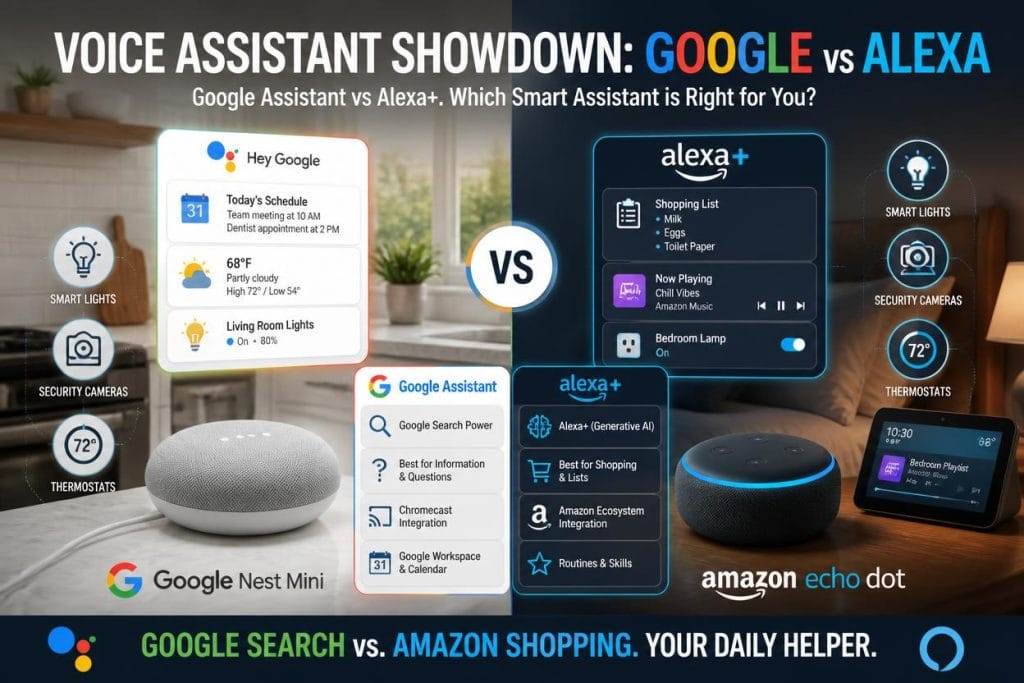
When comparing performance, it is important to separate audio performance from smart-assistant performance. Both products are compact speakers, but their real purpose is voice interaction and smart-home convenience.
The Google Nest Mini uses a 40 mm speaker and three far-field microphones, while its Google Assistant integration gives it access to Google’s voice-controlled ecosystem.
The Echo Dot takes a similar approach through Alexa. Its advantage becomes especially noticeable when you already have Alexa-compatible smart-home devices and want to control them through one voice assistant.
For pure smart-home convenience, your existing ecosystem may have a bigger impact than small differences in hardware.
Price
Neither product should be evaluated only by its listed price because smart speakers are frequently sold with promotions, bundles, and changing retailer offers. The smarter question is what you receive for the money and whether the speaker works with the products you already own.
If the Nest Mini integrates with your existing Google Home setup, it can represent excellent value. If you already use Alexa-compatible devices, the Echo Dot can provide a similarly strong return on your investment.
Use
The biggest difference in everyday use comes down to the assistant and ecosystem you prefer. Google Nest Mini is naturally suited to people who want Google Assistant and Google Home integration. Echo Dot is designed around Alexa and the Amazon ecosystem.
That means there is no single winner for every household. The right choice depends on which platform you are most likely to use every day.
🎯 Which One Should You Choose?
Choose Google Nest Mini if:
- You already use Google Home or other Google-connected smart-home products.
- You prefer Google’s voice assistant and information ecosystem.
- You want a compact speaker with three far-field microphones and 360-degree sound.
- You want Matter support for compatible modern smart-home devices.
- You want a simple smart speaker that fits easily into bedrooms, offices, kitchens, or small living spaces.
Choose Amazon Echo Dot if:
- You already use Alexa-compatible smart-home products.
- You want Alexa as the main voice assistant in your home.
- You want voice control for compatible smart-home devices.
- You prefer Amazon’s ecosystem and Alexa-enabled services.
- You want to build an Alexa-based smart home gradually.
Coming in Part 2: We will take a deeper look at the Amazon Echo Dot’s everyday performance, Alexa experience, smart-home control, sound quality, microphone behavior, and practical value before moving into the full head-to-head verdict.
Amazon Echo vs Google Nest Mini: A Deeper Look at Everyday Performance
Now that we have introduced both speakers individually, it is time to move beyond the basic specifications and look at what actually matters when you use a smart speaker every day. A product can look impressive on a specification sheet, but the real test is how quickly it responds, how reliably it hears you, how useful the voice assistant feels, and how well it fits into your daily routine.
That is where the Amazon Echo vs Google Nest Mini comparison becomes much more interesting. Both speakers are designed to be simple, affordable entry points into smart-home technology, but they are built around different ecosystems. Google Nest Mini centers around Google Assistant and Google Home, while Echo Dot centers around Alexa and Amazon’s connected ecosystem.
If you are buying your first smart speaker, these differences may not seem important at first. After several months of using the device, however, your preferred ecosystem can become one of the most important factors in whether you are happy with your purchase.
🔊 Sound Quality: Which One Sounds Better?
Neither the Google Nest Mini nor the Amazon Echo Dot should be purchased with the expectation that it will replace a dedicated premium Bluetooth speaker. Their biggest selling point is smart functionality, not audiophile-level performance.
That said, sound quality still matters. Most people will use a smart speaker for music, podcasts, radio, timers, background audio, and other entertainment. A speaker that sounds thin or distorted can quickly become frustrating, even if its voice assistant is excellent.
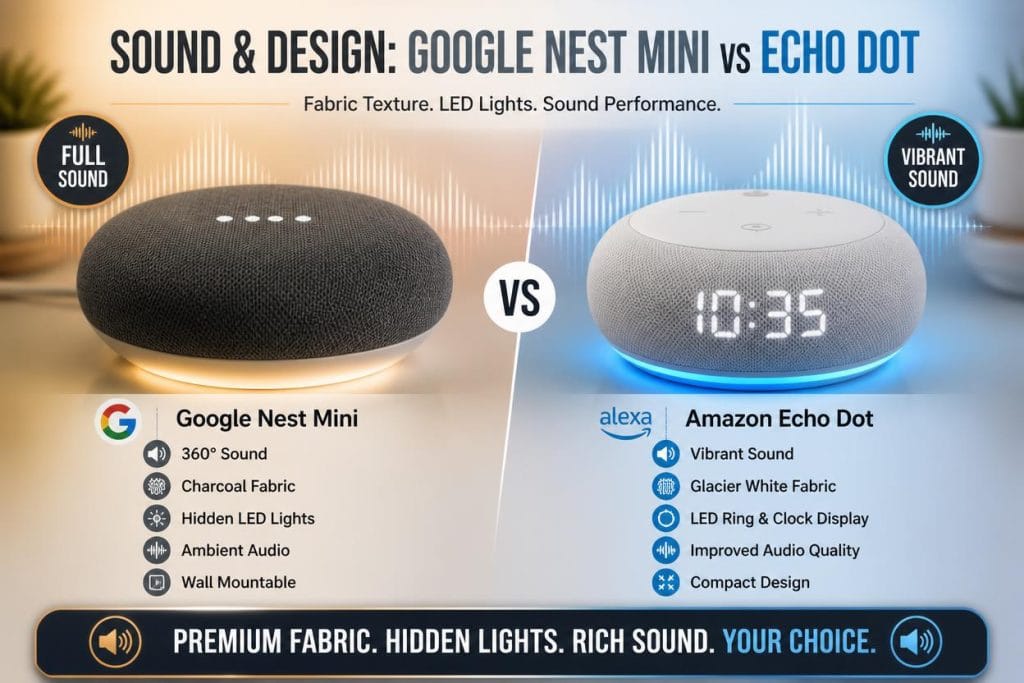
Google Nest Mini Audio Performance
The Google Nest Mini features a 40 mm speaker and 360-degree sound design. Google describes the device as providing clear audio while its compact form allows it to fit into relatively small spaces.
The 360-degree approach is useful when you do not want to position the speaker precisely toward a particular listening position. You can place it on a shelf, desk, counter, or nightstand and still hear the audio from different directions.
For casual listening, the Nest Mini can be surprisingly useful. It is particularly well suited to background music, spoken-word content, podcasts, and voice responses.
However, the physical size naturally limits how much bass and room-filling power you can expect. If you regularly listen to bass-heavy music at high volume, a larger speaker will generally be a better choice.
Amazon Echo Dot Audio Performance
The Echo Dot follows a similar philosophy. It is compact enough to fit almost anywhere, but its primary role is not to compete with large home audio systems.
The Echo Dot is better viewed as an everyday smart speaker that happens to provide useful audio playback. That makes it a good choice for bedrooms, offices, kitchens, entryways, and other areas where you want convenient audio without dedicating much space to a speaker.
For many buyers, the difference between the two speakers will not come down to a dramatic sound-quality advantage. Instead, it will come down to which assistant and ecosystem you prefer.
That is an important lesson from this Amazon Echo vs Google Nest Mini review: sound quality matters, but it should not be the only reason you choose one of these devices.
🎙️ Microphone and Voice Recognition
One of the most important features of any smart speaker is something you cannot see from the outside: its microphones.
If the speaker constantly misunderstands you, asks you to repeat yourself, or fails to hear the wake word while you are standing several feet away, the convenience of voice control disappears.
Google Nest Mini Microphone Performance
The Google Nest Mini includes three far-field microphones. These microphones are designed to hear voice commands from around the room rather than requiring you to stand directly beside the speaker.
This is particularly useful in everyday situations. Imagine that you are preparing dinner and your hands are covered with ingredients. Instead of touching your phone, you can speak to the speaker to perform a supported task.
The same concept works well in a bedroom. You can keep the Nest Mini on a nightstand and use your voice for supported commands without reaching for your phone.
However, microphone performance can vary depending on room conditions. Loud television audio, music, multiple conversations, or noisy kitchen appliances can make voice recognition more difficult for any voice-controlled device.
Amazon Echo Dot Microphone Experience
The Echo Dot is similarly designed around hands-free interaction. Its usefulness depends heavily on Alexa being able to recognize the wake word and understand your request without requiring you to move close to the device.
For a smart speaker, this is one of the most important aspects of the overall experience. When microphone performance works well, voice control feels almost magical. When it does not, you quickly return to using your phone.
In the Amazon Echo vs Google Nest Mini battle, neither device should automatically be considered perfect in noisy environments. Your room placement matters significantly.
For the best results, place the speaker in an open location rather than hiding it behind furniture, inside a cabinet, or directly next to a loud appliance.
🧠 Google Assistant vs Alexa
This is arguably the most important section of the entire comparison.
You are not simply purchasing a small speaker. You are choosing a voice assistant that you may interact with dozens of times every week.
Google Assistant on Nest Mini
Google Assistant is the central intelligence behind the Nest Mini experience. Its biggest advantage is the connection to Google’s broader ecosystem.
For users who already rely heavily on Google services, this can create a natural experience. The Nest Mini can become another convenient way to access information, control compatible devices, and manage supported daily tasks without reaching for a smartphone.
The Google ecosystem is particularly appealing to people who prefer asking conversational questions rather than remembering rigid voice commands.
That does not mean Google Assistant will always be better. Smart assistants evolve continuously, and individual experiences can differ depending on the services, devices, region, account settings, and commands being used.
Alexa on Echo Dot
Alexa takes a different approach and has become closely associated with Amazon’s smart-home ecosystem.
For households with compatible smart lights, plugs, thermostats, cameras, switches, and other devices, Alexa can become a central control system.
One of Alexa’s biggest advantages is the ability to create routines and connect compatible devices. Instead of manually controlling several products, you can use supported Alexa routines to automate multiple actions.
For example, a properly configured smart-home routine could allow a user to trigger several compatible devices with one command. The exact capabilities depend on the products and services connected to Alexa.
This is why the Amazon Echo vs Google Nest Mini decision becomes increasingly important as your smart home grows. The speaker you choose today can influence which ecosystem you naturally continue using tomorrow.
🏠 Smart Home Compatibility
If your primary reason for buying a smart speaker is home automation, you should pay close attention to compatibility rather than focusing only on audio performance.
A smart speaker becomes significantly more useful when it can communicate with the devices you already own.
Google Nest Mini for Smart Homes
The Nest Mini works with compatible smart-home products through the Google Home ecosystem. Google also lists Matter support for the Nest Mini, which is important because Matter is designed to improve interoperability between compatible smart-home platforms and devices.
This can make the Nest Mini appealing to someone building a newer smart home and looking for broader compatibility.
However, Matter support does not mean that every smart-home product will automatically work in exactly the same way. You should always check the compatibility of the specific devices you intend to connect before buying.
Echo Dot for Smart Homes
The Echo Dot is equally attractive to users who are already invested in Alexa-compatible products.
Alexa can serve as a central voice interface for supported smart-home products. Amazon describes Echo devices as being capable of controlling compatible smart-home devices and providing access to other Alexa experiences.
This can be extremely convenient when your home contains several connected devices.
Imagine having smart bulbs in the living room, a compatible smart plug in the bedroom, and a smart thermostat in another area. Instead of opening several apps, you can potentially manage compatible products through Alexa voice commands.
That is the real appeal of an Echo Dot: it can be the small voice-controlled hub that makes a collection of smart devices feel more unified.
📱 Ease of Setup
Another factor that is easy to overlook is setup.
A smart speaker is only useful if you can get it connected without spending hours troubleshooting accounts, Wi-Fi settings, and compatibility issues.
Both Google and Amazon have designed their smart-speaker ecosystems to make setup relatively accessible to mainstream consumers. You will generally need a compatible smartphone, a Wi-Fi connection, and the relevant account and app setup.
Google Nest Mini users typically interact with the Google Home ecosystem, while Echo Dot users manage their device through Amazon’s Alexa ecosystem.
If you already have one of these ecosystems configured, choosing the matching speaker can make setup easier because your account and existing devices may already be familiar to you.
This is another reason why the best answer to Amazon Echo vs Google Nest Mini is often based on what you already own.
💡 Smart Home Routines and Automation
Smart-home routines can turn a simple voice speaker into something much more useful.
Instead of using individual commands for individual devices, routines can allow compatible actions to happen together.
For example, a morning routine might involve turning on compatible lights, providing information, and starting another supported action. An evening routine might do the opposite.
The exact functionality depends on your ecosystem and the products connected to it, but the principle is the same: automation reduces the number of small tasks you need to perform manually.
Amazon’s Alexa ecosystem has long emphasized smart-home routines, making Echo devices attractive for users who want to build a more automated home.
Google Home also provides automation capabilities for compatible devices and services.
If smart-home automation is your priority, do not buy based solely on the speaker. Make a list of your current smart devices first and determine which ecosystem supports the features you actually want.
🎵 Music and Entertainment
Music is one of the most common reasons people purchase smart speakers.
Both devices can serve as convenient voice-controlled audio players, but the services you use matter.
If your preferred music and entertainment services integrate naturally with one platform, that ecosystem may be the better choice for you.
The Nest Mini is naturally attractive to users who already live inside Google’s entertainment ecosystem, while Echo Dot makes sense for people who prefer Alexa-compatible services and Amazon’s broader ecosystem.
Again, there is no universal winner.
A person who listens to music casually in the kitchen may be perfectly satisfied with either device. Someone who has carefully built a smart-home entertainment system should choose the speaker that integrates with that system most naturally.
💰 Which One Offers Better Long-Term Value?
Price is important, but the lowest upfront price does not automatically mean the best value.
A smart speaker is part of an ecosystem. If you buy a speaker that does not work well with your existing smart-home devices, you may eventually spend more money replacing or changing other products.
That is why long-term value should include:
- Initial purchase price
- Compatibility with your existing devices
- Voice assistant quality
- Smart-home automation options
- Audio performance
- Ease of use
- Future expansion potential
For a Google-focused household, the Nest Mini can offer excellent value because it fits naturally into the existing ecosystem.
For an Amazon-focused household, the Echo Dot can offer equally strong value because Alexa can become the central voice interface for compatible devices.
⚡ Power Consumption and Everyday Efficiency
Both devices are designed as compact, continuously powered smart speakers rather than battery-powered portable speakers.
That means you generally place the device somewhere convenient and leave it connected to power.
Because these are small smart speakers rather than large audio systems, they are designed for relatively modest everyday power requirements. However, exact electricity consumption depends on usage, network activity, standby behavior, and local power conditions.
If energy efficiency is important to you, remember that the speaker itself may represent only a small part of your home’s overall smart-home energy consumption. Smart lights, cameras, thermostats, displays, and other always-connected devices can collectively have a much larger impact.
For most shoppers, power consumption should therefore be a secondary consideration compared with compatibility and functionality.
🏡 Where Should You Place Each Speaker?
Placement can have a surprisingly large impact on your experience.
Best Places for Google Nest Mini
- Bedroom nightstand
- Kitchen counter
- Home office desk
- Living room shelf
- Entryway
Because of its compact size, the Nest Mini can fit into areas where larger speakers would be inconvenient.
Best Places for Echo Dot
- Bedroom
- Kitchen
- Home office
- Living room
- Hallway or entry area
The Echo Dot works best when it has a relatively clear acoustic path to your voice. Avoid placing any smart speaker directly behind a television or inside an enclosed cabinet if you want the best possible voice interaction.
🔐 Privacy Considerations
Whenever you install a voice-controlled device in your home, privacy is worth considering.
Smart speakers are designed to respond to wake words and process voice interactions. The exact handling of recordings, settings, and account information can change over time, so users should review the current privacy controls offered by the manufacturer.
Both Google and Amazon provide privacy and account-management settings for their respective ecosystems.
If privacy is a major concern, spend a few minutes reviewing the available settings after installation rather than simply accepting the default configuration.
You should also remember that smart-home convenience always involves some level of connected-device usage. The more devices you connect, the more important it becomes to understand which accounts, permissions, and services are involved.
📊 Everyday Experience Comparison
| Category | Google Nest Mini | Amazon Echo Dot |
|---|---|---|
| Voice Assistant | Google Assistant | Alexa |
| Smart Home | Google Home ecosystem and compatible Matter devices | Alexa ecosystem and compatible smart-home devices |
| Microphones | Three far-field microphones | Designed for hands-free Alexa interaction |
| Audio | 40 mm speaker with 360-degree sound | Compact speaker designed for everyday audio |
| Best Ecosystem | Google-focused households | Amazon/Alexa-focused households |
| Smart Home Automation | Strong with compatible Google Home devices | Strong with compatible Alexa devices |
| Ideal Location | Bedroom, kitchen, office, living room | Bedroom, kitchen, office, living room |
🏆 Part 2 Verdict
After looking at everyday performance, microphones, assistants, smart-home compatibility, entertainment, setup, and long-term value, the biggest conclusion is clear: there is no winner that is perfect for everyone.
The Google Nest Mini is particularly appealing if your digital life already revolves around Google services and Google Home. Its compact design, three far-field microphones, 40 mm speaker, and smart-home capabilities make it a practical choice for everyday use.
The Amazon Echo Dot, meanwhile, becomes increasingly attractive if Alexa is already the center of your smart-home setup. Its value grows when you connect compatible lights, plugs, thermostats, and other devices that you want to control through voice commands.
So, if you are still undecided in this Amazon Echo vs Google Nest Mini comparison, do not ask only, “Which speaker is better?” Ask, “Which ecosystem do I want to use every day?”
That question will usually lead you to the right answer.
🔜 Coming in Part 3
In Part 3, we will compare the two speakers more aggressively across price, value for money, smart-home compatibility, voice assistant performance, music, daily usability, and different types of buyers. We will also examine which speaker makes more sense for beginners, families, Google users, Amazon users, and people building a smart home from scratch.
Amazon Echo vs Google Nest Mini: Price, Value, Smart Home Features, and Real-World Use
By now, you have seen that the Amazon Echo vs Google Nest Mini debate is about much more than choosing between two small speakers. Both products are designed to make your home more convenient, but they approach that goal through different ecosystems, different voice assistants, and different user experiences.
In this part of the review, we are going to take the comparison a step further. Instead of simply looking at specifications, we will focus on the situations that actually influence a buying decision. Which one makes more sense for a beginner? Which one is better for a smart home? Which one offers better everyday value? Which speaker should you choose if you already use Google services? And what about someone who is already heavily invested in Amazon and Alexa?
These questions matter because the cheapest smart speaker is not necessarily the best purchase. The right product should fit naturally into your home and work with the technology you already use.
💰 Amazon Echo vs Google Nest Mini: Which Offers Better Value?
Value is one of the most important factors when buying an affordable smart speaker. Most shoppers are not looking for a luxury audio product. They want something inexpensive that can provide useful features every day.
Both the Google Nest Mini and Amazon Echo Dot are designed to occupy that entry-level smart-speaker category. Their compact designs make them easier to place around the home, while their voice assistants give them capabilities that a conventional speaker does not have.
But value should not be measured by the purchase price alone.
Imagine that you already have several smart lights that work with Alexa. In that situation, an Echo Dot may provide significantly more value because it can become part of your existing system. You do not need to replace your smart lights or learn an entirely new platform.
Now imagine a different household that relies heavily on Google services and already has compatible Google Home devices. For that buyer, the Nest Mini may be the more logical investment.
This is why the winner of an Amazon Echo vs Google Nest Mini comparison can change depending on the buyer.
What Makes the Google Nest Mini a Good Value?
The Nest Mini combines a compact physical design with Google Assistant functionality, smart-home capabilities, wireless connectivity, and a 40 mm speaker. Google also lists three far-field microphones and Matter support for compatible smart-home setups.
For someone who wants a simple Google-powered smart speaker without taking up much space, this combination can be very appealing.
It is especially useful when you want to place several speakers throughout your home. For example, one could sit in the kitchen while another is located in a bedroom or office. The compact form factor makes that kind of setup practical without turning every room into an audio showroom.
What Makes the Echo Dot a Good Value?
The Echo Dot’s strongest value proposition comes from Alexa.
If you want a voice-controlled way to interact with compatible smart-home products, an Echo Dot can become much more useful than its small size suggests.
You can potentially use it as part of a broader Alexa setup involving compatible lights, plugs, thermostats, switches, cameras, and other connected products.
That makes the Echo Dot particularly attractive to buyers who want to start small and expand later.
Instead of purchasing a complete smart-home system all at once, you can begin with one speaker and gradually add compatible devices as your needs change.
🏠 Which One Is Better for a Smart Home?
If smart-home automation is your primary reason for buying a speaker, you should think about the speaker as the “voice” of your home rather than simply an audio device.
The Google Nest Mini can work as part of a Google Home setup, while the Echo Dot can work as part of an Alexa setup. Both approaches can make compatible smart-home devices easier to control.
The important word here is compatible.
Before purchasing either speaker, check the products you already own. Look at your smart bulbs, plugs, thermostats, cameras, switches, appliances, and other connected devices. Determine whether they work with Google Home, Alexa, or both.
If most of your devices are compatible with one platform, choosing that ecosystem is usually the smarter move.
Google Nest Mini for a Growing Smart Home
The Nest Mini can make sense for users who want Google Home at the center of their connected home.
Google’s support for Matter is also relevant for modern smart-home buyers. Matter is intended to make compatible smart-home products work more easily across supported platforms.
However, compatibility should always be checked on a product-by-product basis. A device supporting Matter does not necessarily mean that every feature will work identically across every platform.
For someone building a smart home gradually, this is worth remembering. Do not buy a smart device simply because you see a familiar logo on the packaging. Check the specific functions you need.
Echo Dot for a Growing Smart Home
The Echo Dot is particularly attractive when Alexa is already the preferred platform.
Alexa can act as a central voice interface for compatible smart-home devices. This can reduce the need to open different apps throughout the day.
For example, instead of opening an app to control compatible smart lights, you may be able to give a voice command through Alexa. Likewise, compatible devices can be included in routines designed around particular times or activities.
This is where the Echo Dot can become much more valuable than a traditional speaker.
👨👩👧👦 Which Smart Speaker Is Better for Families?
Families often use smart speakers differently from individual users.
A single person might primarily use the device for music and weather information. A family may use the speaker throughout the day for timers, reminders, entertainment, smart-home control, and general questions.
In a family environment, simplicity matters.
The easier it is for everyone to understand how to interact with the device, the more likely the speaker is to become part of the household routine.
Both Google Assistant and Alexa are designed for voice interaction, so neither product requires users to constantly reach for a phone.
For families already using Amazon services and Alexa-compatible devices, an Echo Dot can be a natural fit.
For families that rely heavily on Google services and Google Home products, the Nest Mini can provide a similarly convenient experience.
Therefore, when comparing Amazon Echo vs Google Nest Mini for a family, ecosystem compatibility should come before minor differences in speaker hardware.
👨💻 Which One Is Better for a Home Office?
A home office is another environment where a compact smart speaker can be useful.
You may want background music while working, a quick timer for focused work sessions, reminders, weather information, or hands-free control of compatible devices.
The small footprint of both speakers is an advantage here. Neither requires much desk space.
The Google Nest Mini can be appealing to people who already work heavily within Google’s ecosystem. If you use Google services throughout your day, having a Google-powered smart speaker nearby can feel intuitive.
The Echo Dot can be equally useful for people who prefer Alexa and already have Amazon-connected smart-home devices.
For an office, however, microphone placement is particularly important. A speaker positioned directly beside a computer, monitor, or other source of constant noise may not provide the same voice experience as one placed in a more open location.
🍳 Which One Is Better for the Kitchen?
The kitchen is arguably one of the best places to use a smart speaker.
Your hands are often busy, and voice commands can be more convenient than touching your smartphone with wet or dirty hands.
You might want to set a timer, play music, ask a question, or perform another supported voice command while cooking.
The compact design of both speakers makes them suitable for kitchen counters, although you should keep electronics away from direct exposure to water, steam, grease, and excessive heat.
For someone who uses Google services heavily, the Nest Mini can be a natural kitchen companion.
For an Alexa-focused household, the Echo Dot can perform the same general role while also connecting to compatible Alexa smart-home devices.
Neither speaker is automatically the better kitchen choice. The better option is the one that integrates with your existing setup and gives you the voice features you actually use.
🛏️ Which One Is Better for the Bedroom?
A bedroom smart speaker should be compact, easy to operate, and unobtrusive.
This is where both products perform well conceptually.
The Nest Mini’s compact design allows it to sit comfortably on a nightstand or shelf without demanding much space.
The Echo Dot has a similarly compact approach and can be placed in a bedroom where you want Alexa available for supported voice commands.
Bedroom use also highlights another important consideration: notification and audio settings.
You should configure the speaker to suit your environment rather than simply leaving every setting at its default. If you use the device near your bed, you may prefer lower volume and carefully selected notifications.
The best smart-home technology should make your life easier, not create unnecessary distractions.
🎵 Music Streaming and Entertainment
Music is one of the easiest ways to test whether you actually enjoy using a smart speaker.
Both products can provide hands-free access to supported audio services, but your preferred platform can determine which device feels more convenient.
The Nest Mini is naturally appealing to users who are already comfortable with Google’s ecosystem.
The Echo Dot is appealing to users who prefer Alexa and Amazon’s connected ecosystem.
For casual background listening, either speaker can be useful. If you want powerful bass, stereo separation, or room-filling volume, however, you should consider a larger dedicated speaker.
This distinction is important because many buyers expect too much from compact smart speakers.
The primary reason to buy a Nest Mini or Echo Dot should be the combination of voice assistance, smart-home functionality, and convenient audio—not high-end music performance.
🔎 Google Assistant vs Alexa for Questions
Voice questions are another area where users often notice differences between platforms.
Google’s ecosystem has a natural connection to its information and search capabilities, which can make the Nest Mini attractive to people who frequently ask general questions.
Alexa, meanwhile, is deeply integrated into Amazon’s ecosystem and provides a broad range of supported voice experiences.
The best choice depends on the type of questions you ask and the services you use.
If your typical commands involve Google-related services, the Nest Mini may feel more natural.
If your typical commands involve Alexa routines, compatible smart-home devices, Amazon-related services, or other Alexa experiences, the Echo Dot may be the better choice.
Neither assistant should be treated as a replacement for a smartphone or computer for every task. Smart assistants work best when used for the tasks they are designed to handle quickly.
🗣️ Voice Recognition in Real Homes
Marketing images often show a person standing calmly in front of a smart speaker and speaking clearly. Real homes are rarely that quiet.
There may be television audio, children talking, kitchen appliances running, music playing, or people having conversations nearby.
This is why microphone performance matters so much.
The Nest Mini’s three far-field microphones are designed to support voice interaction from around the room.
The Echo Dot is similarly designed around hands-free interaction with Alexa.
But no microphone system can completely eliminate the challenges of a noisy environment.
If reliable voice recognition is important, placement becomes part of your setup process.
Keep the speaker away from large noise sources when possible. Do not place it directly beside a television speaker, inside a closed shelf, or behind an object that can block sound.
A good location can make an affordable smart speaker feel significantly more responsive.
🔌 Connectivity and Reliability
Smart speakers rely on connectivity to deliver many of their core features.
The Nest Mini supports Wi-Fi and Bluetooth connectivity, giving it flexibility for connected-home and audio use.
The Echo Dot also relies on network connectivity for many Alexa functions.
This means that your home Wi-Fi network matters.
If your wireless connection is unstable, you may experience problems that have nothing to do with the speaker itself.
Before blaming the device, check your router, network coverage, and the location of the speaker.
A smart speaker located far from the router or in an area with weak wireless coverage may not deliver the same experience as one placed in a well-covered part of the home.
🛒 Which One Is Better for First-Time Buyers?
If you have never owned a smart speaker before, the choice can feel confusing.
You may not know whether you prefer Alexa or Google Assistant, and you may not have any smart-home products yet.
In that situation, start with the ecosystem you already use most.
If your phone, accounts, entertainment services, and other connected products are primarily Google-based, the Nest Mini is a logical starting point.
If you frequently use Amazon services and want to build an Alexa-based smart home, the Echo Dot is likely to make more sense.
Do not overcomplicate the decision.
Your first smart speaker does not need to control every device in your home. It simply needs to be easy enough that you actually use it.
🏗️ Which One Is Better for Building a Smart Home From Scratch?
If you are starting from zero, you have an interesting advantage: you are not locked into an ecosystem yet.
This means you can choose based on the platform you prefer rather than trying to make your existing devices work together.
Before purchasing anything, decide whether you prefer the Google Home approach or the Alexa approach.
Then build around that decision.
Choose smart lights, plugs, thermostats, sensors, and other devices that clearly support your chosen ecosystem and the features you need.
This approach can prevent a common smart-home mistake: buying random products from different brands without checking compatibility first.
A carefully planned ecosystem is usually easier to manage than a collection of unrelated devices.
⚙️ Which One Is Easier to Expand?
Expansion is where a smart speaker can become much more valuable over time.
You may start with a single speaker, but later add smart lights, plugs, cameras, thermostats, appliances, or other devices.
The important thing is to choose a platform that can grow with you.
The Echo Dot makes sense for users who want Alexa to serve as the foundation of that expansion.
The Nest Mini makes sense for users who want Google Home to play that role.
Neither approach requires you to build everything at once.
Start with the devices that solve real problems. There is little benefit in filling your home with smart products that you never use.
📋 Pros and Cons After Extended Consideration
Google Nest Mini Pros
- Compact design that fits easily into small spaces.
- Google Assistant provides convenient voice interaction.
- Three far-field microphones are designed for hands-free voice commands.
- 40 mm speaker with 360-degree sound.
- Google Home integration is useful for compatible smart-home setups.
- Matter support adds flexibility for compatible modern smart-home devices.
- Good choice for households already invested in Google services.
Google Nest Mini Cons
- Not designed to replace a larger premium music speaker.
- The overall experience is strongest when you are comfortable with Google’s ecosystem.
- Some smart-home functionality depends on individual device compatibility.
- Requires continuous power for normal use.
Amazon Echo Dot Pros
- Alexa provides convenient hands-free control.
- Strong fit for Alexa-based smart homes.
- Useful for compatible smart-home routines.
- Compact form factor works well in bedrooms, kitchens, and offices.
- Can become part of a larger Alexa ecosystem.
- Good entry point for users who want to gradually build a smart home.
Amazon Echo Dot Cons
- Its biggest benefits depend on how much you use Alexa.
- Some users may prefer Google’s approach to information and search.
- Compact audio cannot compete with larger dedicated speakers.
- Compatibility should be checked before purchasing additional smart-home products.
⚖️ Amazon Echo vs Google Nest Mini: Who Wins Each Category?
| Category | Winner | Why |
|---|---|---|
| Google Ecosystem | Google Nest Mini | Natural choice for users already invested in Google Home and Google services. |
| Alexa Ecosystem | Amazon Echo Dot | Designed around Alexa and compatible Alexa smart-home products. |
| Compact Design | Tie | Both are designed to fit conveniently into everyday home spaces. |
| Smart Home | Depends on Your Devices | The better option is the one compatible with the products you already own. |
| Google Assistant | Google Nest Mini | Built around Google’s voice assistant experience. |
| Alexa | Amazon Echo Dot | Built around Amazon’s Alexa ecosystem. |
| Beginner Smart Home | Tie | Both can serve as an affordable starting point for a connected home. |
| Home Automation | Depends on Ecosystem | Both platforms support automation for compatible devices. |
| Music | Tie | Both work well for casual listening, but neither replaces a premium speaker. |
| Overall Value | Depends on User | Your existing ecosystem is the deciding factor. |
🎯 Best Choice by User Type
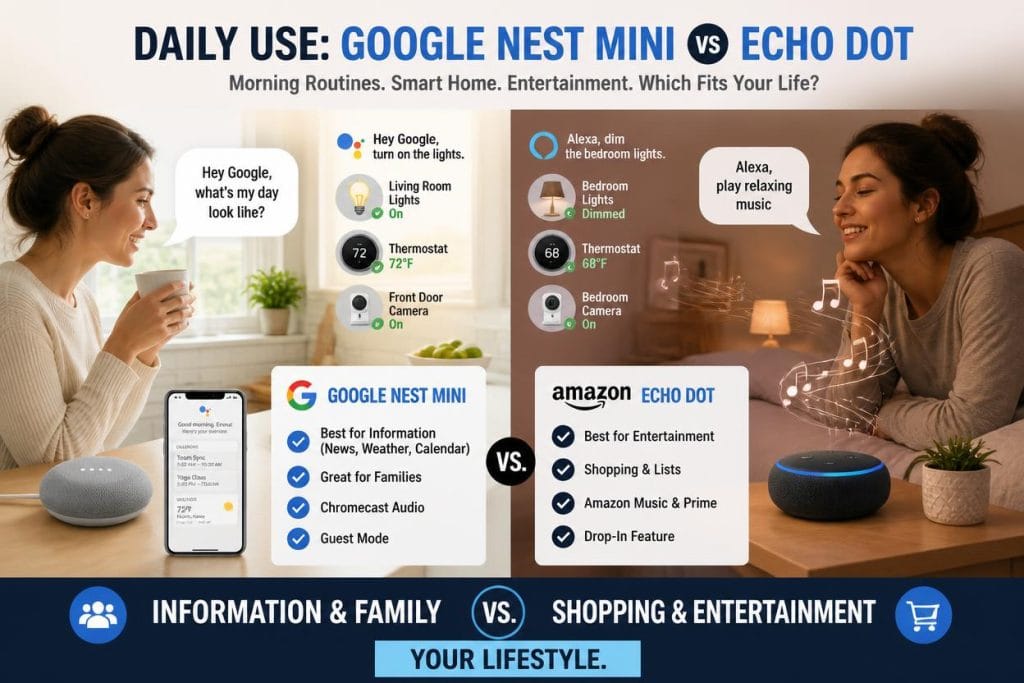
Best for Google Users: Google Nest Mini
If you already use Google services throughout your daily life, the Nest Mini is the obvious starting point.
You will likely spend less time adapting to a new ecosystem because the device fits into the platform you already know.
Best for Alexa Users: Amazon Echo Dot
If Alexa is already part of your home, the Echo Dot is the natural choice.
Adding another Alexa device can expand voice coverage around your home and give you another convenient point for controlling compatible products.
Best for Smart-Home Beginners: Depends on Your Future Plans
If you have no smart-home devices yet, choose the ecosystem you are most comfortable with and then make future purchases compatible with it.
Do not choose randomly based on a temporary discount if you expect to build a large connected home later.
Best for Small Spaces: Tie
Both speakers are compact and easy to place.
A bedroom, office, kitchen, or apartment can benefit from either option without sacrificing much space.
💡 A Simple Buying Strategy
If you are still unsure after reading this comparison, use this simple strategy:
- Check which voice assistant you prefer.
- Check which smart-home devices you already own.
- Check which platform those devices support.
- Think about which ecosystem you want to expand in the future.
- Compare the current price and available promotions.
- Choose the speaker that fits your existing setup.
This method is much more reliable than simply searching for the speaker with the highest number of features.
🏆 Part 3 Verdict
After comparing value, smart-home functionality, family use, home-office use, kitchen use, bedroom use, connectivity, voice assistants, and expansion potential, the Amazon Echo vs Google Nest Mini battle is still extremely close.
The Google Nest Mini is the better choice for someone who wants Google Assistant, Google Home integration, and a compact speaker that fits naturally into a Google-centered home.
The Amazon Echo Dot is the better choice for someone who wants Alexa, Amazon’s ecosystem, and convenient control of compatible smart-home products.
However, if we judge the two products strictly as smart-home platforms rather than just speakers, the decision becomes much easier: choose the ecosystem you are most likely to continue using.
That decision can save you money in the long run because you will not need to replace compatible devices simply because you chose the wrong platform at the beginning.
For a completely new buyer, both products remain compelling entry points. The final winner will ultimately depend on whether your priorities lean toward Google Assistant and Google Home or Alexa and Amazon’s smart-home ecosystem.
In Part 4, we will move toward the final buying decision and examine the two products from a practical buyer’s perspective, including which one is better for different budgets, what you should check before ordering, common buying mistakes, and which speaker deserves the overall recommendation.
Amazon Echo vs Google Nest Mini: Which One Should You Actually Buy?
At this point, the Amazon Echo vs Google Nest Mini comparison has covered the major differences in design, voice assistants, smart-home compatibility, audio, microphones, everyday use, and overall value. But there is still one question that matters most: if you are ready to buy today, which one should you choose?
The answer is not as simple as saying one speaker is universally better. Both products have a clear purpose, and both can be excellent purchases when matched with the right user. The mistake is buying a smart speaker based only on its appearance or a temporary discount.
A better approach is to think about how you will actually use the device six months from now. Will it sit on a desk and occasionally play music? Will it control smart lights throughout your home? Will your family use it every day? Do you already use Google services? Or is Alexa already connected to your smart-home products?
Those questions can completely change the answer.
💵 Which One Is Better for Budget-Conscious Buyers?
If you are shopping on a budget, both the Google Nest Mini and Amazon Echo Dot are designed to provide smart-speaker functionality without requiring the investment associated with larger premium smart displays or high-end speakers.
However, the cheapest product is not always the best bargain.
Suppose the Nest Mini costs slightly less during a particular promotion, but all of your smart-home devices are designed around Alexa. Saving a few dollars on the speaker may not be worth the inconvenience of using a different ecosystem.
The opposite is also true.
If you already use Google Home products, buying an Echo Dot simply because it happens to be discounted could create an unnecessary second ecosystem in your home.
For budget-conscious shoppers, the smartest strategy is therefore to consider the total cost of ownership, not just the checkout price.
What Should You Look for Before Buying?
- Current retail price
- Compatibility with your existing smart-home devices
- Voice assistant preference
- Music services you regularly use
- Wi-Fi reliability in the intended room
- Future smart-home expansion plans
- Available retailer promotions or bundles
This approach can prevent you from spending money twice later.
🏠 Which One Is Better for a Small Apartment?
If you live in an apartment, dorm, studio, or other relatively compact space, either device can make sense.
The compact form factor is one of the biggest advantages of both speakers. You do not need a large entertainment cabinet or dedicated speaker stand.
A Nest Mini can sit on a small shelf or kitchen counter, while an Echo Dot can perform a similar role on a desk, nightstand, or another convenient surface.
For a small apartment, smart-home functionality can actually be more useful than raw speaker volume.
You may want to control lights, plugs, or other compatible devices without walking around the room. A small voice-controlled speaker can make those simple tasks much easier.
If your apartment already uses Google Home, choose the Nest Mini. If it uses Alexa, choose the Echo Dot.
If you are starting from scratch, choose the platform you expect to use for future smart-home purchases.
🏡 Which One Is Better for a Large Home?
Large homes introduce a different consideration: voice coverage.
One smart speaker may not be enough if you want to interact with a voice assistant from multiple rooms.
In that situation, the advantage of choosing an ecosystem becomes even more important because you may eventually want several compatible speakers throughout the house.
You could place one speaker in the kitchen, another in the bedroom, another in the office, and another in a living area depending on your needs.
The key is consistency.
Using the same ecosystem throughout your home can make your setup easier to understand and manage.
If you are building a larger smart home around Alexa, multiple Echo devices can make sense. If you are building around Google Home, multiple compatible Google speakers can provide a similarly unified experience.
👨💼 Which One Is Better for Productivity?
A smart speaker can become a surprisingly useful productivity tool.
You can use voice commands for supported reminders, timers, information, and other everyday tasks while keeping your hands on whatever you are doing.
This is particularly useful when you work from home.
Imagine working on a project and wanting to set a quick timer without interrupting your workflow. Instead of unlocking your phone, finding the correct app, and entering the timer manually, you can simply speak to your smart speaker.
The same concept applies to cooking, exercising, cleaning, organizing, and other situations where your hands are occupied.
The Nest Mini and Echo Dot can both serve this role, but your preferred ecosystem should determine the winner.
🗣️ Which Voice Assistant Feels More Natural?
Voice assistants are highly personal.
Some users prefer the way Google Assistant handles questions and information. Others prefer the Alexa experience and its integration with smart-home devices and Amazon’s ecosystem.
The best way to think about this is not “Which assistant is objectively smarter?” but rather “Which assistant fits the tasks I actually perform?”
If your typical requests involve Google-oriented services and information, the Nest Mini may feel more natural.
If your typical requests involve Alexa routines, smart-home controls, and Amazon-connected services, the Echo Dot may feel more intuitive.
Both assistants continue to evolve, and features can change over time. Therefore, buyers should avoid choosing a device based on a single feature that may change later.
🎙️ Which One Is Better for Noisy Environments?
Voice recognition becomes especially important in kitchens, living rooms, and family spaces where background noise is common.
The Nest Mini has three far-field microphones designed to pick up voice commands from around the room.
The Echo Dot is also designed for hands-free interaction with Alexa.
In practice, placement can be just as important as the microphone hardware.
If you place either speaker next to a television or another loud audio source, you are creating a difficult environment for voice recognition.
A better setup is to place the speaker in an open area where your voice can reach it clearly.
If you frequently use the speaker while music is playing, consider placing it somewhere that gives the microphones a relatively unobstructed path toward the areas where you normally speak.
Neither product should be described as completely immune to background noise. Smart speakers are microphones listening for voice commands, and physical room conditions will always influence performance.
🎧 Which One Is Better for Music?
If music is your top priority, you should set realistic expectations.
These are compact smart speakers rather than full-sized entertainment systems.
The Nest Mini’s 40 mm speaker and 360-degree sound design make it useful for casual listening, background music, podcasts, and spoken content.
The Echo Dot is similarly positioned as a compact smart speaker with voice-controlled entertainment capabilities.
For everyday listening, either can be enjoyable.
For serious music listening, however, a larger speaker will usually provide a more spacious presentation, stronger bass, and greater volume capability.
This leads to an important buying rule: buy the Nest Mini or Echo Dot for smart functionality first and audio second.
If you need both advanced smart-home control and premium audio, you may eventually want to combine a smart speaker with a larger dedicated audio system.
🔌 Which One Makes More Sense for a Smart Home?
This is arguably where the two products differ the most.
Smart-home compatibility can influence the devices you purchase for years.
If you choose Alexa as the foundation of your home, you may naturally begin purchasing products that support Alexa.
If you choose Google Home, you may naturally look for products that integrate with Google’s ecosystem.
This is not necessarily a bad thing. Having a central ecosystem can actually make your smart home easier to manage.
The problem occurs when buyers fail to check compatibility before purchasing.
Before adding a smart device, look for clear compatibility information. If a product supports multiple ecosystems, check whether the exact features you want are available on each platform.
A smart bulb may work with both platforms, for example, but certain advanced features may depend on the ecosystem or service you use.
Always check before ordering.
🔄 What About Matter?
Matter has become increasingly important in the smart-home market because it is designed to improve interoperability between supported smart-home platforms and devices.
The Google Nest Mini supports Matter-compatible smart-home functionality according to Google’s specifications.
This is an attractive feature for buyers who are building a modern smart home and want more flexibility when selecting compatible devices.
However, Matter should not be treated as a guarantee that every smart-home product will work identically across every platform.
Compatibility still depends on the individual device, platform, controller, network configuration, and supported features.
If you are buying smart-home products specifically because of Matter, verify the manufacturer’s compatibility information before purchasing.
📦 What Should You Check on the Product Listing?
When buying through Amazon or another retailer, it is easy to focus on the product photo and price while overlooking important details.
Before clicking the purchase button, check the current product listing carefully.
- Confirm the exact model.
- Check the current price.
- Read the current compatibility information.
- Look at the latest customer feedback.
- Check whether the seller is reputable.
- Review the return policy.
- Confirm what accessories are included.
- Check the current availability.
Product listings can change, and prices may fluctuate depending on promotions, inventory, and seller activity.
This is particularly important with older or frequently discounted smart-home products.
⚠️ Common Mistakes Buyers Make
1. Buying Based Only on Price
A low price is attractive, but it should not be the only factor.
A speaker that does not integrate with your smart-home system may end up costing more in the long run.
2. Ignoring Ecosystem Compatibility
This is probably the biggest mistake.
Always check whether your existing devices work with Alexa or Google Home before making a decision.
3. Expecting Premium Audio
Neither compact speaker is intended to replace a large premium audio system.
They are designed primarily around convenience, voice assistance, and smart-home functionality.
4. Placing the Speaker in a Poor Location
Do not hide the speaker behind a television, inside a cabinet, or next to a loud appliance.
Good placement can make voice interaction much more convenient.
5. Buying Too Many Smart Devices Too Quickly
Once you buy your first smart speaker, it can be tempting to automate everything immediately.
A better strategy is to start with devices that solve actual problems.
For example, smart lighting may be useful because you regularly forget to turn lights off. A smart plug may be useful because you want scheduled control of a compatible appliance.
Build your system around convenience rather than technology for its own sake.
💡 Which Smart Speaker Is Better for Beginners?
For a complete beginner, both are reasonable choices.
The deciding factor should be which ecosystem you are most comfortable with.
If you use Google services heavily, the Nest Mini may be easier to understand because it fits into a familiar environment.
If you already use Amazon services and want Alexa, the Echo Dot is likely to feel more natural.
There is no reason to make the decision more complicated than that.
💡 Which One Should You Buy as a Second Smart Speaker?
If you already own one smart speaker, buying another speaker from the same ecosystem is usually the simplest approach.
For example, if you already use Alexa throughout your home, another Echo-compatible device can expand coverage.
If you already use Google Home, adding another Google-compatible speaker can create a more consistent experience.
Mixing ecosystems is possible, but it can make your smart home more complicated.
Unless you have a specific reason to use multiple platforms, consistency is usually easier.
🆚 Amazon Echo vs Google Nest Mini: Direct Buyer Comparison
| Buyer Type | Recommended Product | Main Reason |
|---|---|---|
| Google Home User | Google Nest Mini | Fits naturally into the existing Google ecosystem. |
| Alexa User | Amazon Echo Dot | Provides a natural extension of an Alexa-based setup. |
| First Smart Speaker | Either | Choose based on the ecosystem you want to build. |
| Smart-Home Beginner | Either | Both can serve as a starting point for compatible devices. |
| Google-Focused Household | Google Nest Mini | Better fit for Google Home users. |
| Amazon-Focused Household | Amazon Echo Dot | Better fit for Alexa users. |
| Small Apartment | Either | Both have compact designs suitable for small spaces. |
| Multiple-Room Setup | Match Existing Ecosystem | Consistency makes expansion easier. |
| Casual Music | Either | Both are suitable for everyday background audio. |
| Premium Music | Neither | A larger dedicated speaker is a better choice. |
🏆 My Recommendation: Amazon Echo Dot or Google Nest Mini?
After looking at both products from the perspective of a real buyer, the recommendation becomes much clearer.
Choose the Google Nest Mini if Google Assistant and Google Home are already part of your daily life.
Its compact design, three far-field microphones, 40 mm speaker, wireless connectivity, and smart-home capabilities make it a practical choice for everyday use. The addition of Matter support for compatible devices also gives it relevance in modern smart-home setups.
Choose the Amazon Echo Dot if Alexa is the ecosystem you want to build around.
The Echo Dot can become much more than a small speaker when it is connected to compatible smart-home devices. For users who want voice-controlled routines and Alexa-based automation, it can be a very practical starting point.
But if I had to choose one for the average buyer who has not yet committed to either ecosystem, I would give a slight overall edge to the Amazon Echo Dot because Alexa’s role as a smart-home voice interface makes the Echo platform particularly appealing for people who intend to expand their connected home over time.
That is not a claim that the Echo Dot is universally superior. A Google-focused user should still choose the Nest Mini.
The winner is ultimately determined by what you want your smart home to become.
🏆 Why I Give the Echo Dot the Overall Edge
The Echo Dot gets the overall recommendation because its value becomes more obvious as your smart-home setup grows.
A simple speaker can play music. A smart speaker can do much more.
When you connect compatible lights, plugs, thermostats, switches, and other devices, the speaker can become a central point for everyday control.
That makes the Echo Dot a particularly attractive option for someone who wants to start small but has plans to build a connected home.
The compact design also makes it easy to add another unit later if you want voice access in different rooms.
For shoppers who already use Alexa, the recommendation becomes even stronger because there is no need to introduce another voice ecosystem.
🌟 When the Google Nest Mini Is Actually the Better Choice
There is one important exception to the recommendation above: if your digital life is already centered around Google, the Nest Mini may be the better purchase by a significant margin.
If you use Google Home-compatible products and prefer Google’s voice assistant experience, buying an Echo Dot simply because it wins a general comparison would make little sense.
The Nest Mini’s strength is ecosystem integration.
A smart speaker should fit into your home rather than force you to redesign your home around it.
For a Google-focused household, the Nest Mini is therefore the smarter choice.
🛍️ Where Should You Buy?
If you are ready to purchase, check the current product listing before ordering. Prices, availability, bundles, and promotions can change, so the current listing is the best place to verify what you will actually receive.
Shop the Google Nest Mini
Shop the Amazon Echo Dot
💭 Is Either One Worth Buying in 2026?
Yes, for the right user.
Smart speakers remain useful because they solve a simple problem: they give you hands-free access to everyday digital functions.
You do not need to take out your phone every time you want to set a timer, ask a question, play supported audio, or interact with a compatible smart-home device.
The important thing is to buy a speaker that matches your ecosystem.
If you make that choice correctly, even a small device can become one of the most frequently used pieces of technology in your home.
❓ Frequently Asked Questions
Is the Google Nest Mini better than the Amazon Echo Dot?
Neither is universally better. The Google Nest Mini is a stronger choice for users who prefer Google Assistant and Google Home, while the Echo Dot is a stronger choice for users who prefer Alexa and Amazon’s smart-home ecosystem.
Can I use both Google Nest Mini and Amazon Echo Dot in the same home?
Yes, you can have devices from both ecosystems in the same home. However, managing two different voice-assistant platforms can be more complicated than choosing one ecosystem and building around it.
Which one should I buy for a smart home?
Choose the speaker that matches the smart-home devices you already own or plan to purchase. If most of your products support Alexa, choose the Echo Dot. If your home is centered around Google Home, choose the Nest Mini.
⚠️ Important Buying Notes
- Check the current product price before purchasing.
- Verify compatibility with your existing smart-home products.
- Check the exact model listed by the retailer.
- Review the latest product information because specifications and features can change.
- Do not expect a compact smart speaker to replace a premium home audio system.
- Place the speaker in an open location for the best voice interaction.
- Review privacy and account settings after setup.
🔜 Coming in Part 5
In Part 5, we will bring the entire Amazon Echo vs Google Nest Mini comparison together with the final verdict, detailed winner breakdown, final pros and cons, buying recommendation, value analysis, and a clear answer to the biggest question: which smart speaker is actually worth your money in 2026?
Amazon Echo vs Google Nest Mini: Final Verdict for 2026
After comparing the two smart speakers from almost every practical angle, it is finally time to answer the question that brought us here: Amazon Echo vs Google Nest Mini — which one is worth your money in 2026?
Both speakers can make your home smarter, more convenient, and easier to control. Both can provide hands-free voice assistance, play audio, answer supported questions, and work with compatible smart-home products. Both are also compact enough to fit naturally into bedrooms, kitchens, offices, and living spaces.
But they are not identical products.
The biggest difference is the ecosystem behind each speaker. The Google Nest Mini is built around Google’s smart-home and voice-assistant experience, while the Amazon Echo Dot is built around Alexa and the Amazon ecosystem.
That difference is more important than a small specification advantage because your smart speaker can eventually become the central voice interface for your home.
If you choose the wrong ecosystem, you may find yourself working around compatibility limitations or maintaining multiple systems. If you choose the right one, the speaker can become a natural part of your daily routine.
🏆 The Overall Winner: Amazon Echo Dot
After considering everyday usability, smart-home potential, ecosystem integration, expansion possibilities, and overall value, the Amazon Echo Dot earns our overall recommendation.
The reason is simple: Alexa makes the Echo Dot particularly useful as the foundation of an expanding smart home. Instead of thinking about it as a small speaker, you can think of it as a voice-controlled access point to compatible smart-home products and Alexa experiences.
That distinction gives the Echo Dot long-term potential.
You can start with the speaker itself and later add compatible smart lights, smart plugs, thermostats, switches, appliances, and other devices. As the number of connected products increases, the usefulness of having a central voice assistant can increase as well.
For someone starting a smart-home journey in 2026, that flexibility is a major advantage.
However, this does not mean that everyone should buy the Echo Dot.
🥈 The Best Alternative: Google Nest Mini
The Google Nest Mini remains an excellent choice, particularly for users already invested in Google services and Google Home.
Its compact form factor, Google Assistant experience, three far-field microphones, 40 mm speaker, wireless connectivity, and compatibility with supported smart-home products make it a capable everyday device.
Google also lists Matter support for compatible smart-home functionality, which is useful for people building a more modern connected home.
If your home already includes Google Home-compatible products, the Nest Mini may actually be the better purchase for you.
In other words, our overall winner does not automatically become the winner for every individual buyer.
Your existing ecosystem should always come first.
🆚 Amazon Echo vs Google Nest Mini: Final Category Winners
| Category | Winner | Reason |
|---|---|---|
| Overall Smart Home | Amazon Echo Dot | Excellent foundation for an Alexa-based connected home. |
| Google Ecosystem | Google Nest Mini | Natural choice for Google Home users. |
| Alexa Ecosystem | Amazon Echo Dot | Built around Alexa and compatible Alexa experiences. |
| Voice Assistant | Depends on Preference | Google Assistant and Alexa each suit different users. |
| Smart Home Expansion | Amazon Echo Dot | Strong choice for users planning an Alexa-based ecosystem. |
| Google Home Integration | Google Nest Mini | Designed for Google’s smart-home environment. |
| Compact Design | Tie | Both are designed to fit into small spaces. |
| Casual Music | Tie | Both are suitable for everyday background listening. |
| Premium Audio | Neither | A larger dedicated speaker is better for serious music listening. |
| First Smart Speaker | Depends on Ecosystem | Choose the platform you plan to use long term. |
| Overall Value | Amazon Echo Dot | Particularly attractive for buyers planning a larger Alexa smart home. |
🔊 Audio: Don’t Buy Either One for Bass Alone
One of the easiest mistakes to make when shopping for a smart speaker is expecting too much from a compact enclosure.
The Google Nest Mini includes a 40 mm speaker and 360-degree sound, making it suitable for casual audio throughout a room.
The Echo Dot is also designed as a compact smart speaker rather than a full-size entertainment system.
Both can be useful for podcasts, radio, background music, voice responses, timers, and everyday entertainment.
But if your primary goal is powerful bass, wide stereo separation, or high-volume music playback, neither should be your first choice.
Instead, consider these products as smart-home devices that happen to provide convenient audio.
That is the right way to evaluate them.
🎙️ Voice Recognition: What Really Matters
Voice recognition is another area where expectations need to be realistic.
The Google Nest Mini uses three far-field microphones designed to hear voice commands from around the room.
The Echo Dot is similarly built around hands-free Alexa interaction.
In a normal room, both can be convenient. But background noise can affect any voice-controlled speaker.
If you regularly use your speaker while the television is playing, people are talking, or kitchen appliances are operating, placement becomes especially important.
Keep the speaker in an open position whenever possible.
Do not bury it behind furniture. Do not put it inside a cabinet. Avoid placing it directly beside another loudspeaker.
A good physical setup can make a noticeable difference in everyday usability.
🏠 Which One Is Better for Smart-Home Automation?
If automation is the main reason you are buying a smart speaker, the Echo Dot gets a slight advantage in our overall recommendation.
Alexa can act as the voice interface for compatible smart-home devices, allowing users to interact with supported products through voice commands and Alexa routines. Amazon describes Echo devices as supporting smart-home control along with other Alexa experiences.
This makes the Echo Dot particularly attractive to users who want to build an Alexa-centered home.
The Nest Mini is still an excellent smart-home option, especially for Google Home users and households using compatible Matter devices.
So the difference is not that one is a “smart” speaker and the other is not.
Both are smart speakers.
The difference is which smart-home ecosystem you want to use.
💡 Why Ecosystem Choice Matters More Than You Think
Imagine that you buy an Echo Dot today.
A few months later, you purchase smart bulbs, smart plugs, a thermostat, and other compatible products. You then create routines and become comfortable with Alexa.
At that point, Alexa is no longer just an assistant. It has become part of your home’s infrastructure.
The same thing can happen with Google Home.
This is why choosing a smart speaker is different from choosing an ordinary Bluetooth speaker.
A Bluetooth speaker can be replaced relatively easily.
An ecosystem is harder to replace because it can involve multiple devices, routines, accounts, and habits.
Choose the platform you expect to stay with for the next several years.
💰 Is the Amazon Echo Dot Worth Buying?
Yes, the Echo Dot is worth considering if you want Alexa and plan to use its smart-home capabilities.
Its compact design makes it easy to place around your home, while Alexa gives it functionality beyond basic audio playback.
The value becomes even stronger if you already own compatible Alexa products.
For example, someone with several Alexa-compatible smart lights and plugs can potentially use the Echo Dot as a convenient voice-control point.
That is much more useful than buying it only to play music occasionally.
If you are going to use Alexa regularly, the Echo Dot can become one of those devices you wonder how you lived without.
💰 Is the Google Nest Mini Worth Buying?
Yes, particularly for Google-focused households.
The Nest Mini offers a compact way to access Google’s voice-assistant experience and compatible smart-home functionality.
Its small size makes it easy to place around the home, while its three far-field microphones are designed for hands-free interaction.
The 40 mm speaker and 360-degree audio design are also appropriate for casual everyday listening.
If you already use Google Home, choosing the Nest Mini can be a much more logical decision than switching to Alexa simply because another comparison gives the Echo Dot a general advantage.
🎯 Choose Amazon Echo Dot If…
- You want Alexa as your primary voice assistant.
- You plan to build an Alexa-based smart home.
- You already own Alexa-compatible smart-home products.
- You want voice control for compatible devices.
- You want to create Alexa routines for supported devices.
- You want a compact smart speaker that can expand with your home.
- You prefer Amazon’s ecosystem.
🎯 Choose Google Nest Mini If…
- You already use Google Home.
- You prefer Google Assistant.
- You use Google services heavily.
- You already own compatible Google smart-home devices.
- You want a compact Google-powered smart speaker.
- You want access to compatible Matter smart-home functionality.
- You prefer Google’s ecosystem.
❌ Who Should Avoid Both?
There are also situations where neither product is the ideal purchase.
If your number-one priority is high-end music quality, you should probably invest in a larger dedicated speaker instead.
If you do not plan to use voice commands or smart-home features, a standard Bluetooth speaker may provide better value for your specific needs.
Likewise, if you have serious privacy concerns about connected microphones in your home and do not want to manage the available privacy controls, a smart speaker may not be the right category for you.
The best product is not necessarily the one with the most features. It is the one whose features you will actually use.
🧠 Our Final Buying Advice
Before buying either speaker, ask yourself five questions:
- Which voice assistant do I prefer?
- Which smart-home devices do I already own?
- Which ecosystem do those devices support?
- Which platform do I want to use long term?
- Will I actually use voice and smart-home features every day?
If you answer these questions honestly, the decision becomes much easier.
Do not get distracted by small specification differences that will have little impact on your everyday experience.
The biggest difference between these two products is the ecosystem.
🏆 Final Verdict: Amazon Echo vs Google Nest Mini
So, which one is worth your money in 2026?
Our overall winner is the Amazon Echo Dot.
It earns the recommendation because it offers a particularly compelling combination of compact design, Alexa functionality, smart-home potential, and long-term expansion possibilities.
For someone who wants to start building an Alexa-based smart home, the Echo Dot is an easy product to recommend.
But there is an important qualification.
If you are already deeply invested in Google Home, choose the Google Nest Mini instead.
There is no benefit in switching ecosystems just to follow a general winner. The Nest Mini can be the better product for a Google-focused household because it fits naturally into the devices and services you already use.
Therefore, our final ranking looks like this:
| Rank | Product | Best For |
|---|---|---|
| 🏆 1 | Amazon Echo Dot | Alexa users and buyers building a smart home |
| 🥈 2 | Google Nest Mini | Google Home users and Google-focused households |
🔥 Final Recommendation
If you want my straightforward advice, choose the Amazon Echo Dot if you are starting a smart home from scratch and want Alexa at the center of your setup.
Choose the Google Nest Mini if Google Assistant and Google Home are already part of your everyday digital life.
That is the simplest and most practical way to decide.
Do not buy based only on which speaker looks better or which one happens to have a temporary discount. Think about the ecosystem first, then the speaker.
When you make that decision correctly, either product can be a smart purchase.
🛒 Ready to Buy?
If you have decided which ecosystem fits your home, check the current product listing before placing your order. Prices, availability, promotions, and seller information can change, so always verify the latest details before purchasing.
Shop the Google Nest Mini
Shop the Amazon Echo Dot
❓ Frequently Asked Questions
Is Amazon Echo Dot better than Google Nest Mini?
For our overall ranking, the Amazon Echo Dot gets the edge because of its strong Alexa ecosystem and smart-home potential. However, the Google Nest Mini is the better choice for users already invested in Google Home and Google services.
Can Google Nest Mini and Echo Dot control smart-home devices?
Yes. Both can work with compatible smart-home devices through their respective ecosystems. Always check the compatibility of your specific device and the features you want before purchasing.
Which is better for music, Amazon Echo Dot or Google Nest Mini?
Both are suitable for casual listening, podcasts, and background audio. Neither should be considered a replacement for a larger premium speaker if high-end music performance is your primary goal.
Which one is easier to use?
Both are designed for straightforward voice interaction. The easier option is usually the one that matches the ecosystem you already understand and use.
Should I buy a smart speaker if I am building a smart home?
Yes, a smart speaker can be a convenient starting point because it can provide a voice interface for compatible devices. The most important decision is choosing an ecosystem that supports the products you plan to use.
⚠️ Important Notes Before Purchasing
- Prices may change after this review is published.
- Product availability may vary by retailer and location.
- Smart-home compatibility can change as manufacturers update products and software.
- Check the exact model and current specifications before purchasing.
- Confirm that your existing smart-home products are compatible with your preferred ecosystem.
- Review current privacy settings after installation.
- Do not expect either compact speaker to replace a dedicated premium audio system.
📌 Final Thoughts
The Amazon Echo vs Google Nest Mini comparison ultimately comes down to one simple decision: Alexa or Google Home?
The Echo Dot is our overall winner because it provides an attractive entry point into Alexa-powered smart-home control and can become more useful as your collection of compatible devices grows.
The Nest Mini is the smarter choice for people who already live inside Google’s ecosystem and want a compact speaker that naturally fits their existing setup.
Both products can make everyday life easier. Both can provide hands-free assistance. Both can work as convenient smart-home control points. And both are compact enough to disappear into your home rather than dominate it.
But if you want one clear recommendation from this Amazon Echo vs Google Nest Mini review, the Amazon Echo Dot is our overall pick for 2026—especially for buyers who are starting or expanding an Alexa-based smart home.
If Google Home is already the foundation of your connected home, however, do not hesitate to choose the Nest Mini. In that situation, ecosystem compatibility makes it the smarter purchase.
Choose the ecosystem first. Choose the speaker second. That is the best way to make sure your money is well spent.
NuWave Bravo Smart Oven: 7 Ways It Transforms Cooking

Adrian
Just like you, I was tired of paying crazy electricity bills every month. Today, after 4 years of trial and error, my smart home uses less than half the energy it used to. I share everything I’ve learned — so you don’t have to make the same mistakes.
Let’s Connect ↓
Adrian — Owner of EcoNex
Solar | Smart Home | Lower bills