Table of contents
Table of Contents
Introduction – BLUETTI EP900 vs Tesla Powerwall 3 – Which One Should You Buy?
Let’s be honest—the decision to install a home battery is a big one. It’s not like buying a new phone or even a car. You’re essentially rewiring how your home gets its power, and you’re making a decade-long bet on a technology that’s still evolving. Get it right, and you’ll have backup power, lower bills, and peace of mind. Get it wrong, and you’ll be stuck with a system that doesn’t quite fit your needs or your budget.
In 2026, two names dominate the conversation for homeowners who want serious whole-home backup: BLUETTI and Tesla. The BLUETTI EP900 is the modular, installer-friendly challenger that promises flexibility and a lightning-fast switchover. The Tesla Powerwall 3 is the undisputed heavyweight champion—the most popular battery in America, with an integrated inverter and a software ecosystem that’s years ahead of the competition.
This brings us to the ultimate debate: BLUETTI EP900 vs Tesla Powerwall 3 – which one truly delivers the best balance of power, scalability, and value for your home? In this comprehensive review, I’m breaking down everything you need to know about the BLUETTI EP900 vs Tesla Powerwall 3 showdown.
We’ll be comparing the BLUETTI Home Battery Backup EP900 + B500 and the Tesla Powerwall 3 across the categories that actually matter: continuous power, modularity, efficiency, and real-world costs. By the time you finish reading this BLUETTI EP900 vs Tesla Powerwall 3 comparison, you’ll know exactly which one belongs on your wall.
Let’s dive into this BLUETTI EP900 vs Tesla Powerwall 3 battle and find out which one truly delivers the best value for your money in 2026.
BLUETTI EP900 + B500 – Modular Power with DIY-Friendly Installation
Overview
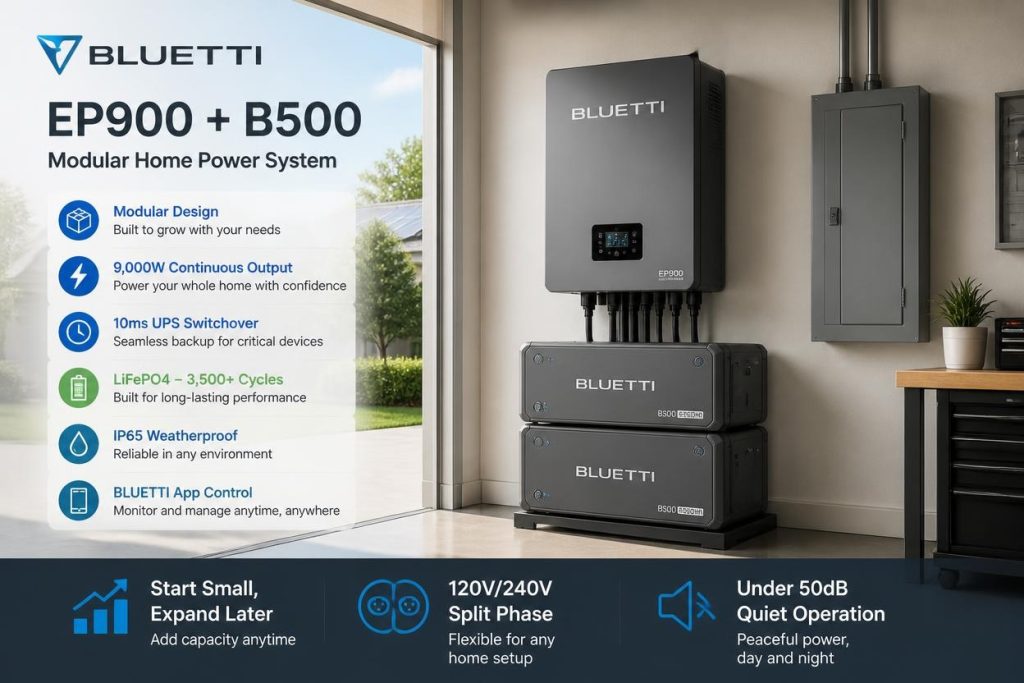
The BLUETTI Home Battery Backup EP900 is a serious contender in the BLUETTI EP900 vs Tesla Powerwall 3 debate, and it’s built for homeowners who want control. The EP900 is a hybrid inverter that pairs with stackable B500 battery modules, each offering roughly 5 kWh of usable capacity.
When you’re comparing BLUETTI EP900 vs Tesla Powerwall 3, the first thing you’ll notice about the BLUETTI is its modular design. You don’t buy one giant fixed battery. You start with a base unit and two B500 modules for about 9.9 kWh of capacity, then add modules as your needs grow—up to four modules per system for 19.8 kWh. And if that’s still not enough, you can install a second EP900 system for a total of 39.6 kWh. It’s a LEGO approach to home energy, and it’s genuinely appealing for anyone who wants to scale gradually without replacing the whole system.
What really sets the EP900 apart in the BLUETTI EP900 vs Tesla Powerwall 3 comparison is its 9 kW continuous output. That’s enough to run central air conditioning, a well pump, and major appliances simultaneously during an outage. For most homes, that’s whole-home backup territory, and you get that power regardless of how many battery modules you install—a rarity in the market.
The 120V/240V split-phase output is another standout feature. It means the EP900 can natively power heavy 240V loads like dryers and EV chargers without needing an autotransformer. That’s a practical advantage that simplifies installation and reduces cost.
The switchover time is where the EP900 truly shines. BLUETTI claims a sub-10ms transfer, which is true UPS-grade. Your desktop computer won’t even reboot, your router won’t drop, and your smart home devices won’t miss a beat. For anyone who works from home or runs sensitive electronics, that’s a genuinely valuable feature.
The EP900 is also designed for simpler installation than Tesla’s ecosystem. BLUETTI ships the unit to you or your electrician, and a licensed professional can typically complete the install in about half a day. You’re not locked into a proprietary installer network, which means you can shop around for competitive quotes and use someone you trust.
For anyone seriously considering the BLUETTI EP900 vs Tesla Powerwall 3 decision, the BLUETTI represents the best choice for homeowners who value modularity, fast switchover, and installation flexibility.
✅ Key Features
- 9 kW Continuous Output: Powers most whole-home loads, including HVAC and heavy appliances.
- Modular B500 Batteries: Start at 9.9 kWh and expand to 19.8 kWh per system, or 39.6 kWh with two systems.
- Sub-10ms Switchover: UPS-grade transfer keeps sensitive electronics running without interruption.
- 120V/240V Split-Phase Output: Native support for heavy 240V loads without an autotransformer.
- Installer-Friendly: Can be installed by any licensed electrician—no proprietary network required.
- IP65 Weather Rating: Suitable for indoor or outdoor installation.
- LiFePO4 Chemistry: 3,500+ cycles and a 10-year warranty.
- Dual MPPT Solar Input: Up to 9 kW of solar charging for integrated renewable energy.
❌ Limitations
- Lower Round-Trip Efficiency: At 85%, it’s below the 90%+ industry average, meaning more energy is lost during storage.
- Limited Maximum Capacity: 19.8 kWh per system is modest compared to Tesla’s 54 kWh stacking.
- Newer Product: Long-term reliability data is still accumulating compared to Tesla’s decade of real-world deployment.
- Less Polished Software: The BLUETTI app is functional but lacks the refinement of Tesla’s ecosystem.
❓ How does the 9,000W continuous output handle whole-home backup during an outage?
In the BLUETTI EP900 vs Tesla Powerwall 3 comparison, the EP900’s 9 kW output is genuinely capable of whole-home backup for most households. It can run central air conditioning (typically 3-5 kW), a refrigerator, lights, a well pump, and electronics simultaneously without tripping. The key advantage is that you get this full 9 kW regardless of how many battery modules you’ve installed—even the base 9.9 kWh configuration delivers the full output. The limitation is runtime: with only 9.9 kWh of usable capacity, heavy loads will drain the battery quickly. A single Powerwall 3 has 13.5 kWh, giving it more runway for the same loads.
❓ Is the modular B500 battery design practical for gradual capacity expansion?
Yes—in the BLUETTI EP900 vs Tesla Powerwall 3 comparison, the modular design is one of BLUETTI’s strongest selling points. Each B500 module adds roughly 5 kWh, so you can start with a smaller investment and add capacity as your budget allows or as your needs change. This is particularly useful if you’re uncertain about how much backup you actually need, or if you plan to add an EV or heat pump later. Tesla’s expansion path is different: you buy a Powerwall 3 with 13.5 kWh, then add Expansion Units in 13.5 kWh increments—fewer, larger jumps. BLUETTI’s finer granularity is more flexible for smaller homes or phased budgets.
❓ How does the 85% round-trip efficiency affect long-term energy savings and solar ROI?
In the BLUETTI EP900 vs Tesla Powerwall 3 comparison, the efficiency gap is real and worth understanding. Round-trip efficiency measures how much energy you get back for every unit you put in. At 85%, the EP900 loses 15% of the energy stored in it. Tesla’s Powerwall 3 achieves around 97.5% efficiency, meaning it loses only 2.5%. Over a decade of daily cycling, that difference adds up. If you’re storing 10 kWh per day, the BLUETTI wastes about 1.5 kWh daily, while the Tesla wastes 0.25 kWh. That’s roughly 456 kWh per year lost with the BLUETTI versus 91 kWh with the Tesla. At average electricity rates, that’s a meaningful difference in long-term savings and solar ROI—one that favors Tesla for anyone planning to maximize their solar investment.
👉🏻 🔥Check the Latest Price on Amazon
Overview
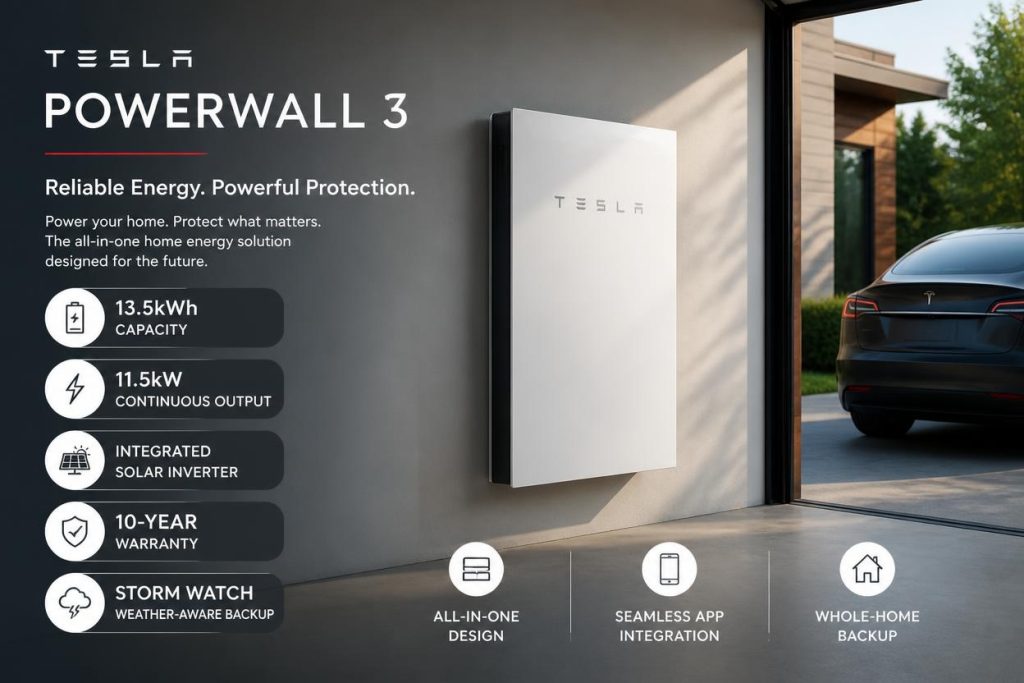
The Tesla Powerwall 3 is the undisputed king of residential batteries in 2026, and it’s the benchmark against which every competitor is measured in the BLUETTI EP900 vs Tesla Powerwall 3 debate. It’s the most popular home battery on the market, and for good reason.
When you’re weighing the BLUETTI EP900 vs Tesla Powerwall 3 decision, the first thing you’ll notice about the Powerwall 3 is its integrated hybrid inverter. This is the headline feature. Unlike previous generations that required a separate solar inverter, the Powerwall 3 combines the solar inverter, battery inverter, and energy management system into one unit. For anyone installing solar and storage together, this simplifies the entire system, reduces equipment costs, and eliminates an extra point of failure.
What really sets the Powerwall 3 apart in the BLUETTI EP900 vs Tesla Powerwall 3 comparison is its continuous power output. At 11.5 kW, it outguns the BLUETTI’s 9 kW. That means it can run more large appliances simultaneously during an outage—central AC, an EV charger, a heat pump, and an electric oven all at once, without throttling. For larger homes or households with high power demands, that extra headroom matters.
The 13.5 kWh usable capacity is standard for the category, but the Powerwall 3’s efficiency is anything but standard. At 97.5% round-trip efficiency, it’s one of the most efficient batteries on the market. You lose almost nothing in the storage process, which maximizes your solar ROI over the system’s lifetime.
The stacking capability is another major advantage. You can install up to four Powerwall 3 units for a total of 54 kWh, giving large homes or off-grid enthusiasts serious capacity. Each additional unit adds both capacity and power, so a multi-unit system can handle virtually any residential load.
The Tesla app is the other killer feature. It’s the most polished energy management software available, with features like Storm Watch (automatically charges the battery to 100% before severe weather), Time-Based Control (charge during cheap rates, discharge during peak), and seamless integration with Tesla vehicles and solar. If you own a Tesla car, the ecosystem value is hard to overstate.
One important caveat: Tesla requires installation through its certified installer network. You can’t buy the Powerwall 3 and hire your own electrician. That limits competitive bidding and means pricing varies by market. In areas with high installer density, prices are competitive. In underserved markets, expect to pay closer to the top of the range.
For anyone seriously considering the BLUETTI EP900 vs Tesla Powerwall 3 decision, the Tesla represents the best choice for maximum power, efficiency, and ecosystem integration.
✅ Key Features
- 11.5 kW Continuous Output: The highest in its class for whole-home backup.
- 13.5 kWh Usable Capacity: Standard capacity with industry-leading efficiency.
- 97.5% Round-Trip Efficiency: Minimal energy loss during storage and discharge.
- Integrated Hybrid Inverter: Simplifies solar-plus-storage installations and reduces costs.
- Stackable to 54 kWh: Up to four units for large homes and extended backup.
- Tesla App Ecosystem: Storm Watch, Time-Based Control, and vehicle integration.
- LFP Chemistry: 10-year warranty with unlimited cycles and 70% capacity retention.
- IP67 Rating: Suitable for indoor or outdoor installation in harsh conditions.
❌ Limitations
- Certified Installer Only: You cannot use your own electrician, which limits competitive pricing.
- Limited Modularity: Expansion units come in 13.5 kWh increments—less granular than BLUETTI.
- Long Wait Times: High demand can mean months of waiting in some markets.
- Inverter Redundancy: If you already have a recent solar inverter, the built-in one is redundant and you lose the cost benefit.
❓ How does the 11.5 kW continuous output change what a household can back up during an outage compared to previous models?
In the BLUETTI EP900 vs Tesla Powerwall 3 comparison, the Powerwall 3’s 11.5 kW output is a generational leap. The Powerwall 2 managed only 7.6 kW, which meant many homeowners had to choose between central AC and other heavy loads during an outage. The Powerwall 3 removes that compromise. You can run central air conditioning, a well pump, a refrigerator, lights, and electronics all at once. You can even charge an EV at a moderate rate while keeping the house comfortable. The extra 2.5 kW over the BLUETTI’s 9 kW might not sound like much, but it’s the difference between “most things work” and “everything works” for larger homes.
❓ Does the integrated hybrid inverter truly simplify installation and reduce overall system cost?
Yes—in the BLUETTI EP900 vs Tesla Powerwall 3 comparison, the integrated inverter is a genuine cost-saver for new solar installations. A standalone solar inverter typically costs $1,500 to $3,000, plus the labor to install it. The Powerwall 3 eliminates that separate component entirely. One installer, one unit, one warranty. For anyone planning to add solar and storage together, the savings are real. The caveat is that if you already have a working solar inverter from a recent installation, the Powerwall 3’s built-in inverter sits unused, and you don’t get that cost benefit. In that scenario, a battery without an integrated inverter—like the BLUETTI—might be more cost-effective.
❓ How reliable is the automatic backup switchover in real-world outages, and what should buyers verify with their installer?
In the BLUETTI EP900 vs Tesla Powerwall 3 comparison, the Powerwall 3’s switchover is generally reliable, but it’s not as fast as the BLUETTI’s sub-10ms claim. Tesla’s Gateway typically switches within 20-100 milliseconds depending on the configuration. For most appliances, that’s imperceptible—lights might flicker slightly, but computers and routers usually ride through it. However, some sensitive equipment may trip. Buyers should verify with their installer whether the system is configured for whole-home backup or essential-circuits backup, as this affects what stays powered. It’s also worth confirming that the Gateway is properly commissioned and tested before the installer leaves, because a misconfigured Gateway can cause frustrating issues during the first real outage.
👉🏻 🔥Check the Latest Price on Amazon
Quick Comparison – BLUETTI EP900 vs Tesla Powerwall 3
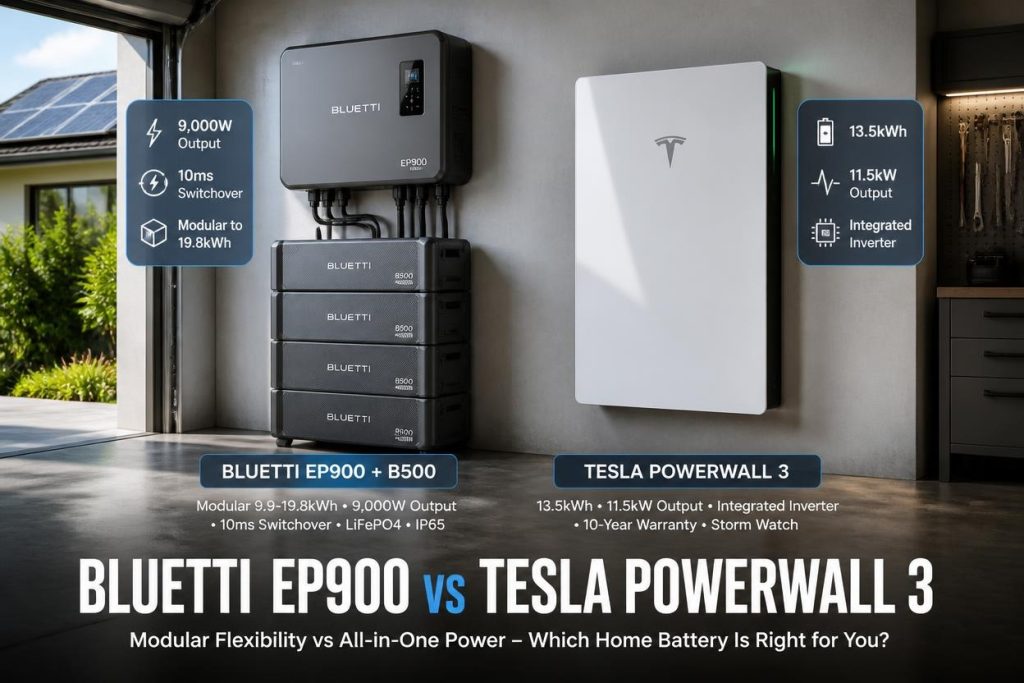
Before we dive deeper into the BLUETTI EP900 vs Tesla Powerwall 3 comparison, here’s a quick side-by-side look at how these two home batteries stack up against each other across all the key categories that matter most to buyers in 2026.
| Feature | BLUETTI EP900 + B500 | Tesla Powerwall 3 |
|---|---|---|
| Price (Installed) | ~$10,000-15,000 (varies) | ~$11,000-16,500 |
| Usable Capacity | 9.9 – 19.8 kWh (per system) | 13.5 kWh (per unit) |
| Continuous Output | 9 kW | 11.5 kW |
| Round-Trip Efficiency | 85% | 97.5% |
| Switchover Time | Sub-10ms (UPS-grade) | ~20-100ms |
| Modularity | 5 kWh increments (B500) | 13.5 kWh increments (Expansion) |
| Max Expandability | 39.6 kWh (two systems) | 54 kWh (four units) |
| Integrated Inverter | Yes (hybrid) | Yes (hybrid, 20 kW solar input) |
| Installation | Any licensed electrician | Tesla Certified Installer only |
| Warranty | 10 years | 10 years, unlimited cycles, 70% retention |
| Best For | Modular budgets, fast switchover, DIY-friendly installs | Maximum power, efficiency, ecosystem integration |
| Overall Value | Excellent for flexibility | Excellent for performance |
Breaking Down the Key Differences in the BLUETTI EP900 vs Tesla Powerwall 3 Comparison
Power: The Tesla wins in the BLUETTI EP900 vs Tesla Powerwall 3 comparison with 11.5 kW versus 9 kW. That extra headroom matters for larger homes and simultaneous heavy loads.
Efficiency: This is the biggest gap in the BLUETTI EP900 vs Tesla Powerwall 3 comparison. Tesla’s 97.5% round-trip efficiency versus BLUETTI’s 85% means significantly less energy wasted over the system’s lifetime. For solar ROI, Tesla is the clear winner.
Modularity: The BLUETTI wins in the BLUETTI EP900 vs Tesla Powerwall 3 comparison for granular expansion. Adding 5 kWh at a time is more flexible than Tesla’s 13.5 kWh jumps.
Switchover: The BLUETTI wins in the BLUETTI EP900 vs Tesla Powerwall 3 comparison for UPS-grade transfer. Sub-10ms is faster than Tesla’s 20-100ms, which matters for sensitive electronics.
Installation: The BLUETTI wins in the BLUETTI EP900 vs Tesla Powerwall 3 comparison for flexibility. Any licensed electrician can install it, opening up competitive pricing. Tesla’s certified installer requirement limits your options.
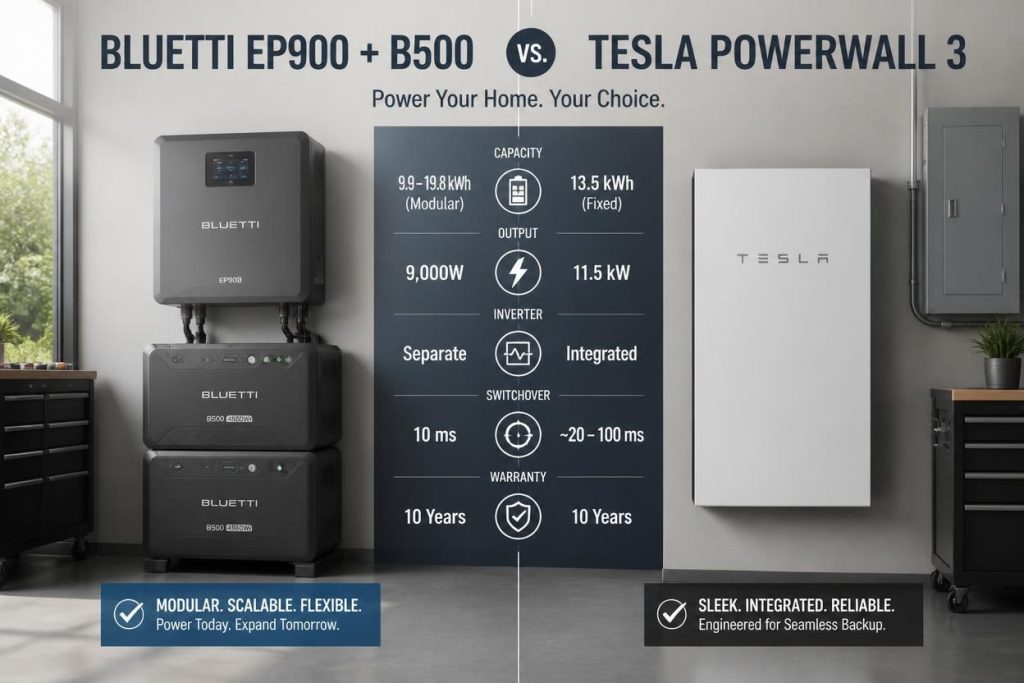
Performance, Price, and Usability – BLUETTI EP900 vs Tesla Powerwall 3
Now that we’ve covered the specs and features in our BLUETTI EP900 vs Tesla Powerwall 3 comparison, let’s get into the real-world performance of both systems. After researching both extensively, I’ve broken down exactly how they perform across the categories that matter most to buyers trying to decide between BLUETTI EP900 vs Tesla Powerwall 3.
Performance – Which One Delivers Better Backup?
The BLUETTI EP900 delivers excellent performance in the BLUETTI EP900 vs Tesla Powerwall 3 comparison. The 9 kW output handles most whole-home loads, and the sub-10ms switchover is genuinely impressive—your electronics won’t even notice the grid went down. The 120V/240V split-phase output is native, so heavy appliances work without extra hardware. The main performance limitation is efficiency: at 85% round-trip, you’re losing more energy than you should, and the 19.8 kWh maximum capacity per system may feel limiting for larger homes or extended outages.
The Tesla Powerwall 3 delivers exceptional performance in the BLUETTI EP900 vs Tesla Powerwall 3 comparison. The 11.5 kW output is the highest in its class, and the 97.5% efficiency means almost nothing is wasted. The integrated inverter simplifies solar installations and maximizes solar self-consumption. The Tesla app is polished and feature-rich, with Storm Watch and Time-Based Control adding genuine value. The switchover is fast enough for most appliances, though not quite UPS-grade.
Which one performs better in the BLUETTI EP900 vs Tesla Powerwall 3 comparison? The Tesla wins for raw power and efficiency. The BLUETTI wins for switchover speed and installation flexibility.
Price – The Budget Factor
Let’s talk money, because this is where the difference in the BLUETTI EP900 vs Tesla Powerwall 3 comparison requires careful consideration.
The BLUETTI EP900 + B500 system starts around $10,000-15,000 installed, depending on configuration and your electrician’s rates. In the BLUETTI EP900 vs Tesla Powerwall 3 price comparison, the modular approach lets you start smaller and expand later, which can be easier on the wallet upfront.
The Tesla Powerwall 3 costs around $11,000-16,500 installed, depending on region and installer. In the BLUETTI EP900 vs Tesla Powerwall 3 comparison, the price is competitive when you factor in the integrated inverter—especially if you’re installing solar at the same time. The 30% federal tax credit applies to both systems, reducing the effective cost significantly.
Which one offers better value in the BLUETTI EP900 vs Tesla Powerwall 3 comparison? The BLUETTI offers better value if you want to start small and expand gradually, or if you already have a solar inverter. The Tesla offers better value if you’re installing solar and storage together, or if you prioritize efficiency and resale value.
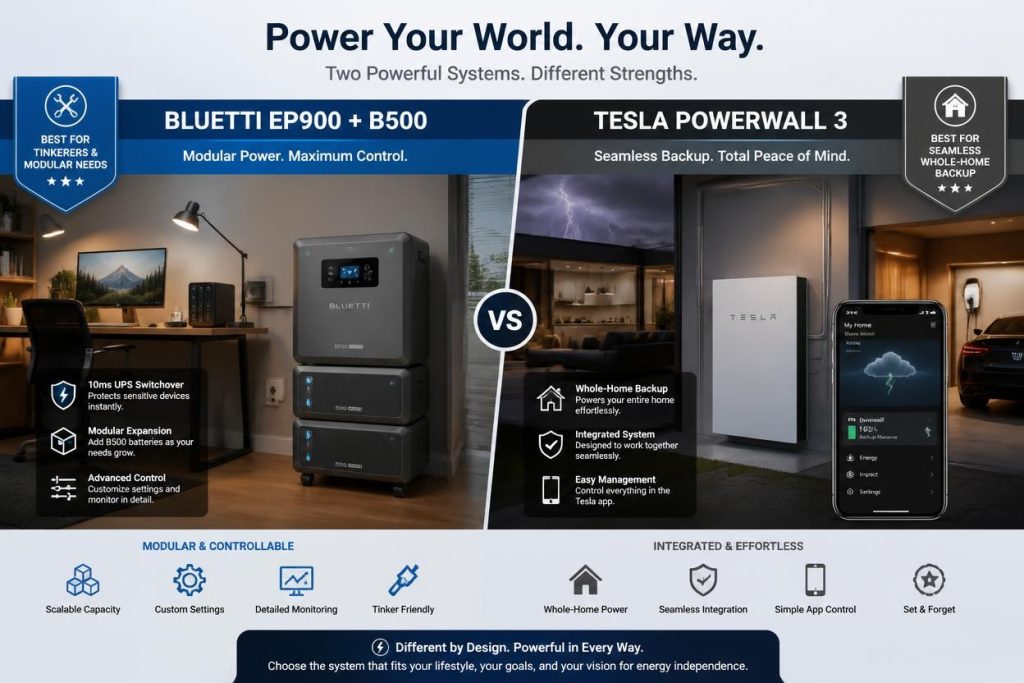
Usability – Which One Is Easier to Live With?
The BLUETTI EP900 is easy to live with in the BLUETTI EP900 vs Tesla Powerwall 3 comparison. The app gives you real-time monitoring and control, and the system is designed for straightforward installation. The modular design means you can add capacity without replacing the whole system. The main usability drawback is the app—it’s functional but not as polished or feature-rich as Tesla’s.
The Tesla Powerwall 3 is exceptionally easy to live with in the BLUETTI EP900 vs Tesla Powerwall 3 comparison. The Tesla app is the best in the business, with intuitive controls, beautiful energy flow visualizations, and features like Storm Watch that automatically prepare your home for severe weather. If you own a Tesla vehicle, the integration is seamless. The main usability drawback is the installer lock-in—you can’t use your own electrician, which can be frustrating if you have a trusted contractor.
Which one is more usable in the BLUETTI EP900 vs Tesla Powerwall 3 comparison? The Tesla wins for software polish and ecosystem integration. The BLUETTI wins for installation flexibility and modular expansion.
Which One Should You Choose?
Choose the BLUETTI EP900 + B500 if:
- You want modular capacity that grows with your needs in 5 kWh increments.
- You already have a solar inverter and don’t need a redundant one.
- You want UPS-grade switchover for sensitive electronics or home office equipment.
- You prefer to use your own trusted electrician rather than a certified installer network.
- You’re on a tighter budget and want to start smaller.
- You want native 120V/240V split-phase output without extra hardware.
Choose the Tesla Powerwall 3 if:
- You want the highest continuous power output (11.5 kW) for whole-home backup.
- You’re installing solar and storage together and want the integrated inverter savings.
- You prioritize efficiency and want the best solar ROI (97.5% round-trip).
- You want the most polished app experience and ecosystem integration.
- You own a Tesla vehicle and want seamless integration.
- You want the most widely installed, proven battery on the market.
Final Verdict – The Winner in 2026
After thoroughly researching both systems for this BLUETTI EP900 vs Tesla Powerwall 3 review, my recommendation goes to the Tesla Powerwall 3 for most homeowners.
Here’s why: The Powerwall 3 delivers more power (11.5 kW vs 9 kW), significantly better efficiency (97.5% vs 85%), and a more polished software experience. The integrated inverter makes it a compelling choice for anyone installing solar and storage together, and the 10-year warranty with unlimited cycles provides peace of mind. The Tesla ecosystem—Storm Watch, Time-Based Control, vehicle integration—is simply unmatched.
That said, the BLUETTI EP900 is an excellent choice for specific scenarios. If you already have a solar inverter, want granular modular expansion, need UPS-grade switchover, or prefer to use your own electrician, the BLUETTI is a strong contender. Its 9 kW output is enough for most homes, and the sub-10ms transfer is genuinely impressive.
In the BLUETTI EP900 vs Tesla Powerwall 3 battle, the Tesla is the better all-rounder for most people, but the BLUETTI wins for flexibility and installation freedom. Choose based on what matters most to you.
Ready to Buy? Shop Now
🔥 Recommended Product:
👉🏻 Buy BLUETTI EP900 + B500 on Amazon
Alternative Option:
👉🏻 Buy Tesla Powerwall 3 on Amazon
Frequently Asked Questions
1. Which is better – BLUETTI EP900 or Tesla Powerwall 3?
In the BLUETTI EP900 vs Tesla Powerwall 3 comparison, Tesla is better for power, efficiency, and software. BLUETTI is better for modularity, switchover speed, and installation flexibility.
2. Can I install these batteries myself?
In the BLUETTI EP900 vs Tesla Powerwall 3 comparison, neither is a DIY project. Both require a licensed electrician for safe installation. The difference is that BLUETTI lets you choose your electrician, while Tesla requires a certified installer.
3. Do these batteries qualify for tax incentives?
In the BLUETTI EP900 vs Tesla Powerwall 3 comparison, both qualify for the 30% federal Residential Clean Energy Credit when installed with solar or as standalone storage. Check local incentives for additional savings.
4. Which battery is better for solar pairing?
In the BLUETTI EP900 vs Tesla Powerwall 3 comparison, Tesla is better for new solar installations because of its integrated inverter and 97.5% efficiency. BLUETTI is better if you already have a solar inverter and want to add storage without redundancy.
Disclaimer: This post contains affiliate links. If you make a purchase through these links, I may earn a commission at no additional cost to you. All opinions expressed are my own based on thorough research and analysis.

Adrian
Just like you, I was tired of paying crazy electricity bills every month. Today, after 4 years of trial and error, my smart home uses less than half the energy it used to. I share everything I’ve learned — so you don’t have to make the same mistakes.
Let’s Connect ↓
Adrian — Owner of EcoNex
Solar | Smart Home | Lower bills