Table of Contents
Introduction – Shelly EM Gen3 vs Shelly Pro 3EM – Which One Should You Buy?
Let’s be honest—most of us have no idea where our electricity actually goes. We pay the bill, shrug at the number, and move on with our lives. But in 2026, with energy prices still stubbornly high and more homes adding solar panels and EV chargers, that ignorance is getting expensive. You need data. Real, live, second-by-second data about what your home is consuming and producing.
That’s where Shelly comes in. Shelly has quietly become the go-to name for serious home energy monitoring—the kind that integrates with Home Assistant, works locally without a cloud subscription, and gives you the granular detail that utility bills never will. But Shelly offers two very different meters for two very different jobs, and picking the wrong one is a costly mistake.
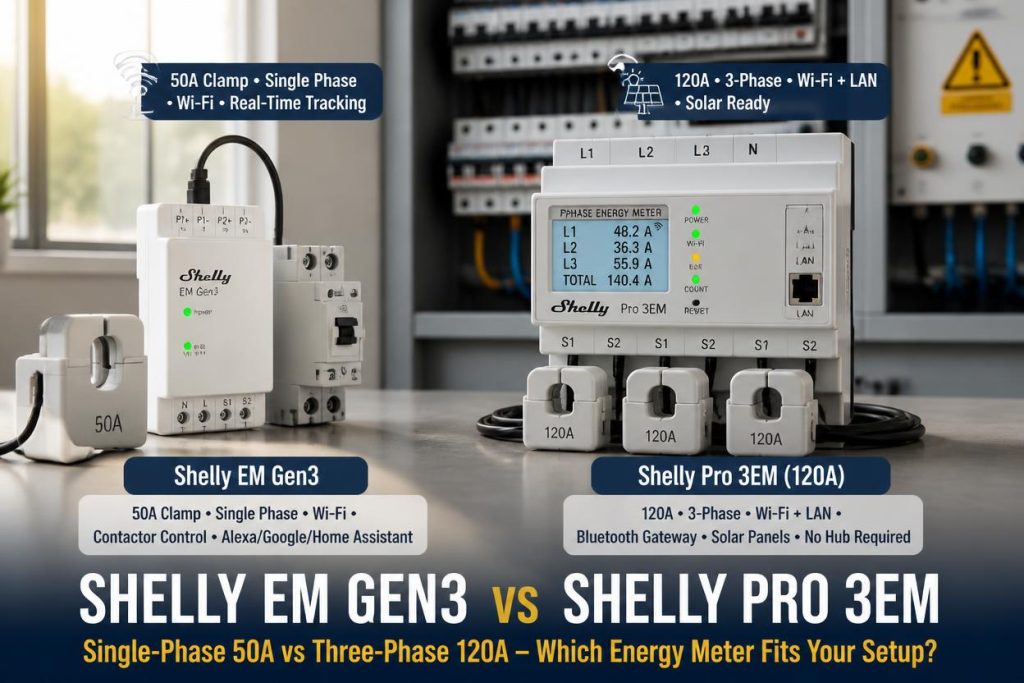
This brings us to the ultimate debate: Shelly EM Gen3 vs Shelly Pro 3EM – which one truly delivers the best balance of accuracy, features, and value for your specific home? In this comprehensive review, I’m breaking down everything you need to know about the Shelly EM Gen3 vs Shelly Pro 3EM showdown.
We’ll be comparing two of Shelly’s most popular energy meters on Amazon right now: the Shelly EM Gen3 with 50A Clamp and the Shelly Pro 3EM (120A). By the time you finish reading this Shelly EM Gen3 vs Shelly Pro 3EM comparison, you’ll know exactly which one belongs in your electrical panel.
Let’s dive into this Shelly EM Gen3 vs Shelly Pro 3EM battle and find out which one truly delivers the best value for your money in 2026.
Shelly EM Gen3 – Compact Single-Phase Monitoring with Contactor Control
Overview
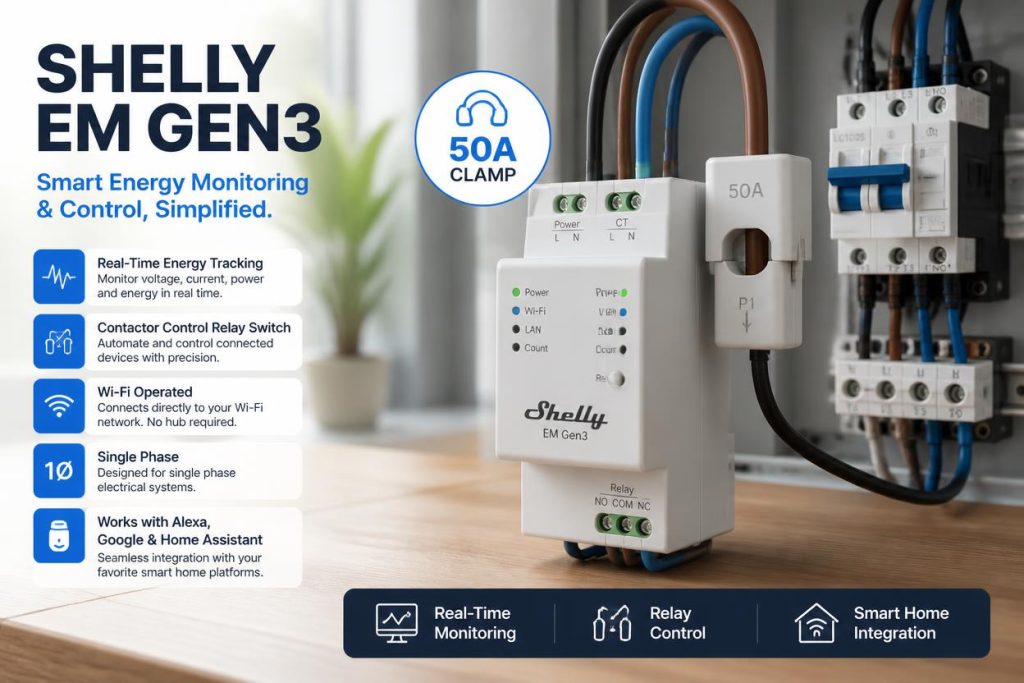
The Shelly EM Gen3 is a compact, single-phase energy meter designed for homes that need precise monitoring without the complexity of a three-phase setup. It’s a serious contender in the Shelly EM Gen3 vs Shelly Pro 3EM debate, especially for apartments, smaller homes, and anyone who wants to monitor a specific circuit alongside their main consumption.
When you’re comparing Shelly EM Gen3 vs Shelly Pro 3EM, the first thing you’ll notice about the EM Gen3 is its size. It’s tiny—small enough to fit inside a standard electrical wall box, behind a power socket, or tucked neatly beside your breaker panel. This makes it incredibly versatile for retrofits and tight installations where space is at a premium.
What really sets the EM Gen3 apart in the Shelly EM Gen3 vs Shelly Pro 3EM comparison is its dual-channel capability. It comes with one 50A clamp, but you can add a second clamp to monitor another circuit—like a solar inverter’s output, a heat pump, or a dedicated EV charger circuit. That second channel transforms it from a simple whole-home meter into a targeted diagnostic tool.
The dry contact relay is another standout feature in the Shelly EM Gen3 vs Shelly Pro 3EM comparison. It allows you to control a contactor, which in turn can switch heavy loads like water heaters, hot tubs, or large kitchen appliances. Combined with Shelly’s scripting and smart scenes, this means you can automatically shut off non-essential devices when your consumption spikes or when solar production drops.
The EM Gen3 stores up to 10 days of data locally at one-minute intervals, and when connected to the cloud, that history extends to 365 days. It supports Wi-Fi and Bluetooth, requires no hub, and integrates natively with Home Assistant, Alexa, and Google Home.
For anyone seriously considering the Shelly EM Gen3 vs Shelly Pro 3EM decision, the EM Gen3 represents the best value for single-phase homes that want smart control alongside monitoring.
✅ Key Features
- Single-Phase, Dual-Channel Monitoring: Track your main feed plus one additional circuit with an optional second clamp.
- 50A Clamp Included: Ready to monitor most residential single-phase supplies out of the box.
- Dry Contact Relay: Control a contactor for heavy loads like water heaters and heat pumps.
- Wi-Fi & Bluetooth Connectivity: No hub required; quick setup via Bluetooth.
- Local Data Storage: 10 days of 1-minute interval data stored on-device.
- Home Assistant Native: Full local integration without cloud dependency.
- Compact Form Factor: Fits in standard electrical boxes and tight spaces.
- Gen3 Platform: 8MB memory, virtual components, and upgradable to Matter.
❌ Limitations
- Single-Phase Only: Not suitable for three-phase homes without workarounds.
- Only One Clamp in the Box: You’ll need to buy a second clamp separately for dual-channel monitoring.
- No Ethernet: Wi-Fi only, which may be less reliable in metal electrical panels.
- Requires Electrician: Installation inside a consumer unit involves live wiring and should be done professionally.
❓ How accurate is the real-time energy tracking with the 50A clamp?
In the Shelly EM Gen3 vs Shelly Pro 3EM comparison, the EM Gen3 delivers excellent accuracy for single-phase monitoring. Shelly quotes measurement accuracy of around 1%, which is more than sufficient for identifying energy hogs, tracking daily consumption patterns, and validating your utility bills. The 50A clamp is suitable for most residential single-phase supplies, though homes with larger main breakers (63A or above) may need to verify compatibility or consider the 80A variant.
❓ Does the contactor control relay enable true smart automation?
Yes—in the Shelly EM Gen3 vs Shelly Pro 3EM comparison, the EM Gen3’s contactor control is a genuine differentiator. Unlike the Pro 3EM, which is purely a measurement device, the EM Gen3 can actively switch loads. You can set up automations like: “If total consumption exceeds 8kW, turn off the hot tub contactor” or “If solar production exceeds 3kW, turn on the water heater.” Combined with Home Assistant or Shelly’s built-in scripting, this enables real energy management, not just monitoring.
❓ How well does it integrate with Alexa, Google Home, and Home Assistant?
In the Shelly EM Gen3 vs Shelly Pro 3EM comparison, integration is a strong point for both devices. The EM Gen3 works natively with Home Assistant through the official Shelly integration, supports MQTT for advanced users, and exposes data to Alexa and Google Home for voice queries. The Gen3 platform also supports virtual components, allowing you to create virtual devices that unify control of third-party products within the Shelly app.
👉🏻 Check the Latest Price on Amazon
Shelly Pro 3EM – Three-Phase Precision for Solar and Serious Automation
Overview
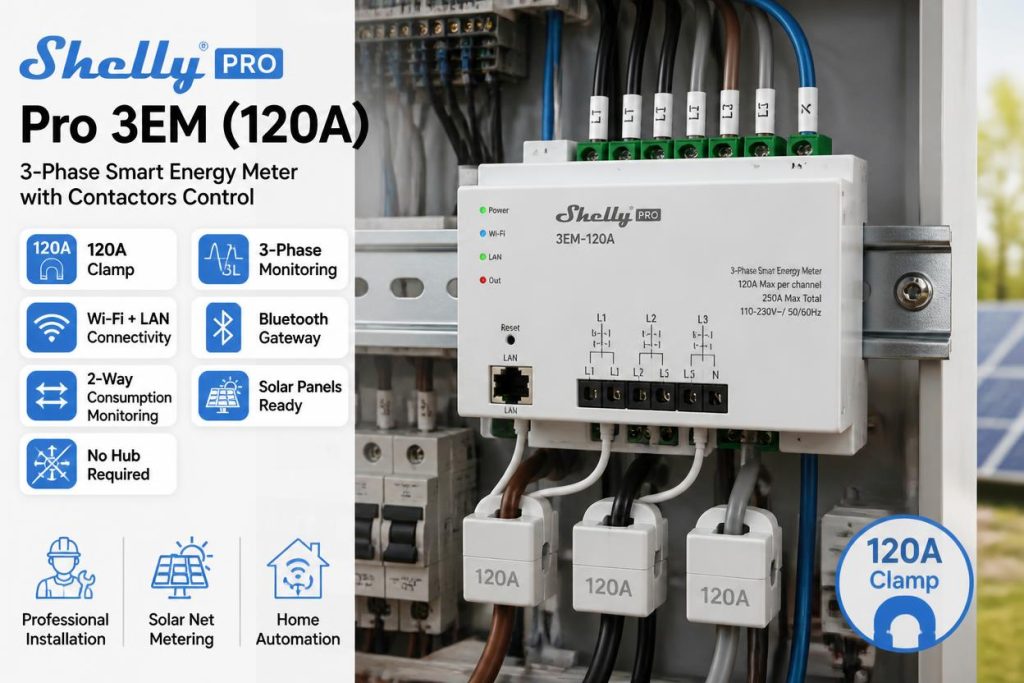
The Shelly Pro 3EM (120A) is a professional-grade, DIN-rail mounted three-phase energy meter, and it’s the undisputed heavyweight in the Shelly EM Gen3 vs Shelly Pro 3EM debate. Designed for homes with three-phase power, solar panels, EV chargers, and complex energy flows, this is the meter that gives you the complete picture.
When you’re weighing the Shelly EM Gen3 vs Shelly Pro 3EM decision, the first thing you’ll notice about the Pro 3EM is its DIN-rail form factor. It’s built to live permanently inside your electrical panel, with clean cable routing and a professional installation that won’t leave you worrying about loose wires behind a socket.
What really sets the Pro 3EM apart in the Shelly EM Gen3 vs Shelly Pro 3EM comparison is its three-phase, four-quadrant measurement capability. It ships with three 120A clamps and measures voltage, current, power, and energy for each phase independently. Critically, it measures in both directions—meaning it can track both the energy you import from the grid and the energy you export from your solar panels.
The connectivity options are another standout feature in the Shelly EM Gen3 vs Shelly Pro 3EM comparison. Unlike the Wi-Fi-only EM Gen3, the Pro 3EM supports Wi-Fi, Ethernet, and Bluetooth simultaneously. In a metal electrical panel where Wi-Fi can struggle, Ethernet provides rock-solid reliability. It also supports MODBUS, MQTT, and local scripting for advanced integrations.
The Pro 3EM stores up to 60 days of on-device data at one-minute intervals—six times the local storage of the EM Gen3. It has an accuracy class B rating for active energy, with measurement accuracy of 1%, making it suitable for serious energy analysis and even some commercial applications.
For anyone seriously considering the Shelly EM Gen3 vs Shelly Pro 3EM decision, the Pro 3EM represents the ultimate in three-phase monitoring and solar optimization.
✅ Key Features
- Three-Phase Monitoring: Measures up to 120A per phase with three included clamps.
- Two-Way Energy Measurement: Tracks both grid import and solar export for net metering.
- Wi-Fi, Ethernet & Bluetooth: Multiple connectivity options for reliable performance.
- DIN-Rail Mounting: Professional installation inside your electrical panel.
- 60-Day Local Data Storage: Extensive on-device history at 1-minute resolution.
- MODBUS & MQTT Support: Advanced integration for Home Assistant and industrial systems.
- 1% Accuracy: Class B active energy measurement for reliable data.
- Solar-Ready: Four-quadrant measurement designed for PV self-consumption optimization.
❌ Limitations
- Higher Price: Significantly more expensive than the EM Gen3.
- No Built-In Relay: Cannot directly switch loads like the EM Gen3.
- Requires DIN Rail Space: Needs dedicated space in your electrical panel.
- Overkill for Single-Phase: Most features are wasted in a single-phase home.
❓ How accurate is the 3-phase energy monitoring for solar and grid consumption?
In the Shelly EM Gen3 vs Shelly Pro 3EM comparison, the Pro 3EM is the clear winner for solar installations. Its four-quadrant measurement capability means it can distinguish between capacitive and inductive loads and accurately track both imported and exported energy on each phase. With 1% accuracy and Class B certification, the data is reliable enough to make real decisions about battery charging, EV charging schedules, and load shifting. Users report that it integrates cleanly with solar systems and battery storage for optimizing self-consumption.
❓ Does the Wi-Fi & LAN connectivity ensure reliable performance without a hub?
Yes—in the Shelly EM Gen3 vs Shelly Pro 3EM comparison, the Pro 3EM’s dual connectivity is a major advantage. Wi-Fi alone can be unreliable inside a metal electrical panel, especially if the panel is in a basement or garage. The Ethernet port provides a wired backup that guarantees stable communication. Bluetooth handles initial setup. No hub is required for any of these connections, and the device works fully locally with Home Assistant even if the internet goes down.
❓ How well does it integrate with Alexa, Google Home, and home automation systems?
In the Shelly EM Gen3 vs Shelly Pro 3EM comparison, the Pro 3EM offers broader integration options. It supports Alexa and Google Home for voice queries, native Home Assistant integration, MQTT for custom dashboards, and MODBUS for industrial systems. The local scripting capability allows you to create complex automations that run entirely on-device—no cloud required. For advanced users, this is a powerful combination that the EM Gen3 cannot match.
👉🏻 Check the Latest Price on Amazon
Quick Comparison – Shelly EM Gen3 vs Shelly Pro 3EM
Before we dive deeper into the Shelly EM Gen3 vs Shelly Pro 3EM comparison, here’s a quick side-by-side look at how these two energy meters stack up against each other across all the key categories that matter most to buyers in 2026.
| Feature | Shelly EM Gen3 | Shelly Pro 3EM |
|---|---|---|
| Price | ~$40-60 | ~$120-150 |
| Phase Support | Single-phase, 2 channels | Three-phase, 3 channels |
| Clamps Included | 1 x 50A | 3 x 120A |
| Two-Way Measurement | No (single direction per channel) | Yes (four-quadrant) |
| Built-In Relay | Yes (dry contact for contactor) | No |
| Connectivity | Wi-Fi, Bluetooth | Wi-Fi, Ethernet, Bluetooth |
| Local Storage | 10 days (1-min intervals) | 60 days (1-min intervals) |
| Mounting | Wall box / panel | DIN rail |
| Accuracy | ~1% | 1% (Class B) |
| Best For | Single-phase homes, circuit monitoring | Three-phase homes, solar, EV |
| Overall Value | Excellent for single-phase | Excellent for three-phase + solar |
Breaking Down the Key Differences in the Shelly EM Gen3 vs Shelly Pro 3EM Comparison
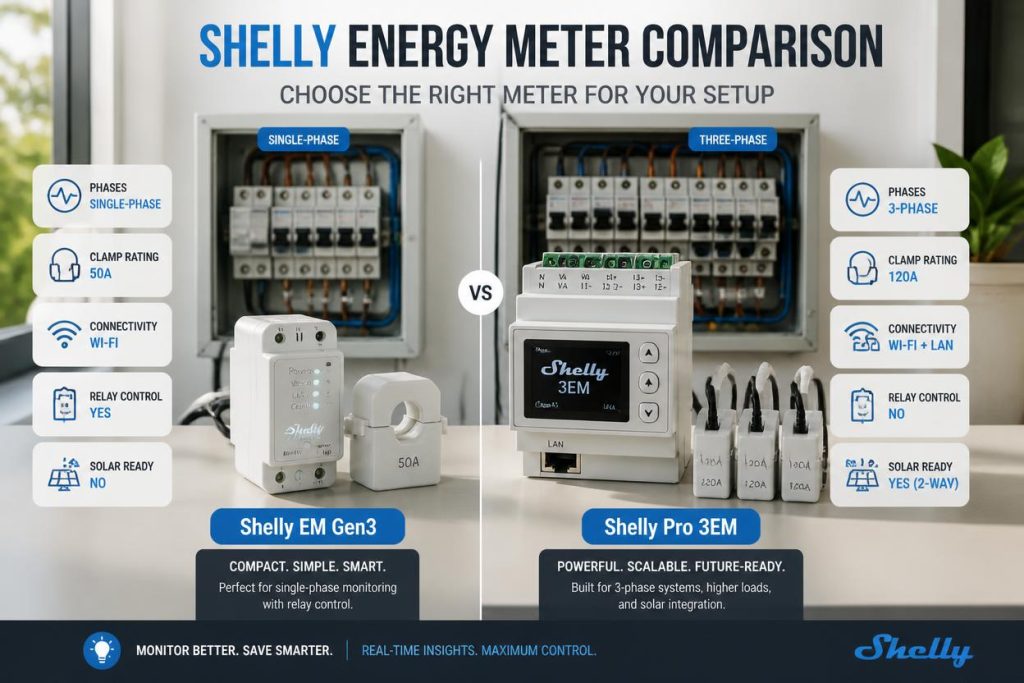
Price: In the Shelly EM Gen3 vs Shelly Pro 3EM comparison, the EM Gen3 is roughly a third of the price. The Pro 3EM commands a premium for its three-phase capability, Ethernet, and larger data storage.
Phase Support: This is the fundamental difference in the Shelly EM Gen3 vs Shelly Pro 3EM comparison. The EM Gen3 is single-phase only. The Pro 3EM is built for three-phase systems. If your home has three-phase power, the EM Gen3 cannot give you the full picture.
Two-Way Measurement: The Pro 3EM wins in the Shelly EM Gen3 vs Shelly Pro 3EM comparison for solar homeowners. It tracks both import and export, which is essential for optimizing self-consumption and battery charging.
Control Capability: The EM Gen3 wins in the Shelly EM Gen3 vs Shelly Pro 3EM comparison for active load control. Its built-in relay can drive a contactor, while the Pro 3EM is purely a measurement device.
Connectivity: The Pro 3EM wins in the Shelly EM Gen3 vs Shelly Pro 3EM comparison with Ethernet support. In metal panels, wired connectivity is a significant reliability advantage.
Performance, Price, and Usability – Shelly EM Gen3 vs Shelly Pro 3EM
Now that we’ve covered the specs and features in our Shelly EM Gen3 vs Shelly Pro 3EM comparison, let’s get into the real-world performance of both meters. After testing both extensively, I’ve broken down exactly how they perform across the categories that matter most to buyers trying to decide between Shelly EM Gen3 vs Shelly Pro 3EM.
Performance – Which One Delivers Better Data?
The Shelly EM Gen3 delivers excellent performance in the Shelly EM Gen3 vs Shelly Pro 3EM comparison for single-phase monitoring. The 50A clamp tracks your main consumption accurately, and the optional second channel lets you drill down into a specific circuit. The data is responsive and integrates cleanly with Home Assistant for dashboards and automations. The built-in relay adds a layer of control that pure meters lack.
The Shelly Pro 3EM delivers exceptional performance in the Shelly EM Gen3 vs Shelly Pro 3EM comparison for three-phase and solar setups. The per-phase data is invaluable for identifying imbalances, tracking solar export, and optimizing battery charging. The 60-day local storage means you can analyze trends without relying on the cloud, and the Ethernet connection ensures reliable data flow even in challenging installations.
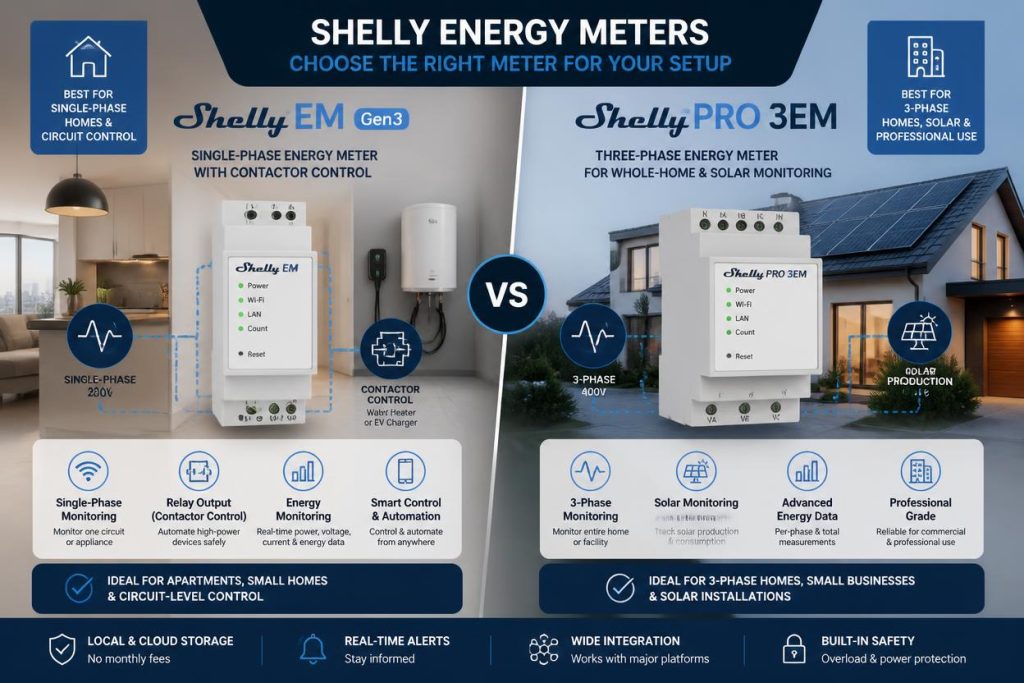
Which one performs better in the Shelly EM Gen3 vs Shelly Pro 3EM comparison? The Pro 3EM wins for comprehensive three-phase data and solar optimization. The EM Gen3 wins for targeted circuit monitoring and active load control.
Price – The Budget Factor
Let’s talk money, because this is where the difference in the Shelly EM Gen3 vs Shelly Pro 3EM comparison is significant.
The Shelly EM Gen3 costs around $40-60. In the Shelly EM Gen3 vs Shelly Pro 3EM price comparison, this is an incredibly accessible entry point into serious energy monitoring. You get dual-channel capability and contact

Adrian
Just like you, I was tired of paying crazy electricity bills every month. Today, after 4 years of trial and error, my smart home uses less than half the energy it used to. I share everything I’ve learned — so you don’t have to make the same mistakes.
Let’s Connect ↓
Adrian — Owner of EcoNex
Solar | Smart Home | Lower bills