
Table of contents
Table of Contents
🔹 Introduction
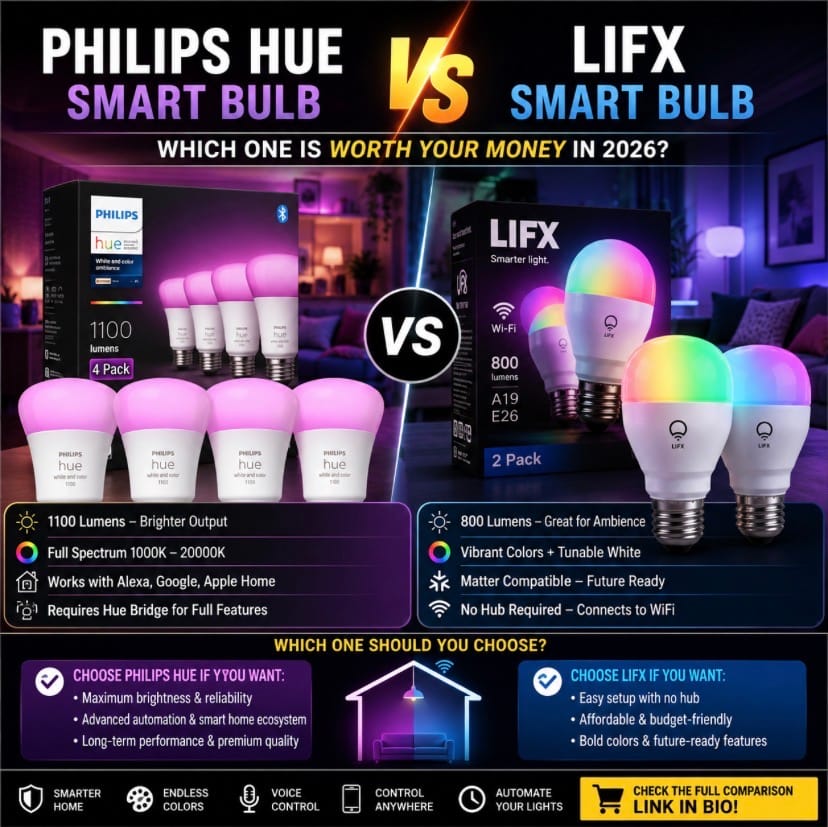
If you’re trying to upgrade your home lighting in 2026, you’re probably stuck choosing between the two biggest names in smart lighting: Philips Hue vs LIFX Smart Bulb. And honestly, it’s not an easy choice.
Both brands promise stunning colors, smart automation, and seamless integration with your favorite voice assistants. But here’s the problem — not all smart bulbs are created equal. Some offer better brightness, some have richer colors, and others are just easier to use daily.
So before you spend your money, it’s important to understand what you’re actually getting. This Philips Hue vs LIFX Smart Bulb comparison will break everything down in a simple, real-world way — no confusing tech talk, just honest advice like you’d get from a friend.
Whether you want the best ambiance for your living room, a gaming setup that pops, or a fully automated smart home, this guide will help you decide which one is actually worth it.
🔹 Philips Hue Smart LED A19 Bulb 4-Pack Review
The Philips Hue Smart LED A19 Bulb 4-Pack White and Color Ambiance is one of the most premium smart lighting solutions on the market right now. If you’ve ever heard people talk about smart lighting, chances are they were talking about Philips Hue.
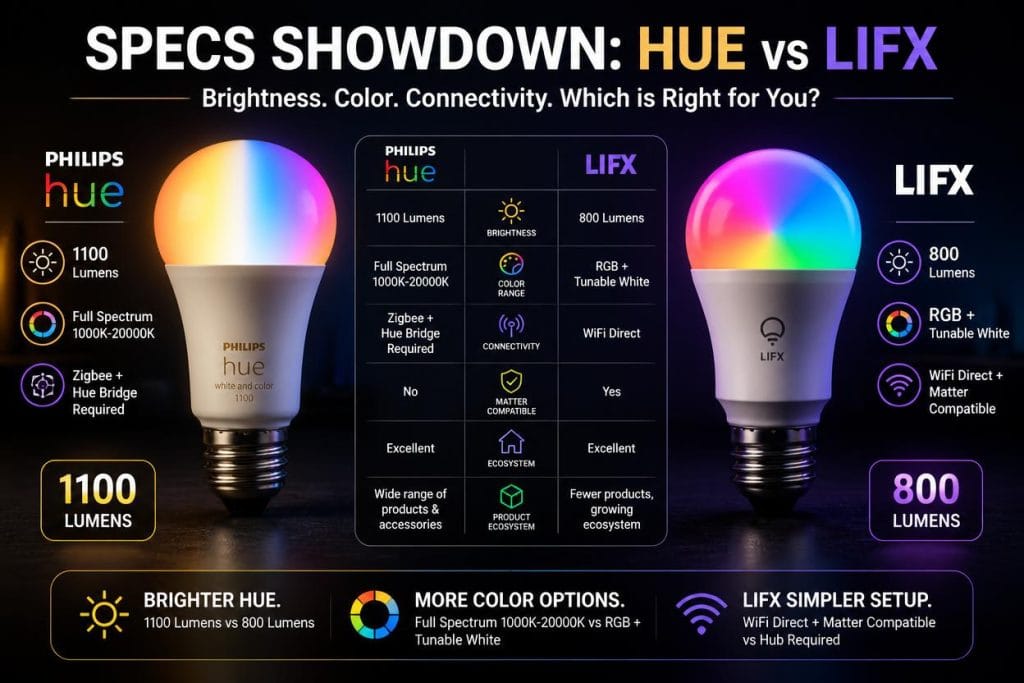
What makes this bulb stand out immediately is its insane color range — from ultra warm candlelight (1000K) all the way to crisp daylight and beyond (20000K). That’s way more flexibility than most people even realize they need… until they try it.
With 1100 lumens, it’s noticeably brighter than many competitors, making it perfect for living rooms, kitchens, and workspaces where lighting really matters. And since this is a 4-pack, you’re not just upgrading one room — you’re transforming your entire home setup.
Another big advantage in the Philips Hue vs LIFX Smart Bulb debate is reliability. Hue has been around for years, and their ecosystem is super stable. Once it’s set up, it just works — no random disconnects, no frustration.
✅ Pros:
- Extremely wide color temperature range (1000K–20000K)
- Brighter output (1100 lumens) than most smart bulbs
- Reliable and stable smart home performance
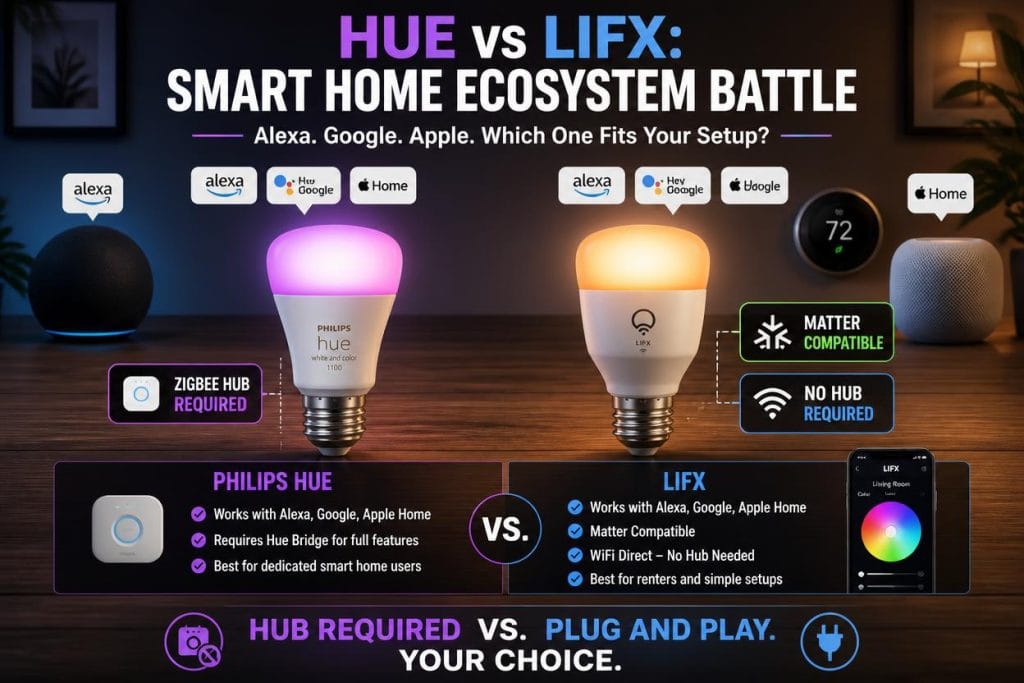
- Works with Alexa, Google Assistant, and Apple HomeKit
- Premium build quality and long lifespan
❌ Cons:
- Higher upfront cost compared to competitors
- Requires a Hue Bridge for full functionality
- App can feel slightly complex for beginners
How does the full-spectrum color range (1000K–20000K) enhance your home lighting?
This is where Philips Hue really shines. The ultra-wide spectrum means you can completely control the mood of your space. Want a warm, cozy vibe at night? Done. Need bright, cool lighting for focus during the day? Easy.
It’s not just about colors — it’s about how your environment feels. This flexibility is a huge reason why many users prefer Philips Hue in the Philips Hue vs LIFX Smart Bulb comparison.
Does smart home integration (Alexa, Google, Apple) make this bulb worth the upgrade?
Absolutely. Being able to control your lights with voice commands or automate them with routines is a game changer. You can wake up to gradually brightening lights, turn everything off with one command, or even sync lights with movies and music.
If you’re building a smart home, this level of integration alone makes Philips Hue worth considering.
🔗 Ready to upgrade your lighting? Check the latest price and grab this Philips Hue deal now
🔹 LIFX Color Smart Light Bulbs (2-Pack) Review
Now let’s talk about the second contender in this Philips Hue vs LIFX Smart Bulb showdown — the LIFX Color Smart Light Bulbs (2-Pack).
If you’re someone who wants powerful smart lighting without dealing with extra hubs or complicated setups, LIFX immediately stands out. Unlike Philips Hue, these bulbs connect directly to your WiFi, which means faster setup and fewer devices to worry about.
Even though these bulbs offer 800 lumens (slightly lower than Hue), they still deliver vibrant, punchy colors that look amazing in bedrooms, gaming setups, or mood lighting environments.
Where LIFX really shines in the Philips Hue vs LIFX Smart Bulb comparison is simplicity. You screw it in, connect it to WiFi, download the app, and you’re ready to go — no bridge, no extra cost.
Another big advantage is its Matter compatibility, which makes it future-proof. As smart home ecosystems evolve, Matter ensures your device continues working smoothly across platforms like Apple Home, Alexa, and Google Home.
✅ Pros:
- No hub required — direct WiFi connection
- Vibrant RGB colors with smooth transitions
- Matter compatibility for future smart home support
- Easy setup — beginner friendly
- Works with Apple HomeKit, Alexa, and Google Assistant
❌ Cons:
- Lower brightness (800 lumens) compared to Philips Hue
- WiFi dependency can sometimes cause minor delays
- App performance can vary depending on network stability
How does it compare to Philips Hue in color quality and app experience?
In terms of color quality, LIFX actually holds its own surprisingly well. Colors are bold, saturated, and visually impressive — especially for entertainment setups or ambient lighting.
However, when comparing Philips Hue vs LIFX Smart Bulb, Philips Hue still feels more refined overall. The Hue app offers smoother automation, better scene control, and a more polished user experience.
That said, LIFX wins when it comes to simplicity. If you want something quick, fun, and easy, LIFX is hard to beat.
How does Matter compatibility improve connectivity and setup across different smart home systems?
Matter is a big deal in 2026. It’s basically a universal language for smart home devices. With Matter support, your LIFX bulb can connect seamlessly across multiple ecosystems without needing separate integrations.
In the Philips Hue vs LIFX Smart Bulb comparison, this gives LIFX a major advantage for users who want flexibility and future-proof technology.
🔗 Want a simpler smart lighting setup? Check today’s price and get your LIFX bulbs here
📊 Quick Comparison Table
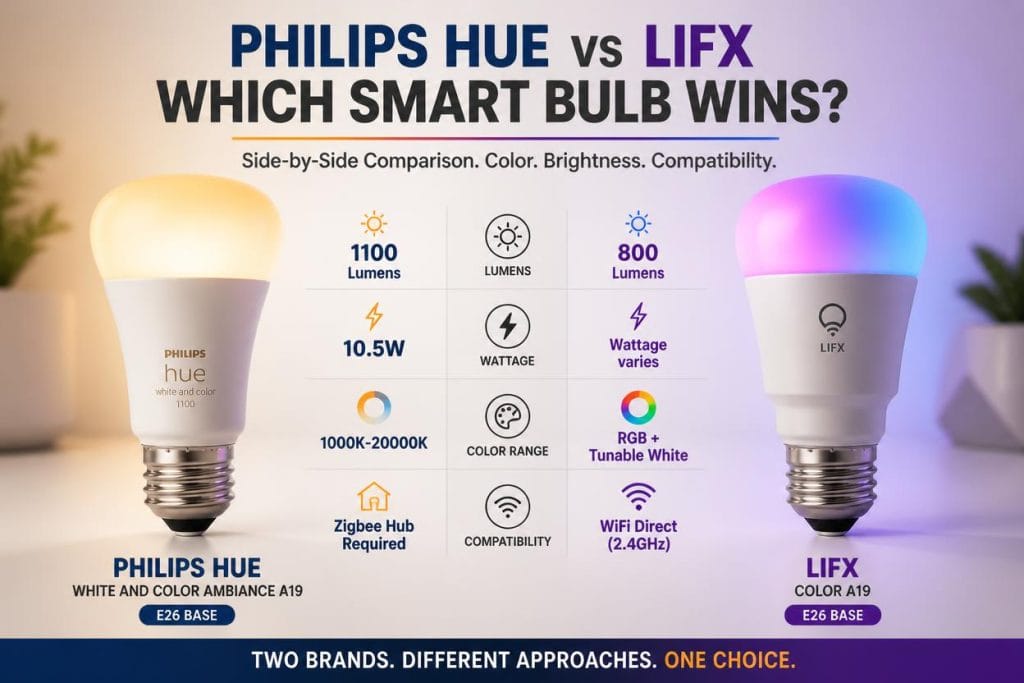
| Feature | Philips Hue Smart LED A19 Bulb 4-Pack | LIFX Color Smart Light Bulbs (2-Pack) |
|---|---|---|
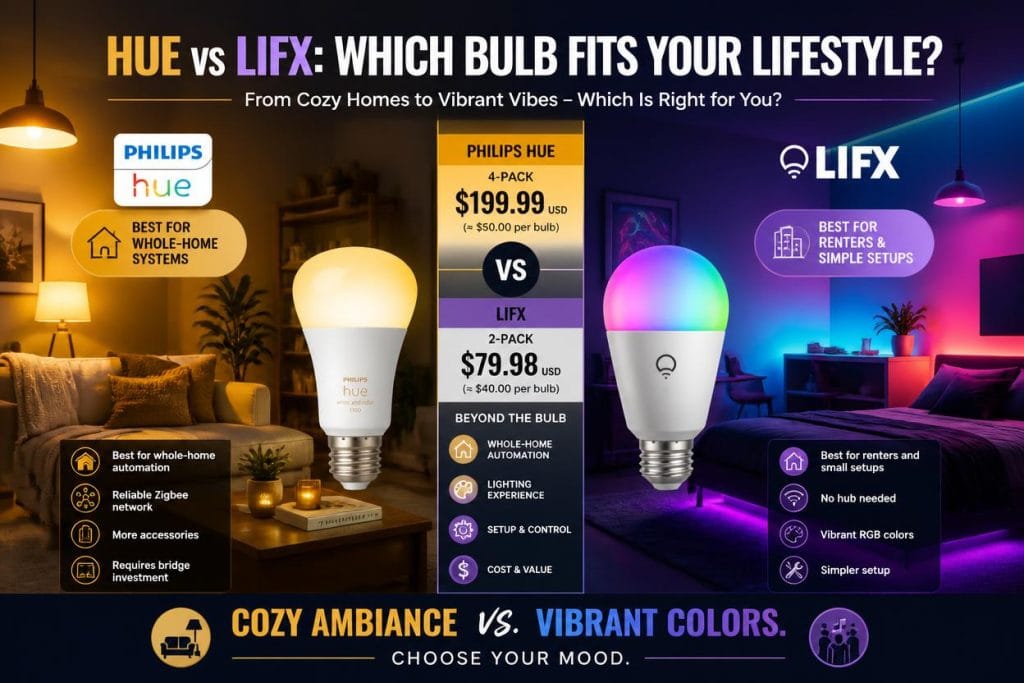
| Price | Higher upfront cost (premium ecosystem) | More affordable, no hub required |
| Performance | 1100 lumens, ultra-wide color range | 800 lumens, vibrant RGB colors |
| Energy Consumption | 10.5W efficient LED | Energy-efficient but slightly less powerful |
| Ease of Use | Requires Hue Bridge for full features | Plug-and-play with WiFi |
| Best For | Full smart home ecosystem and automation | Simple setups and budget-friendly users |
⚡ The Real Difference Between Philips Hue vs LIFX Smart Bulb
Now that you’ve seen both products individually, let’s get into what really matters — the actual differences in real-life use. Because when it comes to choosing between Philips Hue vs LIFX Smart Bulb, the specs only tell part of the story.
What you really want to know is: Which one performs better daily? Which one is worth your money? And which one fits your lifestyle?
🔹 Performance
When comparing Philips Hue vs LIFX Smart Bulb in performance, Philips Hue clearly takes the lead — especially if you care about brightness and consistency.
With 1100 lumens, Philips Hue delivers stronger, more even lighting that can easily fill larger spaces like living rooms, kitchens, or offices. It’s the kind of light you can rely on whether you’re working, relaxing, or hosting guests.
LIFX, on the other hand, comes in at 800 lumens. That’s still good — and honestly more than enough for bedrooms, gaming setups, or ambient lighting — but it doesn’t quite match the power of Hue in larger environments.
However, LIFX fights back with extremely rich and saturated colors. In some scenarios, especially for mood lighting or entertainment setups, LIFX can actually feel more visually striking.
So in this part of the Philips Hue vs LIFX Smart Bulb comparison:
- Philips Hue wins in brightness and overall consistency
- LIFX stands out in bold, vibrant color effects
🔹 Price
Price is where things start to get interesting in the Philips Hue vs LIFX Smart Bulb debate.
Philips Hue is definitely the premium option. Not only are the bulbs themselves more expensive, but if you want the full smart experience (automation, remote control, advanced scenes), you’ll likely need the Hue Bridge — which adds extra cost.
LIFX, on the other hand, is much more budget-friendly upfront. There’s no hub required, no additional hardware — just the bulbs and your WiFi network.
So if you’re trying to save money while still getting a high-quality smart lighting experience, LIFX has a clear advantage here.
- Philips Hue = premium investment
- LIFX = better value for beginners
🔹 Ease of Use & Daily Experience
This is one of the biggest deciding factors in the Philips Hue vs LIFX Smart Bulb comparison.
Philips Hue offers a more polished and reliable experience — but it comes with a slightly steeper learning curve. Setting up the bridge, connecting everything, and exploring the app can take a bit of time.
Once it’s set up though? It’s incredibly smooth. Automations work flawlessly, scenes feel seamless, and everything integrates beautifully across your smart home.
LIFX, in contrast, is all about simplicity. You install the bulb, connect it to WiFi, and you’re done. No extra steps, no confusion.
But here’s the trade-off: because it relies entirely on WiFi, performance can sometimes depend on your network quality. If your WiFi is unstable, you might experience occasional delays or disconnects.
- Philips Hue = best for long-term stability and advanced setups
- LIFX = best for quick setup and ease of use
🔹 Smart Home Integration & Future-Proofing
Both options perform well here, but in different ways.
Philips Hue has one of the most mature ecosystems in the smart home world. It works flawlessly with Alexa, Google Assistant, and Apple HomeKit, and supports advanced automations that go far beyond basic lighting control.
LIFX, however, introduces something very important in 2026 — Matter compatibility.
In the Philips Hue vs LIFX Smart Bulb comparison, this gives LIFX an edge for users who want flexibility. Matter allows devices to communicate across different platforms seamlessly, making your smart home more unified and easier to manage in the future.
That said, Philips Hue is also evolving and continues to update its ecosystem, so you’re not losing future support by choosing it.
- Philips Hue = mature, powerful ecosystem
- LIFX = future-ready with Matter support
🎯 Which One Should You Choose?
At this point in the Philips Hue vs LIFX Smart Bulb comparison, your choice really comes down to your priorities.
- Choose Philips Hue Smart LED A19 Bulb 4-Pack if:
- You want the brightest and most reliable lighting
- You plan to build a full smart home ecosystem
- You care about long-term performance and stability
- You don’t mind paying more for premium quality
- Choose LIFX Color Smart Light Bulbs (2-Pack) if:
- You want an easy, no-hub setup
- You prefer a more affordable option
- You love bold, colorful lighting effects
- You want Matter compatibility for future flexibility
Still not sure? Don’t worry — in the next part, we’ll give you a clear final recommendation so you can make the best decision with confidence.
🏆 Final Verdict: Philips Hue vs LIFX Smart Bulb
Alright — let’s cut through the noise and get straight to the point. After everything we’ve covered in this Philips Hue vs LIFX Smart Bulb comparison, one question remains:
Which one is actually worth your money in 2026?
Both of these smart bulbs are excellent — no doubt about it. But they are built for different types of users.
If you’re looking for a premium, reliable, and long-term smart lighting system, then Philips Hue clearly stands out. It’s brighter, more stable, and offers a deeper ecosystem for automation and customization.
On the other hand, if you want something simple, affordable, and quick to set up, then LIFX is a fantastic choice. It delivers beautiful colors, works without a hub, and gives you a modern smart home experience without extra hassle.
🎯 Our Recommendation
After comparing every detail in this Philips Hue vs LIFX Smart Bulb review, here’s the honest recommendation:
👉 Go with Philips Hue if you want the best overall experience.
Why? Because in the long run, reliability matters more than anything else. Philips Hue offers consistent performance, stronger brightness, and a smarter ecosystem that grows with your home.
Yes, it costs more — but it feels like an investment rather than just a purchase.
That said, LIFX is still a great alternative — especially if you’re just getting started or want a simpler setup.
🔥 CTA (Call To Action)
👉 Ready to upgrade your smart lighting?
- Philips Hue Smart LED A19 Bulb 4-Pack:
Upgrade your home with premium smart lighting — check the latest price here - LIFX Color Smart Light Bulbs (2-Pack):
Get vibrant colors with an easy setup — see today’s deal here
No matter which one you choose, upgrading to smart lighting is one of the easiest ways to transform your home. Better mood, better control, and honestly… it just feels cool.
But if you want the best mix of performance, reliability, and long-term value, Philips Hue is the smarter buy in 2026.
❓ Frequently Asked Questions (Philips Hue vs LIFX Smart Bulb)
1. Which is better for beginners, Philips Hue or LIFX?
If you’re just starting out with smart lighting, LIFX is usually the easier option. In the Philips Hue vs LIFX Smart Bulb comparison, LIFX wins in simplicity because it doesn’t require a hub — you just connect it directly to your WiFi and you’re ready to go.
However, if you’re willing to spend a bit more time on setup, Philips Hue offers a more powerful and reliable system in the long run.
2. Do I really need a Hue Bridge for Philips Hue?
Technically, you can use some Philips Hue bulbs without the bridge via Bluetooth. But to unlock the full experience — including remote access, advanced automation, and syncing with other smart devices — the Hue Bridge is highly recommended.
In the Philips Hue vs LIFX Smart Bulb debate, this is one of the biggest differences. LIFX skips the hub entirely, while Philips Hue relies on it for its best features.
3. Which smart bulb has better color quality?
Both are excellent, but they offer slightly different experiences. LIFX delivers bold, saturated colors that look amazing for mood lighting and gaming setups.
Philips Hue, on the other hand, focuses more on balance and realism. Its color transitions feel smoother, and the wide temperature range (1000K–20000K) gives it an edge for everyday use.
4. Are smart bulbs worth it in 2026?
Absolutely. Smart bulbs are no longer just a luxury — they’re becoming a standard in modern homes. With features like voice control, scheduling, energy efficiency, and customizable lighting scenes, they offer both convenience and a better living experience.
In this Philips Hue vs LIFX Smart Bulb review, both options prove that upgrading your lighting is one of the easiest and most impactful smart home improvements you can make.
📌 Final Thoughts
Choosing between Philips Hue vs LIFX Smart Bulb really comes down to what matters most to you.
If you want premium performance, stronger brightness, and a reliable ecosystem, Philips Hue is the clear winner.
If you prefer simplicity, lower cost, and quick setup, LIFX is a smart and practical choice.
Either way, you’re upgrading your home to a smarter, more flexible, and more enjoyable lighting experience.
👉 The only real mistake? Not upgrading at all.

Adrian
Just like you, I was tired of paying crazy electricity bills every month. Today, after 4 years of trial and error, my smart home uses less than half the energy it used to. I share everything I’ve learned — so you don’t have to make the same mistakes.
Let’s Connect ↓
Adrian — Owner of EcoNex
Solar | Smart Home | Lower bills
Pingback: Review: Govee LED Strip Vs Philips Hue Lightstrip – Which One Is Worth Your Money In 2026? - EcoNex